
Feron Hunt Withdraws From Draft
SMU forward Feron Hunt is withdrawing his name from the draft and will return to school, Jon Rothstein of CBS Sports tweets.
Hunt tossed his name into the draft pool in late March. However, he was considered a marginal second-round prospect, most recently being ranked No. 76 overall and No. 15 among power forwards on ESPN’s Best Available list.
Hunt is coming off a 2019/20 campaign in which he averaged 11.0 PPG and 6.7 RPG in 30 games (28.2 MPG) for the Mustangs.
For information on all early entrants, please click here.
Central Notes: Holden, Kennard, Holiday, Bulls
As the Pistons close in on a GM, they are also looking at Nets director of player personnel J.R. Holden and Warriors assistant GM Mike Dunleavy as potential front office additions, SNY’s Ian Begley tweets. Presumably, Detroit would consider Holden and Dunleavy as candidates as assistant GMs.
However, James Edwards III of The Athletic tweets that the Pistons plan to hire a GM first and allow that person to fill out the staff. Thunder executive Troy Weaver has reportedly emerged as the leading candidate in their GM search, though Clippers assistant GM Mark Hughes and Nets assistant GM Jeff Peterson are also in the mix.
We have more from around the Central Division:
- Pistons swingman Luke Kennard is confident the knee tendinitis that cut short his season is no longer an issue, as he told Keith Langlois of the team’s website. Kennard didn’t play after Christmas but was just about to return when the pandemic struck in March. The Pistons, who are not part of the league’s restart plan, may have to wait until December to play again. “I’m not really nervous about the time off,” Kennard said. “I know what I’m doing right now is going to allow me to stay healthy and get through a full season and be ready to go for all 82 games or whatever they decide.”
- Pacers guard Aaron Holiday has signed with BDA Sports and will be represented by veteran agent Bill Duffy and Nima Namakian, Liz Mullen of the Sports Business Journal tweets. Holiday is signed through at least next season. The Pacers hold an option worth approximately $4MM on his contract for the 2021/22 season.
- Jim Boylen’s status as the Bulls coach remains up in the air even though front office changes have been made and Joe Cowley of the Chicago Sun-Times believes the franchise’s reputation has something to do with it, he said on 670 The Score (hat tip to NBC Sports’ Dan Feldman). “(Rick) Carlisle, the Dallas coach, has made it very clear the disdain the Coaches Association and a lot of coaches have for the Bulls and the practices they have toward coaches. … They’re buying time because they have time to buy, but also I think it’s also a perception thing that they’re looking to change.”
Irving-Led Coalition Details Concerns
A player coalition led by Nets star Kyrie Irving and Lakers guard Avery Bradley is pursuing a further examination of the league’s plan to restart the season in Orlando, ESPN’s Adrian Wojnarowski and Malika Andrews report.
At the top of the coalition’s wish list is a commitment of resources and methods to move forward an agenda of social justice reforms.
The group also has issues with the resumption of play in Orlando’s Disney complex, including an uptick in positive coronavirus cases in Florida; the restrictive environment in the bubble, insurance for players regarding potential illnesses; and the risk of injuries during an accelerated finish.
After a conference call that included nearly 100 players voicing concerns over the restart plan on Friday, a call engineered by Irving, another conference call that included about 40 individuals was held on Monday.
A statement issued to ESPN from the group read in part:
“Native indigenous African Caribbean men and women entertaining the world, we will continue to use our voices and platforms for positive change and truth. … We are combating the issues that matter most: We will not accept the racial injustices that continue to be ignored in our communities. We will not be kept in the dark when it comes to our health and well-being. And we will not ignore the financial motivations/expectations that have prevented us historically from making sound decisions.”
Irving, a VP in the Players’ Association, was a part of the union’s ratification vote on June 5 for the resumption of play. He’s out for the season after undergoing shoulder surgery.
The NBA and NBPA are working on solutions in order to get as many players as possible to rejoin the 22 teams involved the restart plan this month, the ESPN duo adds.
Hoops Rumors Glossary: Sign-And-Trades
Each year when the offseason rolls around, a ton of NBA free agents sign new contracts and teams around the league consummate trades. On a few occasions, these two forms of transactions are combined into something called a sign-and-trade deal. Sign-and-trades occur when a team re-signs its own free agent, only to immediately send him to another team in exchange for players, draft picks, and/or cash.
In order for a sign-and-trade deal to be completed, the following criteria must be met:
- A free agent must be signed-and-traded by the team with whom he finished the season. For instance, the Cavaliers could sign-and-trade Tristan Thompson this offseason, but another team couldn’t sign Thompson and immediately move him.
- If the free agent is restricted, he can’t be signed-and-traded after he signs an offer sheet with a rival team.
- A team acquiring a player via sign-and-trade cannot be over the tax apron after the deal, and can’t have used the taxpayer mid-level exception.
- A free agent can’t be signed-and-traded once the regular season is underway.
- A free agent can’t be signed-and-traded using the mid-level exception or any exception that doesn’t allow for a three-year contract.
- A player receiving a designated veteran contract can’t be signed-and-traded.
Sign-and-trade contracts can be worth any amount up to the player’s maximum salary (with 5% annual raises), and must be for either three or four years. However, only the first year of the deal has to be fully guaranteed.
If a sign-and-trade contract includes a signing bonus, either team can agree to pay it, though if the signing team pays it, it counts toward that club’s limit for cash included in trades for that league year. As for trade bonuses, they would kick in upon any subsequent trades rather than as part of the sign-and-trade transaction itself.
Under some previous Collective Bargaining Agreements, there was more incentive for players to work out sign-and-trade deals, since the contract restrictions weren’t as strict. For example, when Anthony Davis hits free agency this offseason, he’d be eligible for a five-year contract worth up to a projected $200MM if he re-signs with the Lakers, but only four years and approximately $148MM with another team (note: those estimates are based on a $115MM cap projection that now appears unlikely).
Prior to 2011’s CBA agreement, Davis could have received that more lucrative five-year deal even if Los Angeles had signed-and-traded him. But in the unlikely event that the Lakers sign-and-trade Davis this offseason, he’d only be eligible for that four-year, $148MM max.
Under the current CBA, there’s less incentive for teams and players to participate in sign-and-trades. Generally, if a player wants to change teams, it makes more sense for him to sign with the new team outright, rather than making that club give up assets to complete the acquisition. Even the player’s old team may prefer to simply let the free agent walk and claim the resulting cap space, rather than taking back unwanted assets in a sign-and-trade.
There are other roadblocks as well. A team acquiring a player via sign-and-trade subsequently becomes hard-capped for the rest of that league year. Plus, a signed-and-traded player’s salary may be viewed differently than it would be in a standard trade for salary-matching purposes, which can compromise a team’s ability to meet those salary-matching requirements.
However, if a potential suitor is over the cap and under the tax, a sign-and-trade can make sense — especially if that club wants to sign the player for more than the mid-level amount, or if the club can offer the free agent’s prior team something of value.
During the 2019 offseason, sign-and-trades made a comeback in a big way. After just four sign-and-trade deals were completed between 2015-18, a total of 10 players were signed-and-traded last July.
In some cases, those sign-and-trades were a result of teams opting to get something back for restricted free agents who may have signed offer sheets elsewhere (ie. Malcolm Brogdon, Tomas Satoransky, Delon Wright). In other instances, clubs losing maximum-salary free agents turned those deals into sign-and-trades in order to get something back for their departing stars (ie. D’Angelo Russell for Kevin Durant; Terry Rozier for Kemba Walker).
It’s not clear if sign-and-trades will continue to be quite so popular going forward or if a confluence of factors made 2019 an outlier. Still, last summer’s deals provided a blueprint for how sign-and-trade deals can benefit all parties in the right situation.
Note: This is a Hoops Rumors Glossary entry. Our glossary posts will explain specific rules relating to trades, free agency, or other aspects of the NBA’s Collective Bargaining Agreement. Larry Coon’s Salary Cap FAQ was used in the creation of this post.
Earlier version of this post were published in 2013 and 2019 by Luke Adams.
Restart Notes: L. Williams, Lakers, NBPA, More
The Lakers and Clippers are among the NBA’s top championship contenders, but that doesn’t mean all their players are gung-ho about restarting the season. Clippers guard Lou Williams expressed on Instagram why he feels as if resuming play could distract from social-justice causes, while Lakers center Dwight Howard conveyed a similar sentiment over the weekend.
Howard’s agent, Charles Briscoe, told Dave McMenamin of ESPN on Sunday that his client has yet to make a decision on playing basketball this summer, while other Lakers players said that there’s still plenty of time for the team to get on the same page.
“(There’s) no divide,” one Lakers player told McMenamin.
Here’s more on the NBA’s proposed restart:
- The National Basketball Players Association has scheduled another call for 5:00 pm ET today, with all players invited to participate, tweets John Gambadoro of Arizona Sports 98.7. We’ll see if we get a better sense after that call of how the league and union may try to address certain players’ concerns about the return-to-play plan.
- Alex Kennedy of HoopsHype spoke to agents and executives to get a feel for whether teams would use the ability to sign a replacement player for an individual who tests positive for COVID-19 this summer. “I think as long as a team doesn’t have multiple players who get sick at the same time, they won’t sign anyone,” one general manager said. “I think most teams will just wait for their sick player to return.”
- Tim Bontemps of ESPN explores what will be at stake when the NBA resumes play, ranging from the impact the playoff results will have on Giannis Antetokounmpo‘s future or LeBron James‘ legacy to what happens to the league if the bubble plan doesn’t work.
And-Ones: WNBA, Ball Brothers, Kyrie, FA Contracts
Like the NBA, the WNBA now has a plan in place to resume play in Florida next month. The WNBA announced today in a press release that it will play a 22-game regular season at the IMG Academy in Bradenton, Florida, beginning in July.
We will continue to consult with medical experts and public health officials as well as players, team owners and other stakeholders as we move forward with our execution plan,” commissioner Cathy Engelbert said in a statement. “And, despite the disruption caused by the global pandemic to our 2020 season, the WNBA and its Board of Governors believe strongly in supporting and valuing the elite women athletes who play in the WNBA and therefore, players will receive their full pay and benefits during the 2020 season.”
While the NBA was in the midst of its season when the pandemic forced a stoppage, the WNBA’s 2020 campaign had yet to tip off. The season, which would normally consist of 34 games, had originally been scheduled to begin on May 15, but was postponed indefinitely in April.
Here are a few more odds and ends from around the basketball world:
- As expected, the Ball brothers – Pelicans guard Lonzo Ball, G League guard LiAngelo Ball, and projected 2020 lottery pick LaMelo Ball – have officially signed with Roc Nation Sports for representation, the agency announced today (Twitter link). An April report had indicated that the three brothers were joining Roc Nation together.
- Although Kyrie Irving has taken plenty of flak for his stance on resuming the season, Michael Lee of The Athletic argues that Irving is just doing his job as an NBPA vice president, and isn’t being an agitator just for the sake of it. In Lee’s view, Irving isn’t trying to blow up the NBA’s restart plan, but is making sure that players’ concerns are heard and addressed.
- Setting aside rookie contracts and maximum-salary deals, John Hollinger of The Athletic lists the 10 current free agent contracts that he feels represent the best value for teams. The Clippers‘ deal with Ivica Zubac, the Mavericks‘ with Dorian Finney-Smith, and the Celtics‘ with Marcus Smart top Hollinger’s list.
Potential 2020 RFAs Whose Qualifying Offers Will Be Impacted By Starter Criteria
The NBA’s rookie scale, which determines how much first-round picks earn during their first four NBA seasons, also dictates how much the qualifying offers will be worth for those players when they reach restricted free agency after year four. However, the value of those qualifying offers can fluctuate depending on whether or not a player has met the “starter criteria.”
A player who is eligible for restricted free agency is considered to have met the starter criteria if he plays at least 2,000 minutes or starts 41 games in the season before he reaches free agency.
A player can also meet the criteria if he averages either of those marks in the two seasons prior to his restricted free agency. For instance, if a player started 50 games in 2018/19 and 32 in 2019/20, he’d meet the starter criteria, since his average number of starts over the last two seasons is 41.
A player’s ability or inability to meet the starter criteria can affect the value of the qualifying offer he receives as a restricted free agent, as follows:
- A top-14 pick who does not meet the starter criteria will receive a qualifying offer equal to the amount the 15th overall pick would receive if he signed for 120% of the rookie scale.
- A player picked between 10th and 30th who meets the criteria will receive a qualifying offer equal to the amount the ninth overall pick would receive if he signed for 120% of the rookie scale.
- A second-round pick or undrafted player who meets the criteria will receive a qualifying offer equal to the amount the 21st overall pick would receive if he signed for 100% of the rookie scale.
- For all other RFAs, the standard criteria determine the amounts of their qualifying offers.
Extending a qualifying offer to a player eligible for restricted free agency officially makes that player an RFA, ensuring that his team has the right of first refusal if he signs an offer sheet with another club. It also gives the player the option of signing that one-year QO.
Generally, the value of a restricted free agent’s qualifying offer isn’t hugely important, since very few RFAs accept those offers outright. There are exceptions though.
In 2017, for instance, both players who signed their one-year QOs – centers Alex Len and Nerlens Noel – failed to meet the starter criteria heading into restricted free agency, reducing the value of their QOs to approximately $4.2MM (from $6.4MM and $5.85MM, respectively). Had Len and Noel met the starter criteria and been eligible for those larger QOs, their free agencies could have played out differently.
Top-14 picks who failed to meet starter criteria:
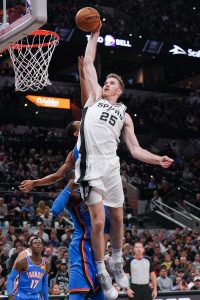 With that in mind, let’s check in on how this year’s RFAs-to-be will be impacted by the starter criteria. Listed below are the former top-14 picks on track for restricted free agency who have not met the starter criteria. These players will be eligible for qualifying offers worth $4,642,800.
- Jakob Poeltl (Spurs)
- Thon Maker (Pistons)
- Denzel Valentine (Bulls)
As the Nos. 9, 10, and 14 picks in the 2016 draft, Poeltl, Maker, and Valentine won’t be hit particularly hard by falling short of the starter criteria. Their projected qualifying offers would have ranged from approximately $5.09MM to $4.7MM, respectively, so a dip to $4.64MM shouldn’t have a major impact on their respective free agencies. Of the three players, only Poeltl looks like a lock to even receive a QO.
The top-14 pick whose situation remains unclear:
Because of the unusual circumstances surrounding this season, the usual definition of the starter criteria becomes a little more complicated. For instance, if a player started 40 games, but his team’s season ended after 65 games, should he be credited with having met the starter criteria based on the fact that he was “on pace” to do so over a full 82-game season?
There’s only one player who technically didn’t meet the starter criteria but was on pace to do so: Bulls guard Kris Dunn. After starting 44 games in 2018/19, Dunn started 32 of Chicago’s games this year, for a total of 76 over the last two seasons. If his starts this season were prorated over a full 82 games, he would have met the starter criteria.
The NBA and NBPA have agreed to prorate the criteria for performance bonuses and incentives in player contracts — it would make sense for the same rules to apply to Dunn. However, as we discussed last week, the fourth-year guard had a knee injury that was expected to sideline him for the rest of the season before COVID-19 threw the schedule into disarray. The Bulls, who had control over Dunn’s ability to make the last six starts he needed, may push back against the idea that proration should allow him to surpass the starter-criteria threshold.
ESPN’s Bobby Marks tells Hoops Rumors that Dunn will likely be deemed to have met the starter criteria, in which case his qualifying offer will be worth $7,091,457. If that changes, the value of his QO would dip to $4,642,800.
First-round picks between 10-30 who met starter criteria:
Only one player falls into this group this season.
- Dario Saric (Suns)
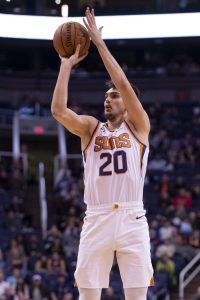
Because Saric was a 12th overall pick and met the starter criteria with 50 starts this season, he’s eligible for a qualifying offer worth $5,087,871 instead of $4,791,213. No other players fit the bill this year — many of the best players drafted between Nos. 10 and 30 in 2016 have already been extended, while the others didn’t have major roles or are no longer on their rookie contracts.
Entering the season, Malik Beasley – who logged nearly 1,900 minutes in 2018/19 – looked like the strongest candidate to join Saric in this group. However, Beasley had an inconsistent role in the Nuggets’ rotation before being traded to the Timberwolves, and ended up making just 14 starts (all with Minnesota), with 1,209 total minutes played.
Second-round picks and UDFAs who met starter criteria:
No second-round picks or undrafted free agents eligible for restricted free agency met the starter criteria this season, which would have put them in line for a qualifying offer worth $3,126,948.
Actually, Bogdan Bogdanovic (Kings) technically qualified for this group, but because his initial NBA contract was more lucrative than most, his qualifying offer will be worth $10,661,733 based on other criteria, rendering the starter criteria irrelevant for him.
De’Anthony Melton, Kenrich Williams, Torrey Craig, and Jevon Carter were some of the other top candidates to meet the starter criteria among second-rounders and UDFAs, but none ultimately recorded more than 1,011 minutes (Melton) or 18 starts (Williams).
As a result, those players – and the rest of this year’s restricted free agents – won’t have their projected qualifying offers impacted by the starter criteria.
Photos courtesy of USA Today Sports Images. Salary information from Basketball Insiders used in the creation of this post.
Ed Davis Discusses Friday’s Call, His Stance On Restart Plan
Jazz center Ed Davis was among the 80-plus players on last Friday’s conference call, which saw a number of players – including Kyrie Irving – express their concerns about resuming the 2019/20 season amid the ongoing pandemic and the fight for social justice in the wake of George Floyd’s death.
Speaking to Alex Kennedy of HoopsHype, Davis expressed support for the Black Lives Matter movement, though he questioned whether sitting out in protest this summer was the best way to advance the cause. Pointing out that refusing to play this summer could compromise the league’s financial situation in 2020/21 and beyond, Davis argued that forgoing all that money would be counterproductive for a league made up predominantly of black players.
“Us missing the rest of this season, we’re talking about billions and billions of dollars for the black community because a lot of guys in the NBA are black men from the inner cities and things like that,” Davis said. “So, the way I look at it, we have to play for that simple fact. I saw Stephen Jackson say that we can’t play because it’s going to be a distraction. Yeah, it’s going to be a distraction, but we can take that money – those billions and billions of dollars – that we’re going to make and pour it back in the community. You can look at it like that – that us losing out on that money would hurt generations of people.
“For me, I make $5MM a year and I’m taking a 25% pay cut, so I’m losing around $30K every two weeks. That’s hundreds of thousands of dollars, and that’s what is creating generational wealth and that’s what is really going to help the black community. I don’t know if guys are looking at it like that. But that’s just my perspective and the reason why I think we need to play.”
Mentioning Irving and Dwight Howard specifically, Davis pointed out that some of the players who have been most outspoken about focusing on social-justice causes rather than returning to play are already set for life financially. Davis noted that the players’ union has to listen to what the league’s younger and lesser-paid players are saying too, acknowledging that there are a wide variety of perspectives on the issues to consider.
Davis also provided some additional details on Friday’s call and expressed a few more opinions on where things stand with the NBA and its players, as well as what he thinks will happen next. His conversation with Kennedy is worth checking out in full at HoopsHype, but here are a few more notable quotes from the veteran big man:
On the difference of opinions during Friday’s call:
“There were 80 guys on the call and maybe 10 who spoke, and of the guys who spoke, it was probably 50/50 – only half said that we might need to take a stand and that playing might not be the best idea.
“… Obviously, it’s a tough situation; we’re in a pandemic. But this is when we really have to stick together and really use our platform and really make a difference. I think that we have so many resources through the NBA and working with the NBA, that’s how we’re gonna make things happen. Taking a stand and not playing, I just don’t think that’s going to better the situation. I guess it might be a little distraction, but it’s on us to turn that distraction into a positive thing.”
On whether he’s confident that the season will resume next month as planned:
“Yeah, I’m about 99.9% sure that we’ll finish the season. I know a couple guys from the Jazz have concerns, but in our group chat when we talk, everybody’s on board and we’re ready to play. We’re hoping that we can start doing contact stuff soon. So the team I play on, we’re ready to go. I don’t know how it is for some of these other teams. But I’ve played with so many different guys in the NBA and I talk to so many different guys and, for the most part, guys want to play.”
On what he’d like to see happen if the restart moves forward as planned:
“I do think if we play and go to Orlando, we can sit down with Commissioner (Adam) Silver and figure out something that we really can do so that these people who are getting murdered on camera can get the justice that they deserve. … We’re in crazy times; we’re in a pandemic and black guys are being murdered on camera. And then (the cops) are going home on paid leave, which is not right. That definitely has to change, and this change is not going to happen over a week, over a month or over a year. This is going to take decades. It’s going to take the people who are in their 20s and raising kids to stop the hatred and stop the racism. That’s what it’s going to take.
“So, I’m not with the quick fixes or emotional decisions; they never really work out well. When you have a plan and find a solution, that’s when you get the most success and that’s when good things happen. I think with (NBPA president Chris Paul), (NBPA executive director) Michele (Roberts) and Adam Silver, they’re gonna do that.”
NBA To Prorate Bonus, Incentive Criteria Using March 11 As End Of Season
A number of players with performance incentives and bonus clauses in their contracts didn’t get the opportunity to earn those bonuses in 2019/20 due to the suspension of the NBA season and the league’s subsequent hiatus.
However, according to Ramona Shelburne and Adrian Wojnarowski of ESPN, the NBA and NBPA have reached an agreement on how to handle performance incentives in ’19/20. The criteria for those bonuses will be prorated, using March 11 as the end of the regular season, so stats accumulated during the eight “seeding games” this summer won’t count toward those incentives.
[RELATED: Hoops Rumors Glossary: Proration]
For instance, Tyus Jones‘ contract with the Grizzlies includes an $858K bonus in the event that Memphis wins 33 games. Prior to the hiatus, the Grizzlies had 32 victories. Rather than needing the Grizzlies win one more game when play resumes, Jones will already be assured of his bonus, since a 32-33 record prorated over a full 82-game season would work out to 40 wins.
Similarly, Raptors guard Kyle Lowry has a series of bonuses related to his All-Star berth and his team’s postseason success that require him to play at least 65 games. When the season went on hiatus, Lowry had appeared in 52 of Toronto’s 64 games. Prorated over an 82-game season, that would work out to approximately 67 of 82 games, so Lowry will be considered to have met that 65-game threshold. He’ll receive his $200K All-Star bonus and could earn up to another $1.5MM, depending on how far the Raptors advance in the playoffs.
ESPN’s Bobby Marks broke down a number of these bonuses and incentives in an earlier Insider-only story. Another important one, noted by Shelburne and Wojnarowski, affects Sixers center Joel Embiid.
The final three years of Embiid’s maximum-salary contract, through 2022/23, had previously only been conditionally guaranteed, with the 76ers retaining the ability to gain salary relief if the veteran center suffered a career-threatening injury related to his back or feet. In order to fully guarantee those salaries, Embiid had to log 1,650 minutes this season.
When the season was suspended, Embiid was only at 1,329 minutes played. However, Philadelphia had only played 65 of 82 games. Prorated over a full season, Embiid’s average number of minutes per Sixers game (approximately 20.45) would work out to 1,677, surpassing the 1,650-minute threshold and ensuring his upcoming salaries are fully guaranteed.
Players whose bonuses and incentives rely on a percentage are unaffected by proration. For example, Mavericks forward Maxi Kleber would receive a $75K bonus for an 80% free-throw rate and another $150K for a 40% three-point average. His percentages are currently 86.3% and 37.4%, respectively, so he’ll receive the first bonus — but not the second. The same would have been true if he had finished at 80.1% and 39.9%.
NBA’s Return Not Believed To Be In Jeopardy
Despite the fact that players have expressed a handful of concerns about the NBA’s restart plan over the last week or two, ESPN’s Ramona Shelburne and Adrian Wojnarowski have found no indications that the NBA’s return is in jeopardy.
According to Shelburne and Wojnarowski, there will probably be some players who opt not to suit up when the season resumes in Orlando, but ESPN’s sources don’t believe that a “significant” amount of players are prepared to sit out.
Although some players have concerns related to COVID-19 and/or the restrictive nature of the Orlando plan, much of the discussion recently has focused on how resuming the season may or may not divert attention away from the Black Lives Matter movement and other social justice causes. NBPA executive director Michele Roberts tells ESPN that players spent much of the weekend discussing how they can use their “obvious influence” to best highlight those causes.
“It’s not a question of play or not play,” Roberts said. “It’s a question of, does playing again harm a movement that we absolutely, unequivocally embrace? And then whether our play can, in fact, highlight, encourage and enhance this movement? That’s what they’re talking about. They’re not fighting about it; they’re talking about it.”
As Shelburne and Woj detail, Roberts – in her conversations with players – has pointed to John Carlos’ and Tommie Smith’s raised fists on the podium at the 1968 Summer Olympics as one memorable example of how athletes used their platform at a sporting event to make a powerful statement.
With the NBA’s plan to resume and complete the 2019/20 season expected to move forward, the league is preparing this week to release a pair of key documents to teams, according to Shelburne and Wojnarowski.
One of those documents will outline the changes to the Collective Bargaining Agreement made necessary by the changes to the NBA calendar, while the other will be a 125-page manual detailing the many health and safety protocols for the return-to-play plan this summer.
Those two documents will represent major steps forward, though there will still be other issues to sort out in the coming weeks, including possible insurance protections for players in Orlando and an offseason plan for the eight clubs left out of the 22-team restart.