
Community Shootaround: Best Open Coaching Job
So far, the 2022 offseason hasn’t been an especially busy one on the head coaching carousel. In some years, upwards of one-quarter or one-third of the NBA’s teams make coaching changes once the season ends, but just three clubs are currently searching for someone to fill that job: the Lakers, Kings, and Hornets.
There’s still plenty of time for that to change. Perhaps Quin Snyder will decide to leave the Jazz or longtime Spurs coach Gregg Popovich will opt to retire. It’s also possible a playoff team that falls short of its expectations will make a change. For now though, there’s just those three openings.
The three teams seeking a new head coach have one thing in common: They all expected to make the playoffs in 2021/22 and fell short.
No team missed out on the postseason in more dramatic fashion than the Lakers, who were among the NBA’s title favorites entering training camp. The team was never able to properly acclimate Russell Westbrook to his new team, didn’t get enough production from several veteran reserves, and was hurt by injuries to LeBron James and Anthony Davis.
The Lakers are one of basketball’s marquee franchises and any team with LeBron and AD on the roster is capable of contending, but some candidates may be wary of pursuing the job. The front office, which has been rumored to meddle, has sky-high expectations for the team but lacks the trade assets and cap flexibility to significantly upgrade a roster that finished out of the top 10 in the West. Some veteran coaches might also be turned off by the way the team handled the ouster of Frank Vogel, who won a title for L.A. less than two years ago.
If the Lakers are one of the NBA’s marquee franchises, the Kings are…somewhere on the other end of the spectrum. In 2022, Sacramento set a new league record for futility by missing out on the playoffs for a 16th consecutive season and traded away one of its best recent draftees, second-year guard Tyrese Haliburton, at the trade deadline.
Still, the duo of De’Aaron Fox and Domantas Sabonis represents a good start, especially on offense. If the team can surround Fox and Sabonis with players who can shoot and defend, there’s some intriguing potential on this roster. Adding those kinds of players is easier said than done, but rookie guard Davion Mitchell has big-time defensive upside and Harrison Barnes is a solid three-and-D wing.
The Hornets, meanwhile, have made the play-in tournament twice in a row, but were blown out and eliminated in their first play-in game both last year and this year. Charlotte looks like a team on the rise, with LaMelo Ball, Miles Bridges, and P.J. Washington still getting better. But Gordon Hayward‘s health problems and a lack of a strong presence at center have limited the team’s ceiling since Ball and Hayward arrived in 2020.
We want to know what you think. Which of these head coaching openings looks most appealing to you? Which do you expect to attract the strongest group of candidates? Which is the least appealing?
Head to the comment section below to weigh in with your thoughts!
Hoops Rumors Glossary: Cap Holds
The Bulls have approximately $98MM in guaranteed money committed to player salaries for 2022/23. However, even though next season’s salary cap is expected to come in at $122MM, Chicago won’t begin the 2022 offseason with tens of millions in cap room to spend.
In fact, the Bulls technically won’t open the new league year with any cap space at all. Each of Chicago’s own free agents will be assigned a free agent amount – or “cap hold” – until the player signs a new contract or the Bulls renounce his rights.
The general purpose of a cap hold is to prevent teams from using room under the cap to sign free agents before using Bird rights to re-sign their own free agents. If a team wants to take advantage of its cap space, it can renounce the rights to its own free agents, eliminating those cap holds. However, doing so means the team will no longer hold any form of Bird rights for those players — if the team wants to re-sign those free agents, it would have to use its cap room or another kind of cap exception.
The following criteria are used for determining the amount of a free agent’s cap hold:
- First-round pick coming off rookie contract: 300% of the player’s previous salary if prior salary was below league average; 250% of previous salary if prior salary was above league average.
- Bird player: 190% of previous salary (if below league average) or 150% (if above average).
- Early Bird player: 130% of previous salary.
- Non-Bird player: 120% of previous salary.
- Minimum-salary player: Two-year veteran’s minimum salary, unless the free agent only has one year of experience, in which case it’s the one-year veteran’s minimum.
- Two-way player: One-year veteran’s minimum salary.
A cap hold for a restricted free agent can vary based on his contract status. A restricted free agent’s cap hold is either his free agent amount as determined by the criteria mentioned above or the amount of his qualifying offer, whichever is greater.
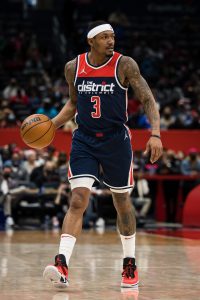 No cap hold can exceed the maximum salary for which a player can sign. For instance, the cap hold for a Bird player with a salary above the league average is generally 150% of his previous salary, as noted above. But for someone like Wizards star Bradley Beal, who earned $33,724,200 this season, 150% of his previous salary would be north of $50MM, well beyond the projected maximum salary threshold.
Beal’s cap hold – assuming he turns down his 2022/23 player option – will be equivalent to the maximum salary for a player with 10+ years of NBA experience. If we assume a cap of $122MM, that figure works out to $42.7MM.
One unusual case involves players on rookie contracts whose third- or fourth-year options are declined. The amount of their declined option becomes their cap hold, and if the player’s team wants to re-sign him, his starting salary can’t exceed that amount.
For instance, the Suns declined Jalen Smith‘s 2022/23 fourth-year option last fall before trading him to the Pacers during the season. As a result, the Pacers won’t be able to offer Smith a starting salary this offseason worth more than $4,670,160, the amount of that option. That figure will also be his cap hold.
That rule is in place so a team can’t circumvent the rookie scale and decline its option in an effort to give the player a higher salary. It applies even if the player is traded, as in the case of Smith, but only to the team the player is part of at season’s end. So, theoretically, the Suns could now offer Smith a starting salary greater than $4,670,160 this offseason despite being the team that initially turned down his option.
If a team holds the rights to fewer than 12 players, cap holds worth the rookie minimum salary are assigned to fill out the roster. So, even if a front office chooses to renounce its rights to all of its free agents and doesn’t have any players under contract, the team wouldn’t be able to fully clear its cap. An incomplete roster charge in 2022/23 projects to be worth $1,004,159, meaning a team without any guaranteed salary or any other cap holds would have closer to $110MM in cap room than $122MM.
A player who has been selected in the draft but has not yet officially signed his rookie contract only has a cap hold if he was a first-round selection. A cap hold for a first-round pick is equivalent to 120% of his rookie scale amount, based on his draft position. An unsigned second-round pick doesn’t have a cap hold.
Cap holds aren’t removed from a team’s books until the player signs a new contract or has his rights renounced by the club. For example, the Warriors are still carrying cap holds on their books for retired players David West and Matt Barnes, who never signed new contracts since playing for Golden State.
Keeping those cap holds allows teams some degree of cushion to help them remain above the cap and take advantage of the mid-level exception and trade exceptions, among other advantages afforded capped-out teams. If and when the Warriors want to maximize their cap room, they’ll renounce West and Barnes, but they’ve been over the cap and haven’t required any added flexibility since those players became free agents in 2017.
Note: This is a Hoops Rumors Glossary entry. Our glossary posts will explain specific rules relating to trades, free agency, or other aspects of the NBA’s Collective Bargaining Agreement. Larry Coon’s Salary Cap FAQ and the Basketball Insiders salary pages were used in the creation of this post.
Earlier versions of this post were published in previous years by Luke Adams and Chuck Myron.
Joe Dumars Leaves Kings For NBA League Office
Veteran basketball executive Joe Dumars is leaving his position with the Kings for a job in the NBA’s league office, according to Shams Charania of The Athletic (Twitter link). The league has confirmed in a press release that Dumars is its new executive vice president of basketball operations.
According to the NBA, Dumars will begin his new role next Monday and will oversee all basketball operations matters for the league, including “the development of playing rules and interpretations, conduct and discipline, and policies and procedures relating to the operation of games.”
Dumars, a Hall-of-Famer as a player, joined the Kings as a special advisor to then-GM Vlade Divac in 2019. When Divac was fired a year later, Dumars became Sacramento’s interim head of basketball operations, then transitioned into a chief strategy officer role following the hiring of Monte McNair. He had held that position for the last two years.
Dumars previously spent 14 years as the president of basketball operations in Detroit, winning an Executive of the Year award in 2003 and building the Pistons team that earned a championship in 2004.
“Joe’s extensive track record of accomplishment as an NBA player and team executive and the leadership and expertise that he has demonstrated in various roles make him a natural fit to drive efforts to further enhance the game,” NBA president of league operations Byron Spruell said today in a statement. “As a respected longtime member of the NBA family, Joe has developed strong relationships across the league that will set the foundation for success in his new position.”
Dumars is replacing Kiki VanDeWeghe, who transitioned into an advisory role for the NBA last August after spending eight years as the EVP of basketball operations.
NBA Won’t Rescind Draymond Green’s Flagrant 2 Foul
The NBA won’t reduce or rescind the Flagrant 2 foul assessed to Warriors forward/center Draymond Green in Game 1 of the team’s series vs. Memphis on Sunday, according to Shams Charania and Anthony Slater of The Athletic (Twitter link).
Green was called for the Flagrant 2 foul and ejected from the game late in the second quarter after grabbing and pulling the jersey of Grizzlies big man Brandon Clarke as Clarke attempted a layup (video link).
As we relayed earlier today, Green expressed optimism during an episode of his podcast on Sunday night that the league would review and adjust the foul, perhaps reducing it to a Flagrant 1. However, it appears that won’t happen.
Players are given two flagrant foul points for a Flagrant 2 foul and one for a Flagrant 1 during the postseason, with four total flagrant foul points resulting in an automatic one-game suspension. Green is now halfway to that automatic suspension and would be forced to miss a game if he’s called for another Flagrant 2 or two Flagrant 1 fouls during the remainder of the playoffs.
Pacific Notes: Green, Nurse, Lakers, Ayton
Having received a costly suspension for Game 5 of the 2016 NBA Finals after having accumulated four flagrant foul points during that postseason, Warriors forward/center Draymond Green is conscious of not repeating that mistake in this year’s playoffs, writes Eric He of NBC Sports Bay Area.
Green was called for a Flagrant 2 foul in Sunday’s win over Memphis, resulting in two flagrant foul points. If he’s called for another Flagrant 2 foul or two Flagrant 1 fouls in this year’s postseason, he would subject to an automatic one-game suspension.
“My biggest worry moving forward is that gives me two flagrant foul points, and as we know I’ve been ejected for accumulation of flagrant foul points,” Green said, per He, during an emergency episode of his podcast on Sunday night. “So I’m hoping that the right thing will happen, and that it will at least get rescinded to a Flagrant 1.”
Green later expressed even more confidence that the NBA would review his foul and make an adjustment: “I’m looking forward to it getting rescinded.”
[UPDATE: NBA Won’t Rescind Draymond Green’s Flagrant 2 Foul]
Here’s more from around the Pacific:
- Asked today about reports that the Lakers are interested in him and whether he plans to remain in Toronto going forward, Raptors head coach Nick Nurse dismissed those L.A. rumors. “I don’t know where that stuff comes from and I’m focused on coaching this team (the Raptors),” Nurse said (Twitter link via Josh Lewenberg of TSN.ca).
- Bill Oram of The Athletic makes the case that the Lakers shouldn’t necessarily trade Russell Westbrook this offseason, arguing that the team won’t have any real chance of “winning” a Westbrook deal since his value is so low. If Los Angeles hangs onto the veteran point guard into next season, it’s possible he could increase his value a little, or new in-season trade opportunities could arise, Oram writes.
- Deandre Ayton‘s ability to take advantage of frontcourt mismatches on offense and to capably switch onto perimeter players on defense makes him a potential X-factor in the Suns’ second-round series vs. Dallas, writes Duane Rankin of The Arizona Republic (subscriber link). Ayton will be a restricted free agent this offseason.
Jalen Suggs Undergoes Right Ankle Surgery
Rookie guard Jalen Suggs underwent surgery last week on his right ankle, according to the Magic, who announced in a press release that the procedure repaired a “slight” stress fracture in the ankle.
The team didn’t announce an exact recovery timeline for Suggs, but said he’s expected to resume basketball activities this summer and make a full recovery by the start of training camp in the fall.
“In assessing Jalen’s right ankle at the conclusion of the season, and consulting with multiple doctors, we came to the determination to undergo this preventative measure,” president of basketball operations Jeff Weltman said in a statement. “We feel by addressing this now Jalen can still have a productive summer leading into training camp.”
It’s unclear how the injury might have affected Suggs’ play in his rookie year. He missed time due to a right ankle sprain and a right ankle bone bruise in the second half of the season.
The No. 5 pick in last year’s draft, Suggs had perhaps the most underwhelming rookie season of any player selected in the top 10, averaging 11.8 PPG, 4.4 APG, and 3.6 RPG with a subpar .361/.214/.773 shooting line in 48 games (27.2 MPG). Besides the ankle issue, the former Gonzaga standout also dealt with a fractured right thumb that cost him 20 games in December and January.
Suggs is still just 20 years old and was highly regarded coming out of college, so the Magic certainly still view him as an important part of their future and will look for him to take a step forward in his second season. It doesn’t sound as if his 2022/23 debut will be delayed at all by last week’s surgery.
Poll: Phoenix Suns Vs. Dallas Mavericks
The Suns were the NBA’s most dominant team in 2021/22. Their 64 regular season wins were eight more than any other team compiled, and their +7.5 net rating ranked first in the league.
However, with Devin Booker banged up for part of their first-round series, it took the Suns six games to beat the upstart Pelicans, and they weren’t exactly blowout victories — Phoenix outscored New Orleans by just nine points across those six games.
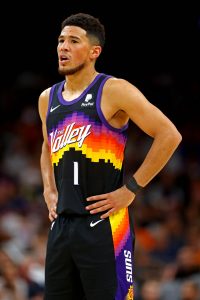 While the Suns may have looked more susceptible to a playoff upset in the first round than they did for most of the season, one crucial stat carried over to the postseason. After registering a ridiculous +33.4 net rating in “clutch” situations during the regular season, Phoenix improved that number to +35.0 in the first round.
The Suns’ ability to score late in close games has been crucial all year, and could be a difference-maker as they look to make a deep playoff run. Having Booker back in the lineup will provide a huge boost as well. He missed three games with a hamstring strain, but returned to action on Thursday and has had three full days of rest before Game 1 of the team’s second-round series on Monday. Assuming he’s back to something resembling 100%, Phoenix will enter the Western Conference Semifinals at full strength.
The Suns’ second-round opponent will be a Mavericks team that has advanced beyond round one for the first time since Luka Doncic arrived in Dallas in 2018, having defeated the Jazz in round one. Like Booker, Doncic was unavailable due to a leg injury (calf strain) for three games in the first round, but the Mavs didn’t miss a beat without him, as Jalen Brunson took his game to another level by putting up 32.0 PPG and 5.3 APG in Doncic’s absence.
Brunson and Doncic, both healthy and ready to go for round two, will face more resistance against Phoenix than they did against Utah’s subpar perimeter defense. Defensive Player of the Year finalist Mikal Bridges has evolved into one of the league’s top shutdown defenders, and he’s flanked by a number of solid performers on that end, including Chris Paul and Jae Crowder. Doncic and Brunson are still capable of putting up big numbers, but they’ll have to work a lot harder to do so in round two.
Although Dallas finished the season 12 games back of Phoenix in the standings, the current iteration of the team looked as dangerous as anyone during the season’s final two months. From the time newly-acquired guard Spencer Dinwiddie made his Mavs debut on February 15 through the end of the regular season, no NBA team had a better record than Dallas (19-6).
The Mavs won’t enter their series vs. the Suns as favorites, but they’re an extremely dangerous team that should make life very difficult for the reigning Western Conference champs.
What do you think? Will the Suns make it back to the Western Conference Finals this season, or will the Mavericks pull off the upset? Vote in our poll, then head to the comment section below to weigh in with your thoughts and predictions!
Which team will win the series?
-
Phoenix Suns in 6-7 games 46% (420)
-
Dallas Mavericks in 6-7 games 31% (282)
-
Phoenix Suns in 4-5 games 21% (192)
-
Dallas Mavericks in 4-5 games 2% (19)
Total votes: 913
2022 NBA Offseason Preview: Detroit Pistons
The Pistons‘ rebuild took a major step forward when they lucked into the No. 1 overall pick in the 2021 NBA draft, giving them first dibs in what looked to be an exceptional pool of prospects. Detroit’s choice – Cade Cunningham – didn’t win this season’s Rookie of the Year award, but he led all first-year players in points per game and his strong second half reinforced the Pistons’ belief in his ability to be a franchise centerpiece.
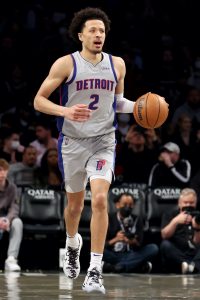 The team’s front office and ownership won’t want to rush the roster-building process, but after winning no more than 23 games in each of the last three seasons, they’ll likely be eager to take the next step forward as soon as possible.
With Cunningham and strong secondary pieces like Saddiq Bey and Isaiah Stewart in place, the Pistons are on the right track, but some more good fortune in the lottery (they have a 52.1% chance of securing a top-four pick) would help further accelerate the team’s climb back to playoff contention.
The Pistons’ Offseason Plan:
The Pistons are one of the only NBA teams projected to have cap room available this summer, but to fully take advantage of it, they’ll have to first resolve Marvin Bagley III‘s free agency, since his cap hold ($28MM+) far exceeds his expected salary.
After three-and-a-half relatively underwhelming seasons in Sacramento, Bagley finished the 2021/22 season strong in Detroit, unburdened by the same expectations he faced with the Kings, where he was known as the player the team drafted one spot ahead of Luka Doncic. He averaged 14.6 PPG with a career-best .555 FG% in 18 games as a Piston.
The Pistons, who reportedly liked the athleticism Bagley brought to the frontcourt and want to re-sign him to a multiyear deal, should have a good amount of leverage, given that the former No. 2 overall pick will be a restricted FA and seems unlikely to draw significant interest from many other teams. The three-year deals signed a year ago by big men Khem Birch ($20MM) and Nerlens Noel ($27MM) could be used as points of comparison.
Even after accounting for the cap hold for their lottery pick and a new deal for Bagley, the Pistons are poised to have a good deal of cap space available. The team has been linked to a wide variety of potential free agent targets, ranging from point guards (Jalen Brunson) to wings (Miles Bridges) to centers (Mitchell Robinson), but shouldn’t feel compelled to spend big in free agency — that cap room could just as easily be used to accommodate trades to continue stockpiling draft picks and/or young talent.
Speaking of trades, the Pistons will face a decision this summer on Jerami Grant, who has one season left on the three-year contract he signed in 2020 and will be eligible for an extension of up to four years. Reports at the trade deadline indicated that vice chairman Arn Tellem was more open to the idea of moving Grant than general manager Troy Weaver was, but if Detroit isn’t prepared to extend the veteran forward, perhaps the front office will become more united behind the idea of pursuing a trade this offseason.
A handful of option decisions will impact how the Pistons fill out their bench — Cory Joseph holds a player option and would be a solid backup to Cunningham or a useful trade chip if he opts in. Detroit also has team options on four players: Hamidou Diallo, Frank Jackson, Carsen Edwards, and Luka Garza.
Salary Cap Situation
Note: Our salary cap figures are based on the league’s latest projection ($122MM) for 2022/23.
Guaranteed Salary
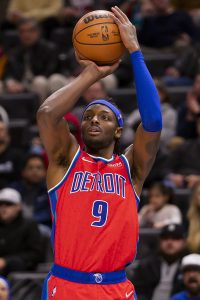 Jerami Grant ($20,955,000)
- Kelly Olynyk ($12,804,878)
- Cade Cunningham ($10,552,800)
- DeAndre Jordan ($7,827,908) — Waived.
- Killian Hayes ($5,837,760)
- Isaiah Stewart ($3,433,320)
- Saddiq Bey ($2,959,080)
- Dewayne Dedmon ($2,866,667) — Waived via stretch provision.
- Saben Lee ($1,752,638)
- Isaiah Livers ($1,563,518)
- Zhaire Smith ($1,068,200) — Waived via stretch provision.
- Braxton Key (two-way)
- Total: $71,621,769
Player Options
- Cory Joseph ($5,155,500): Bird rights
- Total: $5,155,500
Team Options
- Hamidou Diallo ($5,200,000): Bird rights
- Frank Jackson ($3,150,000): Early Bird rights
- Carsen Edwards ($1,815,677): Non-Bird rights
- Luka Garza ($1,563,518): Non-Bird rights
- Total: $11,729,195
Non-Guaranteed Salary
- None
Restricted Free Agents
- Marvin Bagley III ($7,228,448 qualifying offer / $28,280,285 cap hold): Bird rights
- Total (cap holds): $28,280,285
Two-Way Free Agents
- Jamorko Pickett ($1,616,044 cap hold): Non-Bird rights
- Total: $1,616,044
Draft Picks
- No. 5 overall pick ($7,155,120)
- No. 46 overall pick (no cap hold)
- Total: $7,155,120
Extension-Eligible Players
Note: These are players who are either already eligible for an extension or will become eligible before the 2022/23 season begins.
- Jerami Grant (veteran)
Unrestricted Free Agents / Other Cap Holds
- Rodney McGruder ($1,811,516 cap hold): Bird rights
- Total: $1,811,516
Offseason Cap Outlook
Let’s assume the Pistons keep all eight players with guaranteed salaries, re-sign Bagley to a deal starting at $7MM, get the No. 3 overall pick, and bring back all five players who have options. In that scenario, the team would still have over $19MM in cap room.
If the Pistons aren’t committed to picking up all their team options, their cap room could increase to $25-30MM. Of course, Joseph’s option decision, Bagley’s free agency, and possible trades are also wild cards that will affect that number. But if Detroit has a move in mind that requires $20MM-ish in cap space, it looks like it won’t be too difficult to carve out that space.
Cap Exceptions Available
- Room exception: $5,329,000 1
Footnotes
- This is a projected value.
Salary and cap information from Basketball Insiders and RealGM was used in the creation of this post.
Jazz Rumors: Snyder, Mitchell, Gobert, Offseason
Although the Jazz were eliminated in the first round for the third time in four years, the team’s ownership and management groups don’t consider head coach Quin Snyder part of the problem in Utah, sources tell Sam Amick of The Athletic. The comments made by general manager Justin Zanik during a media session on Friday certainly back that up.
“Quin Snyder is one of the best coaches in the NBA,” Zanik said, according to Erik Walden and Andy Larsen of The Salt Lake Tribune. “There is no other partner I would rather have as a coach and as a leader of our players and as a partner in our front office than Quin Snyder.”
According to Amick, Snyder has one guaranteed year left on his contract with the Jazz, then has an option year (the option decision is Snyder’s, not the team’s) for 2023/24. However, sources tell The Athletic that the head coach has been unsure for much of the year what his future holds and plans to assess his options now that the season is over. Staying with the Jazz, going to a new team, or even taking a year off are all options, Amick writes.
Veteran NBA reporter Marc Stein, who first reported on the Snyder situation in March, says today that the Lakers‘ interest in the veteran coach is serious, but adds that there’s skepticism in coaching circles that Snyder would leave Utah for Los Angeles, given the drama that surrounded Frank Vogel during his tenure with the team.
Stein, who reiterates that the Jazz unsuccessfully tried to extend Snyder prior to the 2021/22 season, agrees with Amick that the idea of the 55-year-old taking a year off isn’t out of the question. Snyder is “known to be held in high regard” by the Spurs, according to Stein, who suggests that a one-year hiatus from coaching could put him in position to become Gregg Popovich‘s successor.
Here’s more on the Jazz:
- In addition to relaying Zanik’s comments about Snyder, Walden and Larsen of The Salt Lake Tribune passed along several more of the most interesting quotes from the general manager’s Friday press conference. Notably, Zanik dismissed the idea that the interpersonal dynamics of Utah’s players – including Donovan Mitchell and Rudy Gobert – are a concern. “They’ve given themselves to each other. And all the outside narratives is just a bunch of noise,” Zanik said. “Internally, I see it every day. These guys care about each other.” The GM also referred to Mitchell and Gobert as “foundational pieces.”
- In a fascinating story for ESPN.com, Tim MacMahon takes a look at some of the steps the Jazz have taken to make sure Mitchell is comfortable in Utah and explains why multiple teams have been monitoring the situation closely in anticipation of the All-Star guard possibly asking to be traded. Within a story about the Knicks‘ ongoing interest in Mitchell, Marc Berman of The New York Post says league sources have speculated about the Heat being a potential landing spot for the 25-year-old.
- As MacMahon outlines, Mitchell became the fourth player of 18 (at the time) who signed rookie scale extensions since the 2011 lockout to get a player option in his contract, and the first three (Paul George, Kyrie Irving, and Anthony Davis) all pushed for trades before those deals expired. Some rival executives have also speculated that market size is important to Mitchell, says MacMahon, whose story is worth reading in full.
- According to John Hollinger of The Athletic, if Danny Ainge and the Jazz want to seriously shake up their roster this summer, trading Gobert would be the most logical way to do it. Hollinger identifies some hypothetical trade partners if Utah decides to go that route, breaking down how a Gobert deal might work for the Hornets, Hawks, Raptors, Knicks, or Grizzlies.
Western Notes: Prince, Dinwiddie, Nance, Kings
Timberwolves forward Taurean Prince will be an unrestricted free agent this summer, but he said on Friday that he “plans to return” to Minnesota for next season, as Darren Wolfson of 5 Eyewitness News relays (video link).
Prince told reporters that the strong camaraderie in the Wolves’ locker room is something he hasn’t experienced since college and praised head coach Chris Finch, comparing him to Mike Budenholzer, who coached Prince in Atlanta at the start of his NBA career. The 28-year-old added that he hopes Minnesota reciprocates his interest.
Prince averaged 7.3 PPG and 2.5 RPG on .454/.376/.756 shooting in 69 regular season games (17.1 MPG) during his first year in Minnesota. The Wolves will hold his Bird rights this summer, so they would be able to go over the cap to re-sign him without using any of their mid-level exception.
Here’s more from around the Western Conference:
- Mavericks guard Spencer Dinwiddie earned a $100K bonus on Thursday when Dallas beat Utah to advance to the second round, tweets ESPN’s Bobby Marks. Dinwiddie would receive another $571K if the Mavs get past Phoenix and earn a spot in the Western Conference Finals.
- Having played for four teams and eight head coaches since entering the NBA in 2015, Pelicans forward Larry Nance Jr. would welcome some stability and said on Friday that he’d like to make New Orleans his permanent home, tweets William Guillory of The Athletic. Nance has just one year left on his current contract, but will be extension-eligible this offseason.
- With Monte McNair believed to be entering the final guaranteed year of his contract with the Kings, Jason Anderson of The Sacramento Bee wonders if the general manager will feel pressure to hire a veteran head coach such as Mike D’Antoni instead of a candidate without any head coaching experience.