
Isaiah Stewart Likely Out For Season With Shoulder Injury
An MRI on Tuesday revealed that Pistons big man Isaiah Stewart has a left shoulder impingement, Detroit announced. He will continue to rehabilitate the injury and will be reevaluated in three-to-four weeks, per the team.
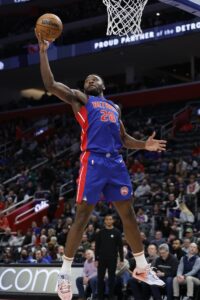 Stewart initially injured the shoulder in January, causing him to miss a handful of games. He has been sidelined since February 25 due to a separate injury (right hip soreness).
With the worst record in the NBA (15-51) and only 16 games remaining on their schedule, there’s little reason to believe the Pistons will rush Stewart back to play again this season. He joins Hamidou Diallo and Bojan Bogdanovic as Pistons who might miss the rest of the season.
Through 50 games, including 47 starts, Stewart averaged a career-high 11.3 PPG, 8.1 RPG, and 1.4 APG on .442/.327/.738 shooting. The primary reason his FG% is down compared to the previous two seasons is that he expanded his offensive repertoire, as he attempted nearly as many threes as twos in ’22/23.
Stewart also slid down to power forward for a significant chunk of his playing time this season, which was a big change. He had played center almost exclusively in his first two seasons.
Still just 21 years old, the former 16th overall pick will be eligible for a rookie scale extension in the offseason. While Stewart is sidelined, Marvin Bagley III and James Wiseman should continue to see plenty of playing time, at least until rookie center Jalen Duren returns from his own injury (bilateral ankle soreness).
Doncic’s MRI Clean, Expected Back Once Pain Dissipates
The MRI on Luka Doncic‘s left thigh strain came back clean, sources tell ESPN’s Adrian Wojnarowski (Twitter link). The Mavericks star is expected to return to action once the pain in his thigh dissipates, Wojnarowski adds.
Doncic left Wednesday’s loss to New Orleans with the injury. He was favoring his left leg as he walked into a post-game media session and replied “not good” when reporters asked how he felt.
The 24-year-old MVP candidate said he had been dealing with pain in his thigh for about a week.
“I think we all can see he’s not moving well, so shooting, defensive, it’s affecting everything,” coach Jason Kidd said after yesterday’s game. “He’s trying to fight through it and help his teammates, but he had to leave.”
Through 57 games (36.3 MPG), Doncic is putting up incredible stats. He’s averaging a career-high 33.0 PPG (second in the league), 8.6 RPG, 8.0 APG and 1.5 SPG on .500/.349/.736 shooting splits.
Hopefully the pain from the injury goes away sooner rather than later, as Dallas is vying for a playoff spot. The Mavs currently hold a 34-33 record, making them the No. 8 seed in the West.
Lakers’ Mo Bamba Out At Least Four Weeks With Ankle Sprain
Backup center Mohamed Bamba has sustained a high left ankle sprain and will be reevaluated in about four weeks, the Lakers announced (Twitter link via Brad Turner of The Los Angeles Times).
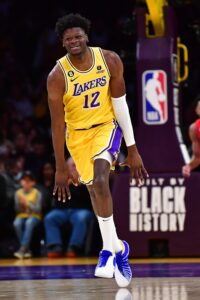 Bamba only played two minutes in Sunday’s victory over Golden State and was out for Tuesday’s win against Memphis.
There’s a good chance that Bamba could miss the rest of the regular season. If he came back in exactly four weeks, which seems unlikely given he’d almost certainly need some time to ramp up his conditioning, the Lakers would have just two regular season games left on their schedule, home contests against Phoenix and Utah.
A trade deadline acquisition from Orlando, the 24-year-old has averaged 4.4 PPG and 5.3 RPG in seven games (11.6 MPG) with the Lakers, posting a .417/.333/.545 shooting line. In 40 games (17.0 MPG) with the Magic this season, he averaged 7.3 PPG, 4.6 RPG and 1.0 BPG on .495/.398/.686 shooting.
The No. 6 overall pick in the 2018 draft, Bamba signed a two-year, $20.6MM contract last offseason after posting career highs in multiple categories in ’21/22. However, he was third on Orlando’s center depth chart for most of ’22/23 and his salary for next season is non-guaranteed.
Bamba’s injury further depletes the Lakers’ frontcourt depth, as LeBron James is also sidelined with a foot injury. With both players out, Anthony Davis, Troy Brown, Jarred Vanderbilt, Rui Hachimura and Wenyen Gabriel should continue to see the bulk of the minutes at forward and center.
The Lakers do have an opening on their 15-man standard roster, so they could sign someone without making a corresponding roster move. Los Angeles is currently 32-34, the No. 9 seed in the West.
Celtics Notes: G. Williams, Brown, Pritchard, Davison
Celtics forward Grant Williams has been playing through a ligament strain in his right (shooting) elbow that has been exacerbated by muscle inflammation in the surrounding area, league sources tell Jared Weiss of The Athletic. Williams has been wearing a sleeve on his elbow since February 12, Weiss writes, which is around the time he sustained the injury.
According to Weiss, Williams was unable to lift heavy weights for a few weeks, though he was able to resume that activity prior to aggravating the injury in practice over the weekend. The former first-round pick has been dealing with pain when he turns or grabs with his right hand, sources tell Weiss.
Williams’ injury may be one reason why he’s been in a shooting slump, as he posted a .333/.325/.737 shooting line in February, far below his season-long splits of .455/.404/.804. As Weiss notes, his playing time has been cut back as well, with trade deadline addition Mike Muscala and second-year forward Sam Hauser both competing with Williams for minutes.
However, Weiss says Williams didn’t blame the elbow injury for missing both free throws in a tie game at the end of regulation on Monday in Cleveland, when one make would have sealed the win. Boston eventually lost in overtime.
Here’s more on the Celtics:
- Williams hasn’t always been known for his shooting ability. In an interesting article for The Athletic, Weiss writes that assistant coach Ben Sullivan, who previously worked with Giannis Antetokounmpo in Milwaukee, helped instill confidence in Williams, something he admits he’s struggled with since he’s been dealing with the injury because he doesn’t think of himself as a natural shooter. Williams provides more insight on the injury and says he’s been receiving cortisone treatments, which have helped with the elbow discomfort. “Shot’s feeling good, medicine helps, so it’s just a matter of continuing to be confident and continuing to shoot the way I am,” Williams said, per Weiss. “From now on, it’s a matter of letting it go, let the shot fly, and think about everything after.”
- Star wing Jaylen Brown says he’s grown weary of dealing with the mask he’s been wearing after suffering a facial fracture last month. “I’m kind of tired of the mask, to be honest,” he said (Twitter link via Weiss). “I know it looks cool. But sometimes it’s hard to breathe. It kind of limits your vision at times depending on the lighting and depth perception. But y’all don’t want to hear none of that, that’s something like excuses.”
- Head coach Joe Mazzulla says reserve guard Payton Pritchard could miss the team’s upcoming six-game road trip, which ends March 21 in Sacramento, tweets Gary Washburn of The Boston Globe. Pritchard sustained a left heel injury at the end of regulation in Monday’s game when he missed a contested driving layup. Rookie guard JD Davison, who is on a two-way contract, may stay with the Celtics to provide depth, Washburn adds.
- In case you missed it, the Celtics still have an opening on their standard roster, and they’re also involved in an intriguing second-round subplot that depends on where Houston finishes in the standings.
Trade Breakdown: Dario Saric To The Thunder
This is the sixth entry in our series breaking down the significant trades of the 2022/23 season. As opposed to giving out grades, this series explores why the teams were motivated to make the moves. Let’s dive into a deal between the Suns and Thunder…
On February 9, the Thunder traded forward/center Darius Bazley to the Suns in exchange for forward/center Dario Saric, Phoenix’s 2029 second-round pick and $1MM in cash.
The Thunder’s perspective:
On the surface, this seems like a pretty minor trade that got lost in the shuffle a bit due to all the blockbusters leading up to the deadline. That said, I thought it was interesting for a number of different reasons.
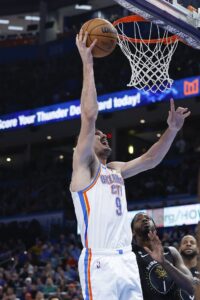 As our Luke Adams explains in our glossary entry on traded player exceptions, even though this seems like a straightforward one-for-one swap, this was actually a non-simultaneous deal for both the Thunder and the Suns, making it mutually beneficial.
A non-simultaneous deal means a team can trade away a single player without immediately taking salary back in return, allowing it to create an outstanding trade exception.
This deal showed the value of having a large ($10,183,800) outstanding traded player exception, which permitted the Thunder to take on Saric’s $9,240,000 contract for “nothing.” That also allowed them to generate a new TPE, worth $4,264,629, which is what Bazley is making this season.
The Suns created their own TPE because they only traded one player and took back less salary than they sent out. It’s worth $4,975,371, which is the difference between Saric’s salary and Bazley’s. Both teams will have until next February to use their new TPEs.
There are plenty of examples of large TPEs not being used at all. Often that has to do with the team’s proximity to the luxury tax and its willingness (or lack thereof) to pay a huge chunk of cash for what could amount to a rental player (many players involved in deadline deals are on expiring or pseudo-expiring contracts — both Saric and Bazley could hit free agency this summer, for example).
The Thunder were in the sweet spot of being over the cap but far enough below the luxury tax line that they could use their large TPE to create an additional asset of sorts to possibly create future value. It also netted them a second-round pick and a little cash, since the Suns were motivated to move off Saric’s contract.
Cap aspects aside, when it was first announced, my first thought was to wonder if Saric might reach a buyout agreement or get waived, even though the Thunder were (and still are) in the play-in race. A handful of days after the deadline, it definitely sounded like he wasn’t going to pursue a buyout, praising the organization and saying he was “open-minded” about his potential role.
However, a report late last month indicated that he nearly was waived as Oklahoma City sought flexibility with its last roster spot, instead choosing to release Eugene Omoruyi.
My second thought was, wait, did the Thunder just make an on-court upgrade and get draft capital back? That very rarely happens.
That’s not to say the Thunder made a win-now move, far from it. The primary objective was landing the second-round pick and creating a new TPE. Saric is on an expiring contract and I’m sure the Thunder’s front office wouldn’t mind if they missed the postseason, though they haven’t shown any signs of blatantly tanking to this point.
He may not be a household name, but Saric is an accomplished player, providing solid value with all three of his previous clubs (he started with Philadelphia and was traded to Minnesota in the Jimmy Butler deal back in ‘18/19). He holds career averages of 11.2 PPG, 5.6 RPG and 1.9 APG on .443/.360/.838 shooting in 402 games (217 starts, 24.0 MPG).
Saric missed all of last season while recovering from a torn ACL he suffered in Game 1 of the 2021 NBA Finals. He had a second surgery last May to repair a torn meniscus, making it an open question what his form would look like upon his return from two major knee surgeries.
He (understandably) had a very slow start to 2022/23, only appearing in 22 of Phoenix’s first 41 games with averages of 3.8 PPG and 2.8 RPG on .358/.351/.857 shooting in 11.6 MPG. That’s why I said his free agent stock was trending down when I wrote about him in January.
However, he was a rotation fixture in the 15 games (seven starts, 18.5 MPG) leading up to the deadline, averaging 8.8 PPG, 5.4 RPG and 2.3 APG on .485/.438/.800 shooting. Saric’s solid play has continued post-trade, as he’s averaging 10.1 PPG and 3.7 RPG on a scorching hot .627/.458/.889 shooting line through nine games with the Thunder (14.9 MPG).
The 28-year-old has an excellent feel for the game, using his high basketball IQ to overcome his relative lack of athleticism. He is a below-the-rim finisher, but has good touch and lots of tricks around the basket – he’s shooting 67.1% at the rim this season, which ranks in the 71st percentile, per DunksAndThrees.com.
The Thunder run a five-out offense where every player on the court is capable of dribbling, passing, screening and shooting. All of those are strengths of Saric’s.
He isn’t a great defensive player at either frontcourt position, and he’s undersized against some centers (he’s listed at 6’10” and 225 pounds). That said, he’s generally in the right spots, he just lacks the foot speed to stick on the perimeter and the length to protect the paint.
Oklahoma City has had a ton of draft picks over the past few years, and still has loads more in the future. Bazley was one that didn’t work out.
The No. 23 overall pick of the 2019 draft, Bazley entered the NBA as an excellent athlete with raw skills. He turned into a solid defensive player, but struggled mightily offensively.
I gained a newfound respect for Bazley as a person after I saw a video of him talking about his diminished playing time this season (he only appeared in 36 of 54 games for an average of 15.4 MPG). His team-first attitude and self-awareness were admirable.
While Bazley is certainly young and talented enough that he could develop elsewhere, he was viewed as unlikely to be in the Thunder’s long-term plans even if they had kept him through the deadline. The harsh reality is trades are part of the business.
The Suns’ perspective:
Phoenix’s primary, secondary and tertiary reasons for making this deal were financial. As Luke Adams details in our glossary entry, the NBA’s luxury tax is set up so that the penalties become increasingly punitive the further teams go beyond the tax line.
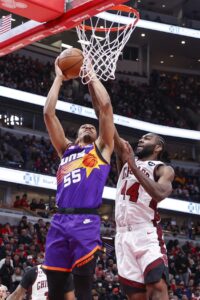 Trading Saric for Bazley saved the Suns approximately $20MM toward their estimated luxury tax payment. According to Eric Pincus of Sports Business Classroom, the Suns are currently $22,249,841 over the tax with an estimated luxury tax bill of $53,436,904. And that’s after this trade was made.
Saric started to pick up steam prior to the deadline, was a key contributor to the team’s culture, and played a role in its run to the Finals a couple years ago. Would he have provided $20MM worth of value for the remainder of this season? In the most optimistic scenarios, maybe? But probably not.
Trading for Kevin Durant means there won’t be many minutes at power forward in the playoffs. Ditto at center behind Deandre Ayton. The Suns still have several options to explore backing up those frontcourt spots, including Torrey Craig, T.J. Warren, Ish Wainright, Jock Landale, Bismack Biyombo and Bazley.
Maybe the Suns like Bazley as a defender and believe he has untapped upside on offense. He’s still just 22 years old. But he had also only appeared in one of a possible seven games (for seven minutes) entering Wednesday’s matchup with his former team.
In all likelihood, Bazley’s role will be minor going forward. As a championship hopeful, the Suns can’t really afford to play him when it counts, because opposing teams dare him to shoot and he’s only converting 50% at the rim, which is in the sixth percentile of all players, per DunksAndThrees.
Given Phoenix’s cap situation going forward, plus its window of contention and where Bazley is at in his development, the odds of him receiving a qualifying offer to become a restricted free agent seem slim. If that scenario plays out, he would instead become an unrestricted free agent in the offseason.
The $4,975,371 TPE the Suns created as part of the deal could be used to acquire a player who makes more than the minimum at some point in the future. Losing one second-round pick several years down the line isn’t a big deal, as a few are typically up for sale in every draft.
How far the Suns go in the postseason will ultimately be determined by their star players’ health. Obviously, Durant suffering an ankle sprain just three games after returning from a knee injury isn’t ideal, but they’ve still been on a roll lately, winning 16 of their past 21 games.
The Suns are betting they have enough depth behind Durant and Ayton that losing Saric won’t come back to bite them – a reasonable position, particularly considering how much money they saved by moving him.
Nets GM Sean Marks Expected To Continue Running Front Office
Nets general manager Sean Marks is expected to remain in charge of Brooklyn’s front office in 2023/24, multiple sources tell Brian Lewis of The New York Post.
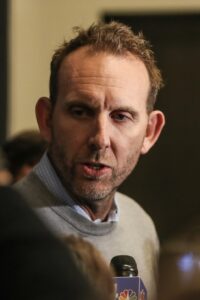 As Lewis writes, the past couple seasons have been nothing if not turbulent for both Marks and the Nets, mainly due to off-court controversies.
To open 2021/22, Kyrie Irving refused to get vaccinated against COVID-19, which reportedly played a role in James Harden requesting a trade ahead of last year’s deadline. The primary piece the Nets received in return, Ben Simmons, didn’t end up playing last season and underwent back surgery — he hasn’t looked like his old self for the majority of this season.
Last offseason, Kevin Durant requested his own trade and reportedly tried to have former head coach Steve Nash and Marks fired. Brooklyn eventually worked things out with Durant and he remained with the team heading into this season.
The Nets had a rough start to ’22/23, going 2-5 before parting ways with Nash. Things started to turn in a positive direction after Jacque Vaughn was promoted to interim head coach, then Irving was suspended by Brooklyn promoting an antisemitic film on social media. He wound up missing eight games, with the team going 5-3 in his absence.
The team was firing on all cylinders once Irving returned, with Durant playing at an MVP level. At one point the Nets won 18 of 20 games, but then Durant went down with a knee injury. Irving was reportedly unhappy with the team’s contract extension offer in early February and requested — and was granted — a trade. Durant then quietly requested his own trade to Phoenix, and was sent to the Suns on February 9.
Marks did the best he could to recoup value for the now-departed star trio, but the championship window certainly appears to be closed in the short term. That led some to wonder whether his job might be in jeopardy, according to Lewis.
However, one source tells Lewis that “ownership has full confidence” in Marks and the rest of the front office’s ability, while another tells Lewis that Marks and owner Joe Tsai are “in lockstep.”
As Lewis notes, the Nets decided to give Vaughn a multiyear contract extension after the trade deadline, with Marks quoted in the press release. That signaled that he might remain the club’s lead decision-maker for the basketball operations department.
A former NBA player, Marks has been GM of the Nets since February 2016.
Lewis writes that “Marks’ current contractual status is unclear.” A report (subscriber link) last summer from Kristian Winfield of The New York Daily News indicated that Marks had signed a contract extension, but both Lewis and Alex Schiffer of The Athletic (Twitter links) heard differently.
Ja Morant Will Not Be Charged With A Crime
The Glendale, Colorado Police Department announced in a press release (via Twitter) that it has concluded its investigation and will not charge Ja Morant with a crime due to a lack of “available evidence.”
“GPD was not able to determine that probable cause existed for the filing of any charges. … The investigation also concluded that no one was threatened or menaced with the firearm and in fact no firearm was ever located. Although the video was concerning enough to prompt an investigation, there was not enough available evidence to charge anyone with a crime,” per the statement.
Police were investigating the Grizzlies star for an incident that took place over the weekend in which Morant appeared to waive a gun during an Instagram Live stream at a strip club in Glendale early Saturday morning. It was the latest in a string of incidents that have caused many to question Morant’s off-the-court behavior.
While it’s certainly good news for Morant that he will not be criminally charged, the NBA is still investigating the incident and it has been reported that the league is “concerned” and has been monitoring his actions for months. The 23-year-old apologized after the Grizzlies announced that he would be away from the team for at least two games, which have now been played.
However, head coach Taylor Jenkins said there’s no timetable for Morant to return to the team and it doesn’t sound like he’s planning on having him back tomorrow versus Golden State.
Free Agent Stock Watch: Southwest Division
For the rest of the regular season and postseason, Hoops Rumors is taking a closer look at players who will be free agents or could become free agents during the 2023 offseason. We consider whether their stock is rising or falling due to their performance and other factors. Today, we’re focusing on a handful of Southwest players.
Christian Wood, F/C, Mavericks
- 2022/23: $14.32MM
- 2023/24: UFA
- Stock: Neutral
2022/23 has been a roller coaster season for Wood, whom the Mavs acquired in the offseason for their 2022 first-round pick and expiring contracts. He started the season coming off the bench and was providing quality offensive production, averaging 17.2 PPG and 7.8 RPG on .550/.402/.688 shooting through 26 games (26.3 MPG).
A handful of days after Maxi Kleber tore his hamstring, Wood was inserted into the starting lineup, averaging 20.3 PPG, 9.4 RPG and 2.4 BPG on .516/.367/.814 shooting in 16 games (33.4 MPG). The team went 9-7 during that span, but unfortunately Wood sustained a fractured left thumb that sidelined him for eight games.
In 12 games since he returned from injury, Wood has seen his role cut back significantly, averaging 13.1 PPG and 5.2 RPG on .457/.298/.860 shooting in 18.9 minutes per contest. Defensive concerns could be the main culprit, though I haven’t seen that publicly stated as of late.
The 27-year-old heard his name pop up in both extension and trade rumors leading up to the February 9 deadline, but neither came to fruition. He remains eligible for a four-year, $77MM extension until June 30, though that appears increasingly unlikely unless he plays a major role in a deep postseason run.
Kenyon Martin Jr., F, Rockets
- 2022/23: $1.78MM
- 2023/24: $1.93MM team option
- Stock: Up
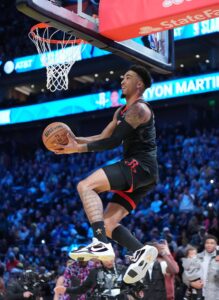 The No. 52 overall pick of the 2020 draft, Martin is averaging career highs with 12.0 PPG and 5.6 RPG while shooting a career-best 56.2% from the field through 65 games (26.9 MPG). The high flier is another player who saw his name mentioned in trade rumors early in the season, but obviously Houston decided to keep him.
Considering his team option for next season is only $1.93MM, it seems unlikely that the 22-year-old would enter free agency. So why is he on this list?
As our Luke Adams detailed last month, if the Rockets exercise their option for ‘23/24, Martin would become an unrestricted free agent in 2024. However, if they decline it, he would be a restricted free agent this summer, giving Houston more control. That’s what happened last summer with Martin’s teammate, Jae’Sean Tate.
Martin has appeared in every game this season for the Rockets, including 24 consecutive starts (32 total). If he starts nine of Houston’s 17 remaining games, he would reach the starter criteria and increase his qualifying offer to $5,216,324.
Dillon Brooks, G/F, Grizzlies
- 2022/23: $11.4MM
- 2023/24: UFA
- Stock: Down
Brooks has always faced criticism for his poor shot selection. However, he has never been this inefficient — his 48.3% true shooting percentage is the second-worst mark in the NBA among 197 qualifying players, only ahead of Detroit’s Killian Hayes (44.7%).
There isn’t one particular area to point to, because he’s struggling from everywhere: 51.6% at the rim (ninth percentile), 38.3% from mid-range (26th percentile), and 31.9% from three-point range (24th percentile), per DunksAndThrees.com.
On the other hand, Brooks is an outstanding defensive player who is tasked with guarding the league’s best perimeter scorers. The Grizzlies have been better with him on the court in each of the past three seasons.
For better or worse, a big part of the team’s identity is tied to Brooks’ brash attitude and confidence. At 27 years old, he’s theoretically in the middle of his prime. He will get a raise on his current deal, but he hasn’t helped himself on the offensive end of the court.
Tre Jones, G, Spurs
- 2022/23: $1.78MM
- 2023/24: RFA ($5.22MM qualifying offer)
- Stock: Up
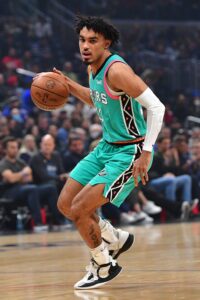 The No. 41 overall pick of the 2020 draft, Jones rarely saw the court in his first season, appearing in 37 games with an average of 7.3 MPG. He saw more action last season, but he was still limited to a reserve role, appearing in 69 games with averages of 6.0 PPG and 3.4 APG in 16.6 MPG.
After trading away Dejounte Murray in the offseason, San Antonio had a glaring hole at point guard. Jones has filled that void, averaging career highs in points (12.5), rebounds (3.6), assists (6.2), steals (1.3) and minutes (29.1) per game.
While he has struggled with scoring efficiency (51.2% TS, ninth-worst in the league among qualifying players), Jones does a very good job of taking care of the ball (3.67-to-1 assist-to-turnover ratio), he’s only 23 years old, and he’s on a minimum contract. He has certainly outplayed that deal.
Jones has already met the starter criteria, which increased the value of his qualifying offer to $5,216,324. There’s an excellent chance the Spurs extend that offer to him and make him a restricted free agent.
Jaxson Hayes, F/C, Pelicans
- 2022/23: $6.8MM
- 2023/24: RFA ($7.74MM qualifying offer)
- Stock: Down
A former lottery pick (No. 8 overall in 2019), Hayes has yet to live up to his draft status. He has only appeared in 38 games this season with a career-low 13.6 minutes per night, a strong sign that the Pelicans don’t view him as a long-term fit on the roster.
Hayes won’t turn 23 until May, so he has time to possibly turn his career around. He is 6’11” and is a strong run-and-jump athlete. His shot isn’t broken by any means – he’s at 72.0% from the line for his career, a solid mark for a big man.
He just looks lost on the court way too often, frequently making careless, head-scratching mistakes at inopportune times, things that drive coaches crazy. The odds of New Orleans extending Hayes a $7,744,600 qualifying offer to make him a restricted free agent are very low, so he will likely hit unrestricted free agency this summer.
Free Agent Stock Watch: Northwest Division
For the rest of the regular season and postseason, Hoops Rumors is taking a closer look at players who will be free agents or could become free agents during the 2023 offseason. We consider whether their stock is rising or falling due to their performance and other factors. Today, we’re focusing on a handful of Northwest players.
Jordan Clarkson, G, Jazz
- 2022/23: $13.34MM
- 2023/24: $14.26MM player option
- Stock: Up
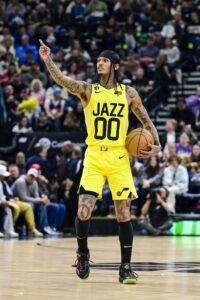 Clarkson is expected to decline his player option to land a long-term contract in free agency, which makes a lot of sense. He’s averaging career highs in points (20.8) and assists (4.4) per game and has matched his career best in rebounds per night (4.0) while posting a .444/.338/.816 shooting slash line (.558 true shooting percentage).
The veteran guard will turn 31 years old in the offseason, so this might be his last chance to land a major multiyear payday. He is an all-around poor defensive player, but his play-making has improved this season, and his shot-creation ability is widely coveted.
I don’t have a great feel for how much Clarkson might get in free agency. His representatives could point to the contracts signed by Anfernee Simons (four years, $100MM) and Jordan Poole (four years, $123MM guaranteed) last summer, for example – Clarkson is much older and has less upside, but his strengths, weaknesses and production are fairly similar to those players.
If I were a GM, I would be very hesitant to pay Clarkson that much money, but he has earned a raise on his current deal, that much is certain.
Udoka Azubuike, C, Jazz
- 2022/23: $2.17MM
- 2023/24: UFA
- Stock: Down
A former first-round pick (No. 27 overall in 2020), Azubuike has unfortunately dealt with a few significant ankle injuries in his brief NBA career, which has impacted his development. Utah declined its fourth-year team option on the 23-year-old big man before the season started, sending a strong signal that he wasn’t in the team’s long-term plans.
Azubuike has only appeared in 26 games this season for an average of 5.9 minutes per contest. It’s hard to get much of a read on someone who plays so little, but he is a limited offensive player who struggles at the free throw line (he shot 41.6% in four college seasons and is at 55.2% on very low volume in the NBA).
The remaining 17 games will essentially serve as an audition for Azubuike. How he performs — and if he gets minutes — could very well determine whether or not he’s able to land a guaranteed contract in the offseason. The odds of that happening seem lower than 50/50 at the moment.
Naz Reid, C, Timberwolves
- 2022/23: $1.93MM
- 2023/24: UFA
- Stock: Up
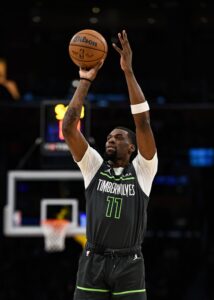 Reid’s per 36 numbers have been quite consistent in each of his four seasons. So why is his stock up?
The primary reason is he’s shown that his game is scalable, meaning his production doesn’t suffer with more playing time. The 23-year-old is averaging 16.5 points, 7.0 rebounds, 1.4 steals and 1.0 block in 11 games as a fill-in starter (26.1 minutes), with the team going 6-5 in those contests. Playing well against reserves is one thing, but doing it over the course of a full game against starters is something entirely different.
Reid has slimmed down considerably since going undrafted out of LSU in 2019 and has shown that he is a quality backup center capable of spot starts. Something in the range of $8-11MM annually seems within reach — a massive increase on his current minimum-salary contract.
Jaylen Nowell, G, Timberwolves
- 2022/23: $1.93MM
- 2023/24: UFA
- Stock: Down
I liked what I saw from Nowell last season and thought he should have gotten more minutes at times. He is shifty with the ball with a quick first step, and shows some nascent play-making ability.
Something has been off with him for nearly the entire ‘22/23 season, which is unfortunate because he had a big opportunity to establish himself after the Rudy Gobert trade freed up backcourt playing time.
Maybe that’s part of the problem. He often looks like he’s trying too hard and forcing the issue instead of letting the game come to him, often a sign of a player pressing. The steep decline in three-point shooting — from 39.4% last season to 29.3% in ‘22/23 — looks like another mental hurdle, as he hesitates at times even when he’s wide open, instead of trusting himself and letting it fly.
Nowell is only 23 and on a minimum deal. He will get more than that in free agency, but probably not as much as he was aiming for before the season began.
Drew Eubanks, C, Trail Blazers
- 2022/23: $1.84MM
- 2023/24: UFA
- Stock: Up
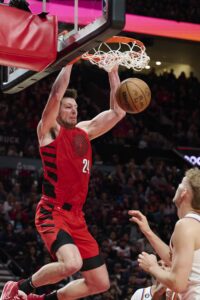 Another player on a minimum-salary deal, Eubanks plays within a clearly defined, limited offensive role of setting hard screens, rolling for the occasional lob, and crashing the offensive glass. His averages of 6.1 points, 5.1 rebounds and 1.2 blocks don’t exactly jump off the page, though he is shooting an impressive 68.3% from the field through 62 games (19 starts, 19.9 minutes).
However, he is an above-average defensive player who moves his feet well for a big man, allowing him to switch onto smaller players better than most centers. The 26-year-old is also a solid rim protector, making up for his relative lack of height (he’s 6’9”) with powerful leaping ability and solid timing while challenging and blocking shots.
Eubanks isn’t the type of player who is going to land a major payday in free agency, but I do think he’s solidified himself as a quality backup due to his consistent energy and the self-awareness he brings of knowing his role. The Blazers have been better when he’s on the court, which is always a positive sign. A multiyear deal in the range of $4-7MM per season seems pretty reasonable.
Heat’s Omer Yurtseven On Verge Of Season Debut
Heat center Omer Yurtseven will be available on Monday versus Atlanta in what would mark his 2022/23 season debut, according to Anthony Chiang of The Miami Herald. The second-year big man underwent left ankle surgery in November to address an impingement, bone spur and stress reaction.
Yurtseven was assigned to the G League last week as he ramped up his activity and closed in on his debut. In two games with the Sioux Falls Skyforce, Miami’s affiliate, the 24-year-old averaged an impressive 27.5 points, 13.5 rebounds and 4.0 assists, Chiang notes.
“It was really long and really grueling,” Yurtseven said of his rehab process. “It feels amazing playing those two games back-to-back. Playing 70 minutes total and afterwards feeling fine, feels amazing.”
Yurtseven, who can become a restricted free agent in the offseason, had a strong rookie showing, averaging 5.3 points and 5.3 rebounds in just 12.6 minutes per contest (56 games). That included one 10-game stretch filling in as a starter for Bam Adebayo when the Turkish center averaged 13.6 points, 13.9 rebounds, 2.9 assists and 1.0 steal.
However, Yurtseven might not be guaranteed any minutes on Monday. As Chiang writes, Cody Zeller has done a nice job as the primary backup center since signing a rest-of-season deal with the Heat.
“It’s impressive, what Cody has done,” head coach Erik Spoelstra said. “You just already can see it, optically, and you can feel it. He fits. He complements our guys. He’s a hard-playing dude. He really competes. He lets it all out there and even just the diving, going after loose balls, the rebounding, the extra effort. It becomes inspiring. Offensively, he’s just really smart, so he can run our offense very well.”
In other Heat-related news, Kevin Love will be out on Monday with a rib contusion, Chiang adds in the same story.