
Police Investigating Ja Morant
The Glendale, Colorado Police Department is investigating Grizzlies star Ja Morant to determine whether he may have broken any gun laws following an incident over the weekend, according to Ramona Shelburne and Liz Merrill of ESPN.
Morant’s latest controversy began with an Instagram Live video that appears to show him waiving a firearm around while shirtless at a nightclub at 4:19 am CT on Saturday. It’s the latest in a string of incidents that have caused many to question Morant’s off-the-court behavior.
The department confirmed the incident occurred in Glendale, a small enclave surrounded by Denver, per Shelburne and Merrill. Colorado is an open-carry state, but there are exceptions to the law. In Colorado, it is illegal to possess a gun while drinking alcohol, ESPN’s duo notes.
It is unclear if Morant was under the influence of alcohol when he streamed the video, but it did occur at a bar and other people near him were spotted drinking.
The fourth-year guard is away from the team after the NBA announced that it was investigating the incident. League rules prohibit players from possessing a firearm when they’re on team property or traveling on team business, as ESPN notes.
The 23-year-old issued an apology following the Grizzlies’ announcement that he would be away from the team for at least two games (one has already been played). Head coach Taylor Jenkins suggested his absence could extend far beyond that, with no timetable for Morant’s return.
Devin Booker, Julius Randle Named Players Of The Week
Suns guard Devin Booker and Knicks forward Julius Randle have been named the NBA’s players of the week, the league announced (via Twitter).
Phoenix went 3-0 last week, with Booker averaging 36.0 points, 5.3 rebounds, 7.7 assists and 1.0 block on .560/.500/.778 shooting in the three victories. The three-time All-Star won for the Western Conference.
Randle, the East’s winner, averaged 29.5 points, 8.3 rebounds and 4.8 assists on .526/.465/.727 shooting last week. New York went 4-0 to extend its winning streak to nine games.
It was the first time either player has won the award this season.
According to the NBA (Twitter link), the other nominees in the West were Anthony Davis, Jamal Murray, Domantas Sabonis and Jalen Williams, while Giannis Antetokounmpo, James Harden, Tyrese Maxey and Immanuel Quickley were nominated in the East.
Thunder Notes: SGA, Butler, Jaylin Williams
Berry Tramel of The Oklahoman (subscriber link) calls Shai Gilgeous-Alexander another “too-good-to-be-true superstar,” noting that the fifth-year guard went out of his way to wear a Thunder– and Oklahoma City-inspired jacket to his first All-Star game. As Tramel writes, Gilgeous-Alexander may not have had the prospect pedigree of Kevin Durant, but he has developed into a star in his own right, and the 24-year-old is a “consummate leader, forever saying and doing the right things.”
When Tramel brought his “too-good-to-be-true” theory up to head coach Mark Daigneault, he readily agreed.
“Part of the reason why it’s too good to be true, is because he doesn’t separate himself out,” Daigneault said of SGA. “Even with all the temptations and all the attention and status and money, and all the stuff that could tempt you to separate yourself.
“And really, there’s nothing in the NBA stopping players from doing that. You’re kind of at the mercy of whether they want to. Fortunately for us, he’s on that track. He’s already checked a lot of those boxes. And yet, he wants to do it inside the team. He wants to do it inside the organization, he wants to be part of something bigger than himself.”
Gilgeous-Alexander’s maturity and team-first mentality, not to mention his long-term contract that runs through 2026/27, seems to bode well for the Thunder as they continue to build around him, according to Tramel.
Here’s more on the Thunder:
- Gilgeous-Alexander cleared the NBA’s health and safety protocols on Saturday and was able to suit up on Sunday, tweets Joe Mussatto of The Oklahoman. Gilgeous-Alexander missed five consecutive games with a combination of an abdominal strain, right ankle soreness and then entering the protocols. The Thunder went just 1-4 in his absence, but were victorious last night against Utah. The 24-year-old didn’t miss a beat in his return, recording 38 points, seven rebounds, four assists, three steals and a block.
- Daigneault said Thunder GM Sam Presti was high on guard Jared Butler entering the 2021 draft, per Mussatto (Twitter link). Butler just signed a two-way deal with Oklahoma City last week, making one brief appearance thus far. The Thunder had four picks ahead of where Butler was selected (No. 40 overall), including two in the 30s, so they had multiple chances to take him. Instead, they wound up packaging the Nos. 34 and 36 picks (used on Rokas Jokubaitis and Miles McBride) in a trade to land Jeremiah Robinson-Earl (No. 32).
- In an article for The Oklahoman, Mussatto details how rookie big man Jaylin Williams and the Thunder have perfected the art of drawing charges. The team has a league-leading 83 charges on the season, far exceeding the Heat’s 63, which ranks second. Williams is a ground-bound center, but he uses his game knowledge to protect the rim in a different way. “It stems from my dad,” he said, “just watching film with him from a young age, me understanding the game and understanding there’s more than basketball than putting the rock through the rim.”
Trade Breakdown: Josh Hart To The Knicks (Four-Team Deal)
This is the fifth entry in our series breaking down the significant trades of the 2022/23 season. As opposed to giving out grades, this series explores why the teams were motivated to make the moves. Let’s dive into a deal four-team deal involving the Knicks, Trail Blazers, Sixers and Hornets.
On February 9:
- The Knicks acquired Josh Hart, the draft rights to Bojan Dubljevic, and the draft rights to Daniel Diez (all from Trail Blazers).
- The Trail Blazers acquired Matisse Thybulle, Cam Reddish, Ryan Arcidiacono, the Knicks’ 2023 first-round pick (top-14 protected), and the draft rights to Ante Tomic (from Knicks).
- The Sixers acquired Jalen McDaniels, the Knicks’ 2024 second-round pick (from Hornets), and the Trail Blazers’ 2029 second-round pick.
- The Hornets acquired Svi Mykhailiuk, either the Hornets’, Hawks’, or Nets’ 2023 second-round pick (whichever is most favorable; from Sixers), and either the Pelicans’ or Trail Blazers’ 2027 second-round pick (whichever is most favorable; from Trail Blazers).
- Note: The Hornets had traded away their 2023 second-round pick in a prior deal.
Note: The Blazers, Sixers and Hornets all generated traded player exceptions in this deal, which can be found here.
The Knicks’ perspective:
Any time you deal away a first-round pick, even if it’s lottery-protected, ideally you want to re-sign the player you’re acquiring, particularly a player who can become a free agent in the offseason like Hart. The Knicks almost certainly would not have made this deal for 25 games of Hart – you can bet that they intend to bring him back, and they have his Bird rights, meaning they won’t require cap room to sign him.
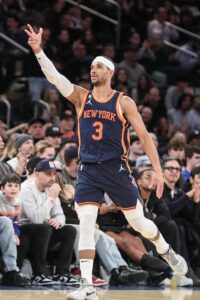 Hart has already said multiple times that he’s looking for a home, is tired of moving, and hopes to remain with New York. That would certainly suggest that there’s mutual interest in the veteran wing sticking with the Knicks, even if the they haven’t publicly said anything about it.
I liked Hart’s fit with the Knicks when the trade was announced, and he has played very well for New York — the team is undefeated in his eight games. He’s averaging 11.5 points, 5.4 rebounds, 3.4 assists and 1.4 steals on .618/.600/.667 shooting in 27.0 MPG thus far.
Obviously, those shooting splits are unsustainable, but Hart has a lot of desirable qualities that mesh well with the players on the roster. One interesting wrinkle is that Hart has been closing games over RJ Barrett, which I think is smart from head coach Tom Thibodeau – Hart is a better defender and doesn’t need the ball on offense. We’ll see if it continues going forward.
Hart has always struck me as a player Thibodeau would love because he plays with maximum effort, chasing after loose balls all over the court. He is a hard-nosed, versatile defensive player. He also is a solid passer on offense, even if he’s fairly limited as a half-court scorer.
The 27-year-old (he turns 28 on Monday) compensates for his relative lack of half-court scoring by being an absolute bull in transition, often pulling down rebounds and going coast-to-coast. He is one of the best rebounders in the league for a wing, particularly for his size (6’5”, 215 pounds), averaging 7.7 boards per game over the past three seasons.
There are two primary knocks against Hart. One is his all-out playing style has led to a number of injuries. He has missed an average of about 19 games per season in his five years leading up to 2022/23, though he has only been sidelined for three this season, not counting the two games missed due to the trade.
The second is that teams are going to dare him to shoot threes, as he’s only at 34.7% for his career from downtown (the league average is 36.0% this season). He was weirdly reluctant to shoot threes with Portland, going through long stretches where he would pass up wide-open shots. That inhibits offensive spacing and can be problematic when paired with a non-shooting big.
Still, he is a valuable role player who does a solid job defending against tough competition, and his ability to make plays for himself and others — especially on fast breaks — is a nice addition to the Knicks. They’re 27th in pace, so he gives them some extra juice.
Reddish had not played in a game since December 3, and trading a protected first-rounder for him last year didn’t pan out. Arcidiacono and Mykhailiuk rarely saw the court, only playing a combined 66 minutes all season for New York. Trading away three players who weren’t contributing to the team’s on-court success for an impactful role player who almost immediately started closing games is a big deal, especially considering the Knicks have only made the playoffs once in the past nine years.
The Trail Blazers’ perspective:
Portland received a former first-round pick in Reddish and the Knicks’ lottery-protected first-rounder this season for a high-end role player in Hart. Arcidiacono was included for salary-matching purposes and is unlikely to have a role, but he’s not a bad fallback option as a third-string point guard – he takes care of the ball and is a decent shooter.
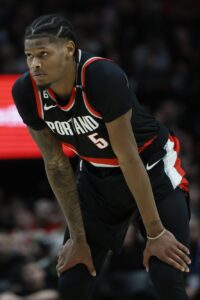 The Blazers also snagged Thybulle for a second-round pick (to Philly) and sent Charlotte another second-rounder to take a player they didn’t want (Mykhailiuk).
The primary reason the Blazers made this trade is that Hart has an odd contract and is expected to opt out of his player option in search of a long-term raise in free agency. Paying both Hart and Jerami Grant (UFA) would have pushed them into the luxury tax without other cost-cutting moves.
For as solid as Hart is, it’s not like Portland was going anywhere this season whether he was in the lineup or not. It’s a shame, because Damian Lillard has been phenomenal (he’s averaging a career-high 32.3 points with a 65.3 true shooting percentage — he’s at peak Stephen Curry levels of volume and efficiency), but the roster just isn’t good enough to do much beyond fighting for the back end of the play-in tournament.
As previously mentioned, Hart was oddly reluctant to shoot threes this season with the Blazers and I’m not really sure why. However, he will be missed for everything else he provides — most of their problems stem from rebounding and defense anyway, and he was one of their best players in both of those categories.
I like the Thybulle pickup and he looks like a good fit on the roster. He isn’t going to keep shooting 51.6% from beyond the arc like he has through seven games as a Blazer, but he was pigeonholed into a very narrow role with the Sixers and I believe he can provide more all-around value than he showed with them.
Thybulle is an absolute menace on defense and he knows that’s what he’s best at. A part-time wing player earning All-Defensive nods two seasons in a row is practically unheard of, but those awards were well deserved. The Blazers need all the help they can get on that end.
Reddish has now been dealt twice in a little over a year, with his value diminishing pretty drastically – the Knicks gave up a protected first-rounder to acquire him last year, but now moved him and a lottery-protected first to land Hart. The 23-year-old, who was the No. 10 overall pick in 2019, has yet to solidify himself as a solid NBA player.
Like Thybulle, Reddish has played well for Portland so far, averaging 14.1 points, 2.5 rebounds, 2.3 assists and 1.3 steals on .470/.373/.941 shooting in eight games (27.7 minutes). Those numbers far exceed his career averages, which are pretty underwhelming (10.4 points, 3.0 rebounds, 1.3 assists, 1.0 steal on .398/.327/.849 shooting in 161 games (24.7 minutes).
Both Thybulle and Reddish can be restricted free agents in the summer if the Blazers extend each of them a qualifying offer – I don’t think that’s a lock for either player, particularly Reddish.
The first-rounder Portland acquired from New York would currently land at No. 23 overall, which is decent. Definitely nothing to scoff at for a player on a pseudo-expiring contract whom the Blazers couldn’t reasonably afford to retain given the overall state of the team. If the Knicks go in a major slump to end the season and miss the playoffs — which seems extremely unlikely considering how hot they’ve been lately — the Blazers would instead receive four second-round picks.
Another aspect of this deal from Portland’s side is that it probably made them worse in the short term, which increases the odds of missing the playoffs and keeping their own lottery pick. The Blazers owe their pick to the Bulls if they make the postseason – if it doesn’t convey this year, the protections roll over to 2024 (it’s lottery-protected for several years, which makes it difficult for the team to trade future picks due to the Stepien rule).
The Hornets’ perspective:
Charlotte’s side of things is pretty straightforward. The Hornets were concerned about how much McDaniels would cost in unrestricted free agency and decided to move him and get something of value while they could.
I don’t think they necessarily wanted to trade McDaniels, especially after spending four years working with him on developing his game and seeing it start to pay off. Forwards who are 6’9″ with a bit of two-way versatility aren’t exactly common.
The problem is that Gordon Hayward is under contract through next season, the Miles Bridges situation still isn’t resolved, P.J. Washington will be a restricted free agent this summer, and Kelly Oubre is unrestricted. McDaniels is arguably the worst player of the group, making him relatively expendable.
The Hornets are almost certainly getting back their own 2023 second-rounder in the deal, which Philadelphia previously controlled and would currently land at No. 34 overall. Charlotte sent New York’s 2024 second-rounder to the Sixers as part of the multi-team agreement, which was slightly surprising, but if the Knicks are good again next year, that pick would land in the back half of the second round.
That No. 34 overall selection has real value and could be packaged with other seconds to move into the late first round this June. It could also be paired with Denver’s first-rounder (currently No. 28), which the Hornets control, to move up a little. Either way, it gives them more options in the upcoming draft and for trades.
The Hornets also picked up a 2027 second-rounder from Portland to take on Mykhailiuk’s salary. It’s reasonable to view that as a higher upside pick than the Knicks’ second-rounder they shipped to Philly. President of basketball operations Mitch Kupchak selected Mykhailiuk No. 47 overall back in 2016 when he was with the Lakers, so there is a connection there, but it seems unlikely that the veteran wing will have much of a role going forward.
The Sixers’ perspective:
The key takeaway from the Sixers’ side of things is they moved out of the luxury tax and arguably upgraded on the wing at the same time. I’m not sure I would take McDaniels over Thybulle in a vacuum, but it’s at worst debatable and he certainly provides length and positional size, which the team lacked.
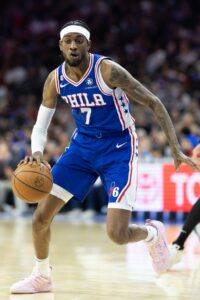 Thybulle is a terrific defensive player, but he wasn’t consistently in the rotation this season due to his offensive limitations. He seemed to fall out of favor with the team after last year’s poor playoff showing, and the Sixers decided to trade him instead of letting him reach free agency.
McDaniels was averaging career highs in all the major counting stats for Charlotte, including points (10.6), rebounds (4.8), assists (2.0), steals (1.2) and minutes (26.7) per game. The 25-year old also hasn’t missed a game this season, which is impressive (he technically did miss one game due to the trade, but that was out of his control).
McDaniels doesn’t stand out in any one particular area, which is sort of a double-edged sword. It means he’s versatile enough to do a lot of different things on the court, but none at an elite level.
The big question mark with McDaniels is essentially the same as it was with Thybulle: can he make enough threes to stay on the court against top teams? With a roster loaded with talented scorers, other types of shots are hard to come by for role players like McDaniels. He is only at 34.1% for his career from deep, including 32.1% this season.
The Sixers picked up his Bird rights as part of the trade, giving them the ability to offer McDaniels more money and years than rival teams. For what they gave up, they likely aren’t committed to re-signing him though, nor should they be. They have the rest of the season to evaluate him and see how he does in the playoffs.
The 25-year-old’s minutes have been cut back pretty significantly since the trade, and his role is more in line with what it would be on a good team (which Philadelphia is). He was getting more run with the Hornets out of necessity due to injuries.
As previously mentioned, the Sixers basically swapped second-round picks with Charlotte, though the one they got back has far less upside. They also received Portland’s 2029 second-rounder for Thybulle — not much of a return, but he was only averaging 12.1 minutes per game with Philly this season and is on an expiring contract.
Norman Powell Sidelined With Left Shoulder Subluxation
The Clippers are missing several rotation regulars for their game on Friday in Sacramento, tweets Andrew Greif of The Los Angeles Times.
Forward Kawhi Leonard is out on the second of a back-to-back due to right knee injury management, forward Marcus Morris is out with an injured elbow, and center Ivica Zubac, who has missed three of the past four games with a strained right calf, remains sidelined.
The most noteworthy injury on the injury report is swingman Norman Powell, who was ruled out with a left shoulder subluxation — that’s the same injury that Stephen Curry sustained earlier this season, which caused him to miss 11 games (just under four weeks).
As Greif notes, Jeff Stotts of InStreetClothes.com wrote about shoulder subluxation at the time of Curry’s injury and stated that the average absence since the 2005/06 season for a player dealing with that issue is approximately 21 days.
The Clippers have stated that Powell will undergo treatment and therapy for at least the next week (Twitter link via Greif). At that point, the team should have a clearer sense of when he’ll be able to return to action.
Powell is L.A.’s third-leading scorer this season at 16.6 points per game, so he’ll certainly be missed. However, it’s possible his absence (and others) will help simplify some rotation decisions for Tyronn Lue, who is still determining how best to use the Clippers’ new-look roster after the team added Eric Gordon, Mason Plumlee, Bones Hyland, and Russell Westbrook in recent weeks.
Bulls Convert Carlik Jones To Standard Contract
8:56pm: The Bulls have officially signed Jones to his standard contract, the team announced in a press release.
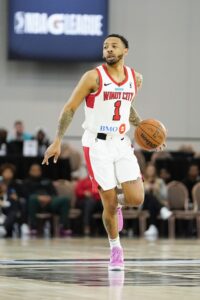 7:12pm: The Bulls plan to convert Carlik Jones‘ two-way deal into a standard contract that covers the rest of 2022/23, according to Shams Charania of The Athletic (Twitter link).
As K.C. Johnson of NBC Sports Chicago notes (via Twitter), Jones will fill the opening that was created when the team waived veteran guard Goran Dragic. The Bulls will have an open two-way slot once Jones is officially promoted to the standard roster.
Jones, 25, was a rookie last season after going undrafted out of Louisville. He appeared in five NBA games in 2021/22 on 10-day hardship deals with the Mavericks and Nuggets, but spent most of his rookie year playing with the Texas Legends, the Mavs’ G League affiliate.
Jones played for the Bulls’ Summer League team in 2022 and was later signed to an Exhibit 10 deal, but was waived before the season started. He signed a two-way deal with Chicago in December, appearing in two games for a total of 23 minutes.
The second-year guard has spent the majority of ’22/23 with Chicago’s G League affiliate, the Windy City Bulls, averaging an impressive 26.1 PPG, 4.4 RPG, 7.4 APG and 1.4 SPG on .489/.356/.800 shooting through 16 regular season games (39.3 MPG). He was on our list of five G League players making bids for NBA call-ups due to their strong performances, and now that has come to fruition.
Jones competed in the G League’s Next Up Game last month, which was essentially its version of the All-Star Game.
Spurs Waive Isaiah Roby, Claim Sandro Mamukelashvili Off Waivers
4:35pm: San Antonio has officially waived Roby and claimed Mamukelashvili, the team announced. The Spurs immediately converted Mamukelashvili to a standard contract, and their 17-man roster is full.
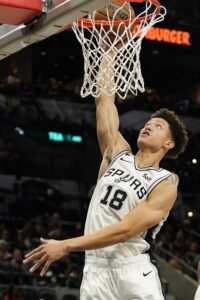 4:15pm: The Spurs plan to waive forward/center Isaiah Roby and will claim big man Sandro Mamukelashvili off the waiver wire, sources tell Shams Charania of The Athletic (Twitter link).
There is a corresponding move that is missing from Charania’s report, however, as Roby is on San Antonio’s 15-man roster, while Mamukelashvili was on a two-way contract with Milwaukee.
The Spurs’ two-way are currently occupied by forwards Dominick Barlow and Julian Champagnie, so they will either need to promote or waive one of those players, or perhaps immediately promote Mamukelashvili — we’re not sure yet if that’s permitted.
Ironically, the Spurs claimed Roby off waivers last summer, and now will reportedly release him to add another player off waivers. His name did pop up in one trade rumor prior to the deadline, which signaled that San Antonio may not have viewed him as a long-term keeper. He is currently sidelined with an ankle injury that has kept him out of action since February 13.
Roby, 25, spent his first three seasons with the Thunder, averaging a combined 9.1 PPG and 5.1 RPG on .495/.365/.708 shooting in 109 games (62 starts, 21.9 MPG) with Oklahoma City. As previously mentioned, San Antonio claimed him off the waiver wire last offseason, but his role has been pretty limited in 2022/23, averaging 4.1 PPG and 2.5 RPG on .432/.300/.488 shooting in 42 games (11.3 MPG).
Assuming he clears waivers, the Spurs will be on the hook for Roby’s full $1,930,681 salary and he’ll become an unrestricted free agent.
Mamukelashvili, 23, was waived a couple days ago by the Bucks. A report at the time suggested that another team might be interested in his services, and now he will reportedly land with San Antonio.
After spending four college seasons at Seton Hall, Mamukelashvili was selected 54th overall in the 2021 draft. He has spent the past two seasons on a two-way contract with the Bucks, but his playing time was very limited at the NBA level — he averaged 3.2 PPG and 2.1 RPG on .439/.345/.750 shooting in 65 games (9.6 MPG) from 2021-23.
The big man played much more for the Wisconsin Herd in ’22/23, Milwaukee’s G League affiliate. He averaged 19.5 PPG, 9.2 RPG, 3.8 APG and 1.3 SPG on .533/.200/.667 shooting in 11 Showcase Cup games (30.9 MPG), and 23.3 PPG, 13.0 RPG, 4.8 APG, 1.0 SPG and 1.0 BPG on .486/.471/.667 shooting in four regular season games (36.5 MPG).
Jared Butler Signs Two-Way Contract With Thunder
MARCH 3: Butler has officially signed a two-way contract with the Thunder, according to a press release from the team.
MARCH 2: The Thunder intend to sign guard Jared Butler to a two-way contract, his agent, Mark Bartelstein of Priority Sports, tells ESPN’s Adrian Wojnarowski (Twitter link).
Butler was a key member of the national champion Baylor Bears in 2021, averaging 16.7 PPG, 3.3 RPG, 4.8 APG and 2.0 SPG while shooting 41.6% from 3-point range as a junior. However, questions about his health hurt his draft stock and he slipped to No. 40 overall in the 2021 draft after having been considered a likely first-rounder.
The 22-year-old spent his rookie season with the Jazz, appearing sparingly in 42 games (8.6 MPG) while averaging 3.8 PPG and 1.5 APG on .404/.318/.688 shooting. Utah had a roster crunch during preseason this past fall and ultimately released Butler despite the fact that his $1.56MM salary for this season was guaranteed.
Butler has spent the 2022/23 season with the Grand Rapids Gold, Denver’s G League affiliate, averaging 19.5 PPG, 3.8 RPG, 5.2 APG and 1.2 SPG on .483/.458/.771 shooting in 18 games (30.1 MPG) during the fall Showcase Cup. He has averaged 17.1 PPG, 3.3 RPG and 5.8 APG on .438/.354/.840 shooting in 23 regular season games (30.2 MPG) with the Gold.
The Thunder had an open two-way slot, so they won’t need to cut anyone to sign Butler. Their 17-man roster will be full once the move is official.
Cavaliers Sign Sam Merrill To 10-Day Deal
MARCH 3: Merrill’s 10-day contract is now official, the Cavs have confirmed. The deal will cover Cleveland’s next five games, running through the club’s March 12 contest in Charlotte.
MARCH 1: The Cavaliers intend to sign guard Sam Merrill to a 10-day contract, sources tell Shams Charania and Kelsey Russo of The Athletic (Twitter link).
Merrill, 26, was the 60th and final pick of the 2020 draft after four years at Utah State. He spent his rookie season with Milwaukee, winning a championship with the Bucks in a very minor role.
He was traded to the Grizzlies in the 2021 offseason, but unfortunately suffered a major ankle sprain in November 2021 which later required surgery. Memphis waived him last January, and he didn’t join another NBA team until signing a partially guaranteed deal with the Kings this past summer.
He spent training camp with Sacramento, but ultimately didn’t make the roster. Merrill’s $150K partial guarantee made him ineligible to join the Kings’ G League affiliate, and the Cleveland Charge, the Cavs’ affiliate, selected him first overall in October’s G League draft.
The sharpshooter hasn’t played much at the NBA level, logging just 8.1 minutes per game in 36 career games with Milwaukee and Memphis. However, he has put up strong numbers for the Charge in ’22/23, averaging 17.5 PPG, 2.8 RPG, 2.6 APG and 1.3 SPG on an excellent .469/.437/.852 shooting line in 18 regular season games (33.8 MPG).
The Cavs have an opening on their standard roster, so a corresponding move will not be required in order to sign Merrill.
Greg Brown Signs With Ontario Clippers
Former Trail Blazers forward Greg Brown has signed a rest-of-season deal with the Ontario Clippers, L.A.’s G League affiliate, according to Albert De Roa of HoopsHype.
Brown was a highly touted prospect entering college, but his stock fell ahead of the 2021 draft, as he was selected 43rd overall after one season at Texas. The raw, athletic forward only made 16 appearances for a total of 93 minutes this season with Portland.
The Blazers waived Brown to accommodate new acquisitions as part of a four-team trade last month. He will receive his full $1.54MM salary for 2022/23.
In 64 games with Portland over the past two seasons, the 21-year-old holds career averages of 4.0 PPG and 2.4 RPG on .422/.294/.636 shooting in 11.5 MPG. In four regular season games (27.0 MPG) with Ontario, he has averaged 15.8 PPG, 5.0 RPG, 1.0 SPG and 2.0 BPG on .375/.280/.750 shooting.