
Pelicans Sign Dereon Seabron, John Petty Jr.
The Pelicans have officially signed guards Dereon Seabron and John Petty Jr., the team announced in a press release.
According to Andrew Lopez of ESPN (Twitter link), Petty will receive an Exhibit 10 contract, while Seabron’s two-way contract, which was reported back in June, is now official. The Pelicans also confirmed that they have signed Daeqwon Plowden, who is on an Exhibit 10 deal.
Seabron, 22, was one of the top undrafted players following the 2022 NBA draft a few months ago. He averaged 17.3 points, 8.2 rebounds, 3.2 assists and 1.4 steals during the 2021/22 season while leading North Carolina State in all four categories.
The 6’7″ guard was named the Most Improved Player in the ACC and was a second-team all-conference choice as a sophomore for the Wolfpack. Seabron most recently suited up for New Orleans during Las Vegas Summer League, averaging 8.2 points, 3.6 rebounds and 2.4 in five games (18.6 minutes), per RealGM.
Petty, 23, went undrafted in 2021 after four years at Alabama. He signed an Exhibit 10 deal with the Pelicans last fall and was waived before the season, designating him as an affiliate player for their G League team, the Birmingham Squadron.
In 31 games (26.2 minutes) for the Squadron last season, he averaged 8.5 points, 4.6 rebounds and 1.8 assists. Like Seabron, Petty also suited up for New Orleans during Summer League, averaging 7.6 points, 5.2 rebounds, 2.6 assists and 1.4 steals in five games (24.0 minutes), per RealGM.
The Pelicans still have one two-way slot still open after signing Seabron. Second-round pick E.J. Liddell, who unfortunately tore his ACL during Summer League, remains unsigned.
Extension Candidate: De’Andre Hunter
This is the fourth installment in our series examining players who are prime candidates for contract extensions. This series will explore the player’s strengths and weaknesses, and will evaluate what a fair deal between the player and his team might look like. We’re continuing today with a look at an oft-injured wing with tantalizing two-way potential.
Rundown:
The No. 4 overall pick of the 2019 draft after two college seasons at Virginia, De’Andre Hunter had a prominent role as a rookie for the Hawks, but his results were a little uneven, which is normal for first-year players. In 63 games (32.0 MPG) in 2019/20, he averaged 12.3 PPG and 4.5 RPG on .410/.355/.764 shooting (.521 true shooting percentage).
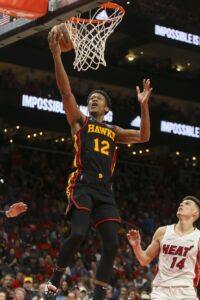 Hunter clearly worked hard on his game entering year two, as he got off to a great start, averaging 17.9 PPG and 5.6 RPG on a stellar .517/.375/.877 (.646 true) shooting line in 17 games (33.3 MPG). Unfortunately, things went downhill from there, as right knee discomfort and swelling ultimately led to arthroscopic surgery and multiple setbacks, causing Hunter to miss all but five games the rest of the regular season.
He did appear in all five games of Atlanta’s first-round playoff victory over the Knicks, but didn’t look like the same player. Hunter underwent surgery to repair a torn lateral meniscus in the same knee shortly thereafter.
Last season, Hunter had a slow start, not quite looking like himself after the meniscus tear. On November 8, he sustained a tendon injury on his right wrist, which required surgery and caused him to miss eight weeks of action (26 games).
Overall, he averaged 13.4 PPG and 3.3 RPG on .442/.379/.765 shooting (.547 true) in 53 games (29.8 MPG). The Hawks were very banged up at the end of the year, causing them to be overmatched in their first-round playoff loss to the Heat, but Hunter was the team’s best performer – he averaged 21.2 PPG and 3.8 RPG on .557/.462/.800 shooting (.674 true).
Strengths:
During that 17-game stretch to start ’20/21, Hunter legitimately looked like he could be a future All-Star, using his length and athleticism to aggressively drive to the hoop. Even though the Hawks lost the game, he had a memorable performance against the eventual champion Bucks, scoring a career-high 33 points on 13-of-21 shooting while fearlessly attacking Giannis Antetokounmpo.
Hunter has plus size for a forward at 6’8″ and 225 pounds with a 7’2″ wingspan, and he’s versatile on both ends of the court. He’s often tasked with guarding the opposing teams’ best perimeter scorers, as Atlanta has lacked reliable wing defenders.
The 24-year-old was a high draft choice in large part due to his defensive upside, and while he shows flashes of being a plus defender, he lacks the consistency necessary to be a true defensive force. The talent is definitely there though, and that’s something you can’t teach.
Hunter gets to the free throw line at a good rate, can score in a variety of ways, and was an above-average three-point shooter in ‘21/22 (37.9%). Nearly all of his attempts from long distance came via catch-and-shoot, and he converted a career-best 40.5% from the corners.
Improvement Areas:
Consistency is the name of the game for Hunter. He has shown flashes of high-level two-way potential, but he hasn’t been able to string it together consistently for any sustained period of time.
Losing time to injuries is out of his control, but it has certainly had an effect on his performance the past couple of years. In order to land a big pay day, he needs to prove that he can stay healthy.
Hunter is a below-average rebounder, and there’s no reason he can’t be better at his size. An average of 3.3 boards per game is unacceptably low for a forward. Even though he’s a versatile scorer, he only shot 55% at the rim last season — 23rd percentile of all players, per DunksAndThrees.com.
He’s also a poor play-maker, recording more turnovers (69) than assists (68) in ‘21/22. Hunter’s 6% assist percentage was only in the 12th percentile. There’s a lot of room for improvement there.
Conclusion:
Out of all the players eligible for rookie scale extensions in 2022, Hunter’s market value is one of the most difficult to gauge due to his injury history and inconsistent play. He definitely has a lot to prove in the upcoming season, both for his own future and to the Hawks.
They’re very different players, but maybe someone like Thunder wing Luguentz Dort works as a point of comparison for Hunter – Dort signed a five-year, $82.5MM deal with a fifth-year team option as a restricted free agent this offseason. Dort is a better defender, but Hunter has more offensive upside.
Since he isn’t getting a maximum-salary deal, Atlanta can only offer Hunter four years in an extension. Dort got $64.78MM guaranteed over four years, with an additional $1MM in annual unlikely incentives.
Sources told Jake Fisher of Bleacher Report in July that the Hawks and Hunter’s agents were approximately $20MM apart in their extension discussions. Making an educated guess, I would wager Atlanta was offering around $60MM – perhaps with additional incentives tied to games played – and Hunter was looking for around $80MM.
Hunter could easily outplay a $15MM-per-year contract, but he hasn’t shown he’s worth even that much yet. Analytics are really low on Hunter’s game – I’m more bullish on his potential, assuming he can stay healthy.
I don’t see any reason for the Hawks to budge in what they’re willing to offer, and given his injury history, there are valid reasons for Hunter to consider signing a relatively team-friendly deal. If he turns down an extension and has a breakout fourth season, that’s a good problem to have for Atlanta, because he’d be providing excess value on the final year of his rookie deal and would make it an easier decision to invest in him long term.
Cavaliers Notes: Mitchell, Offseason Moves, Coaching Changes
What are the Cavaliers getting in newly-acquired star Donovan Mitchell? Cavs beat writer Kelsey Russo recently spoke to Jazz beat writer Tony Jones about that topic in an article for The Athletic.
Jones expects Mitchell’s efficiency to improve playing alongside a talented core of Darius Garland, Evan Mobley and Jarrett Allen, and he believes his off-court fit will be seamless. Mitchell is an excellent three-level scorer and strong ball-handler who is able to manipulate defenses at a high level, Jones writes.
According to Jones, having less of an offensive burden should help Mitchell on the defensive end, where he’s been a net negative and “needs to get better and more competitive.” Jones also states that Mitchell has been working hard this offseason to get in better shape, which played a factor in his poor defense in the playoffs against Dallas last season.
Russo mentions the fact that Mitchell has extensive playoff experience, which Cleveland’s roster lacks. Jones notes that Mitchell’s ability to blow past defenders off the dribble is extremely valuable in the postseason, and he’s had some memorable performances against elite competition.
Here’s more from Cleveland:
- The Cavs rose to No. 8 in David Aldridge of The Athletic‘s re-ranking of offseason moves that improved teams the most. According to Aldridge, the Cavaliers took a big swing, but it could create a window of contention that the team hasn’t had without LeBron James in a couple of decades.
- Sources tell Chris Fedor of Cleveland.com (Twitter link) that the Cavs will be making a couple of changes to their coaching staff for 2022/23. Mike Gerrity, formerly a player development coach with the Cavs, will become the new head coach of their G League affiliate, the Cleveland Charge, while former Charge head coach Dan Geriot is heading back to the Cavs as an assistant. The Charge confirmed that Gerrity will be their new head coach in a press release.
- In case you missed it, Fedor reported on Wednesday that Cleveland was hosting several players for free agent workouts this week, including Armoni Brooks and Kelan Martin.
Poll: Dennis Schröder’s Next Team
Veteran point guard Dennis Schröder, currently playing for the German national team in EuroBasket action, is the only unrestricted free agent left on our list of the top 50 NBA free agents of 2022.
It’s hard to believe we’re only a year-and-a-half removed from Schröder reportedly turning down an extension from the Lakers worth $80MM+. Last summer he had to settle for a one-year, $5.9MM deal with the Celtics, who eventually traded him to the Rockets in February.
In 64 games (28.7 MPG) split between Boston and Houston during the 2021/22 season, Schröder averaged 13.5 PPG, 3.3 RPG and 4.6 APG on .431/.344/.853 shooting — solid production. Still, when a team trades you away in the middle of an extended hot streak and goes on to make the NBA Finals, that raises some red flags.
Schröder, who turns 29 next week, remains a talented scorer and is a plus ball-handler who can set up both himself and teammates. His ability to create shots is a valuable skill. And it’s not as though he’s past his peak physically — he’s still one of the quickest players in the league.
He’s not without flaws, however, as he’s an inconsistent outside shooter whose defensive effort often fluctuates. He also skews a little on the selfish side, preferring to look for his own shot, even though he’s a good passer when he’s so inclined.
More than two months into free agency, there aren’t many teams with roster openings, so the odds of Schröder landing a deal for more than the veteran’s minimum seem remote. Having said that, I’d be shocked if he doesn’t find a team before training camps start later this month.
Things have been pretty quiet on the rumors front. Marc Stein reported that the Lakers were giving “legit consideration” to signing Schröder a couple of weeks ago, but then they traded for Patrick Beverley, making a reunion more uncertain. A couple of high-ranking Mavericks executives recently watched Schröder compete, and Stein subsequently wrote the Mavs have considered adding a veteran ball-handler, but Dallas might not want to carry a 15th roster spot right away due to the luxury tax. All the other rumors about Schröder are months old.
Even though they haven’t been linked in any way that I’m aware of, the Hornets might make the most sense as a potential match. They only have 13 players on guaranteed deals and don’t have a backup point guard behind LaMelo Ball at the moment.
The Suns and Hawks could also be a fit. Both teams only have 13 players on guaranteed deals. Phoenix has Chris Paul and Cameron Payne at the point, but Paul is one of the oldest players in the league and Payne is coming off a down season. Schröder spent his first five seasons with the Hawks, but they already have Trae Young, Dejounte Murray and Aaron Holiday, so minutes might be harder to come by there.
With training camps less than three weeks away, we should learn pretty soon where Schröder will be headed — assuming he finds a team. In the meantime, we want to know what you think. Which team will sign Schröder in the coming weeks?
Vote in our poll, then head to the comment section below to share your two cents!
Which team will sign Dennis Schröder?
-
Mavericks 30% (581)
-
Lakers 18% (358)
-
Other team 16% (321)
-
Hornets 12% (241)
-
Won't be on an NBA team 11% (215)
-
Suns 10% (196)
-
Hawks 2% (46)
Total votes: 1,958
Mavericks, Knicks Eyeing Bojan Bogdanovic
The Mavericks and Knicks are among the teams with interest in Jazz veteran Bojan Bogdanovic, according to John Gambadoro of Arizona Sports 98.7 FM (Twitter link), who states that Utah is looking for draft picks and players on expiring contracts in return.
In addition to Dallas and New York, Gambadoro reports that the Lakers and Suns remain interested in the sharpshooting forward, but he notes that the Jazz might not have as much interest in Phoenix’s first-round picks because they are expected to be one of the top teams once again in 2022/23 after having the NBA’s best record last season (64-18).
The Lakers’ interest in Bogdanovic has been well-documented, and Gambadoro reported a week ago that the Suns inquired about his services as well. Bogdanovic, who is on a $19.55MM expiring contract, is a talented scorer and shooter, averaging 18.3 PPG and 4.1 RPG on .461/.403/.860 shooting over the past four seasons. He’s currently competing in EuroBasket action with the Croatian national team.
If the Jazz are looking for expiring deals, the Mavs don’t have a clean one-for-one fit for salary-matching purposes. Reaching an extension agreement with Maxi Kleber rules him out, and it’s highly unlikely that they’d consider moving Christian Wood after just acquiring him in June.
That only leaves Dwight Powell‘s $11MM expiring deal, plus former first-rounder Josh Green and Frank Ntilikina to match salaries. Green has a team option for $4.77MM in ’23/24.
The Knicks could pull it off a little easier, at least in theory, by trading Derrick Rose‘s $14.5MM pseudo-expiring contract (team option in ’23/24) plus someone like Cam Reddish, who will make $5.95MM in the final season of his rookie deal.
As Gambadoro mentioned, either package would have to include draft picks to land the highly-coveted forward.
The Jazz are in the midst of a full-fledged rebuild after trading their two best players, three-time All-Stars Rudy Gobert and Donovan Mitchell, plus veterans Royce O’Neale and Patrick Beverley. They’ve targeted first-round picks and/or young players in all four deals.
Extension Candidate: Cameron Johnson
This is the third installment in our series examining players who are prime candidates for contract extensions. This series will explore the player’s strengths and weaknesses, and will evaluate what a fair deal between the player and his team might look like. We’re continuing today with a look at a former lottery pick who was an important role player for a 64-win team last season.
Rundown:
The Suns shocked a lot of people by selecting Cameron Johnson with the No. 11 overall pick of the 2019 draft, as many scouts had him rated as a late first-rounder. He was technically drafted by the Timberwolves, who traded him along with Dario Saric to acquire the No. 6 pick, used on Jarrett Culver – an unmitigated disaster of a deal for Minnesota.
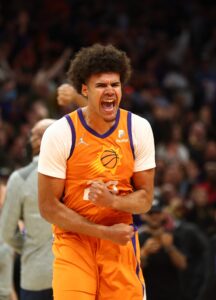 Part of the reason Johnson was rated lower than where he was drafted was that he was an older prospect. After receiving a redshirt for his freshman year, he wound up playing a full four years afterward – he spent his first few college seasons with Pittsburgh before transferring to North Carolina.
Johnson quickly quieted those critical of the move with a solid rookie season in 2019/20, appearing in 57 games (22.0 MPG) while averaging 8.8 PPG and 3.3 RPG on .435/.390/.807 shooting (.586 true shooting percentage).
His statistics were quite similar in year two: 9.6 PPG and 3.3 RPG on .420/.346/.847 shooting (.563 true) in 60 games (24.0). He was even better during Phoenix’s lengthy postseason run to the Finals, providing a ton of value with his sharpshooting – in 21 playoff games (21.1 MPG), he averaged 8.2 PPG and 3.1 RPG on .500/.466/.906 shooting (.693 true – a phenomenal mark).
Johnson had a breakout third season in ‘21/22, finishing third in Sixth Man of the Year voting after appearing in 66 games (26.2 MPG) with averages of 12.5 PPG and 4.1 RPG on .460/.425/.860 shooting. Among non-centers who averaged at least 12 PPG in 50 or more games, Johnson was fourth in the league in true shooting percentage (.625), trailing only Kevin Durant, Giannis Antetokounmpo and teammate Mikal Bridges.
Despite a disappointing second-round loss to Dallas, the 26-year-old had another strong individual playoff showing offensively last season, putting up 10.8 PPG and 3.5 RPG on .465/.373/.813 shooting (.619 true) in 13 games (24.6 MPG).
Strengths:
Johnson has proven to be a very efficient role player, and more than worthy of his draft slot. His shooting creates space for teammates, which is always valuable.
While he’s primarily known for his outside shooting, which he’s very good at (39% career from three, including 43.8% from the corners), Johnson is an underrated finisher as well. He shot 71% at the rim last season, which was in the 88th percentile of all players, per DunksAndThrees.com.
Johnson is a very self-aware player, particularly on offense. He doesn’t try to do too much, which is a good thing for a complementary player – his 6.7% turnover percentage was the 11th-best mark in the NBA in ‘21/22, per Basketball-Reference. He isn’t asked to make plays for others very often, but he makes quick decisions if he isn’t open and is a willing passer – his career assist-to-turnover ratio is 2.13-to-1, which is a strong mark for a forward.
Phoenix’s offense, which ranked fifth in the league last season, could really soar if head coach Monty Williams gives Johnson a bigger role – he thrived in 16 games as a starter in place of Jae Crowder, averaging 16.3 PPG and 4.9 RPG on .492/.420/.912 shooting (.659 true).
Improvement areas:
At 6’8″ and 210 pounds, Johnson is slender for a power forward, his primary position. He lacks the strength to defend stronger players down low – Luka Doncic repeatedly exploited that fact during the playoffs.
Most advanced stats rated Johnson as a slightly above average defender, but that doesn’t pass the eye test – in most matchups he’s not a liability, but I think he’s closer to league average than above. He does certain things well – he’s pretty quick on his feet, does a good job of staying vertical when contesting shots, and rarely commits fouls.
However, he’s a below average rebounder, and while opponents shot 1.0% worse than expected with Johnson defending them during the regular season, they shot 3.3% better than expected in the playoffs, per NBA.com. Forcing turnovers isn’t the be-all and end-all when it comes to defense, but Johnson isn’t very good at that either – he recorded 0.9 steals and 0.2 blocks per game in ‘21/22.
Adding strength would help a lot, on both ends of the court. He’s already a very good finisher, but he doesn’t get to the free throw line much – adding some muscle would aid him in that regard. And while he’s a smart decision-maker, his ball-handling is pretty mechanical.
Conclusion:
Johnson is going to land a big payday on his next contract, the only question is when and from whom. As was the case with Deandre Ayton, luxury tax concerns will likely limit Phoenix’s interest in giving Johnson a hefty long-term extension (the Suns matched Ayton’s four-year maximum-salary offer sheet from the Pacers, but they could have given him more money – and an additional year – and chose not to).
If I were representing Johnson, I wouldn’t accept a team-friendly discount in the range of $60MM over four years, because he’d provide value to any NBA team with his highly efficient offensive game and (mostly) adequate defense. Whether he might be open to that is something only he knows.
The Spurs’ Keldon Johnson received a four-year extension with a base value of $74MM, and even though he’s four years older, I think Cameron will end up getting a deal similar to that. Despite the possibility of facing the repeater tax, I would imagine Phoenix would match a contract in that range when Johnson reaches restricted free agency next summer, but I’d be a little surprised if they offer it in an extension before the season starts.
If his agents try to point to his teammate Bridges as a reference point, I think that would be a mistake – Bridges is in a completely different class as a defender and is a better overall player. He received a four-year, $90MM extension from the Suns prior to last season, so I think Johnson will get less than that. Something in the range of $70-80MM sounds about right.
Lakers Notes: Nunn, Backcourt, Westbrook, Outlook
Lakers guard Kendrick Nunn was recently cleared for increased contact in workouts, league sources tell Jovan Buha of The Athletic. Head coach Darvin Ham told reporters, including Buha, that Nunn has primarily been working on individual drills and working out in the weight room.
According to Buha, Ham also said that Nunn, Austin Reaves and Lonnie Walker are all in consideration for the starting lineup, and the trio will have “notable roles.”
Nunn, who missed all of last season with a knee issue, said he was “100%” healthy back in July, but subsequent reports from Buha have cast a cloud on his status. Still, additional contact was an important hurdle to clear for the 27-year-old, so we’ll see if he’s ready to go once the season starts next month.
Here’s more on the Lakers:
- The “combustible” pairing of Patrick Beverley and Russell Westbrook could provide the spark necessary to ignite the Lakers, or it could blow up in their faces, opines Mirjam Swanson of The Southern California Newsgroup (subscriber link). As Swanson observes, both players are well-known for being stubborn, and their previous run-ins have been well documented. Everyone in L.A. is saying the right things right now, but only their on-court play and actions will prove whether the backcourt pairing will work or not, Swanson adds.
- Westbrook needs to reinvent his game in order to make things work with the Lakers, argues Dylan Hernandez of The Los Angeles Times. Westbrook’s refusal to adjust his playing style was a primary reason why he fit so poorly with the team last season, Hernandez notes. Asking him to make drastic changes this late in his career might not be fair to the former MVP, but he’ll have to play much better defense and make offensive adjustments for the team to find success in year two, Hernandez writes.
- League insiders are pretty skeptical regarding the Lakers’ outlook for the 2022/23 season, according to Eric Pincus of Bleacher Report. One common thread brought up by the insiders was that the defense might not be good enough to hold up the poor shooting of the roster. Only one of the seven insiders Pincus spoke to was confident the Lakers would make the playoffs outright.
Eastern Notes: Harrell, Gafford, Raptors, Pistons
Sixers free agent addition Montrezl Harrell would ideally be used as a situational player rather than a primary backup center, according to Kyle Neubeck of PhillyVoice.com. In 71 games (23.1 MPG) split between the Wizards and Hornets last season, Harrell averaged 13.1 PPG, 6.0 RPG and 2.0 APG while shooting 64.5% from the floor and a career-high 71.6% from the line.
As Neubeck observes, Harrell will not only be reunited with former Rockets teammate James Harden, who reportedly played a major role in recruiting Harrell, but he’ll be playing under Doc Rivers once again as well — his former Clippers head coach.
Harrell won the Sixth Man of the Year award with the Clippers and Rivers a couple of years ago, but struggled defensively in the postseason, and Rivers stubbornly stuck with him. It remains to be seen whether Rivers will be more flexible with his lineups than he has been in the past, Neubeck notes.
The 28-year-old’s distinct strengths (energy, finishing at the rim) and weaknesses (size, defense) make it hard to rely on him in every matchup, but he should be well-positioned for a more defined role behind Joel Embiid, Neubeck writes.
Here’s more from the Eastern Conference:
- Scouts are split in their opinions regarding Wizards center Daniel Gafford due to his inconsistency, per Josh Robbins of The Athletic. Robbins takes an in-depth look at Gafford’s strengths and weaknesses, using video clips and stats, and querying scouts to get a well-rounded take on Gafford’s game and what he might develop into in the future.
- The Raptors didn’t make any splashy offseason moves, and may not be a top contender to come out of the East, but they’re not stuck in the middle either, argues Eric Koreen of The Athletic. Toronto is trying to develop young players while being as competitive as possible, which is a difficult balancing act at times, but the team has successfully managed it in the past, according to Koreen, who adds that the Raptors have consistently exceeded their expected win totals under president Masai Ujiri.
- In a mailbag column for The Athletic, James Edwards III tackles a number of Pistons-related topics. Edwards thinks second-year wing Isaiah Livers is a prime breakout candidate, Isaiah Stewart‘s three-point shooting from Summer League should carry over into the 2022/23 season, and veterans Cory Joseph, Alec Burks, Nerlens Noel and Kelly Olynyk should all have more trade value as the in-season deadline nears.
Trail Blazers Officially Announce Four Camp Signings
The Trail Blazers have officially signed Devontae Cacok, Olivier Sarr, Isaiah Miller and Jared Rhoden, the team announced. All four players, whose deals were previously reported, received Exhibit 10 training camp deals.
Of the group, only Cacok and Sarr hold NBA experience — Cacok has appeared in 36 games in parts of three seasons with the Lakers and Spurs, while Sarr played 22 games with the Thunder last season. Miller went undrafted out of UNC Greensboro in 2021 and spent last season in the G League with the Iowa Wolves; Rhoden is an undrafted rookie out of Seton Hall.
The Blazers have an unusual roster situation for a couple of different reasons. At the end of August, they waived Didi Louzada, using the stretch provision to stay below the luxury tax threshold of $150,267,000. That left the standard 15-man roster with 14 players on guaranteed deals, but even adding a minimum-salary player would push them over the tax line, so that last spot will almost certainly remain open for now (they could sign someone later in the season if they want to, since NBA salaries are prorated).
The second reason the roster situation is unusual is because Portland is one of only two teams without an NBA G League affiliate (the Suns are the other). Ordinarily players signed to Exhibit 10 deals are earmarked as affiliate players, and assuming they’re waived before the regular season, they become eligible for a bonus worth up to $50K.
However, since the Blazers don’t have an affiliate, none of the four players will be eligible for the bonus. Instead, evidently all four will be competing for the club’s lone two-way spot that’s still open — Brandon Williams currently occupies the other. Players on two-way contracts are eligible to appear in up to 50 games, but aren’t eligible for the postseason.
Malcolm Hill Re-Signs With Bulls On Two-Way Deal
Malcolm Hill has re-signed with the Bulls on a two-way contract, reports Shams Charania of The Athletic (via Twitter). According to NBA.com’s transactions log, the deal is already official.
The Bulls extended Hill a two-way qualifying offer at the end of June, so he likely just decided to sign the QO to stick with Chicago.
The 26-year-old Hill was an unusual rookie last year. He went undrafted in 2017 out of Illinois and played internationally in the Philippines, Germany, Kazakhstan, and Israel prior to returning stateside.
Hill initially signed a training camp deal with the Pelicans prior to the 2021/22 season, but was waived before the season started and spent time with the team’s G League affiliate, the Birmingham Squadron. In December of last year, he signed a 10-day hardship contract with the Hawks, appearing in three games.
After Hill’s 10-day deal with Atlanta expired, he caught on with Chicago, initially signing a 10-day hardship deal before inking a two-way contract. Hill appeared in 16 games (10.4 MPG) with the Bulls, averaging 3.4 PPG and 1.8 RPG on .432/.323/.700 shooting.
The 6’6″ wing had a bigger role and put up better stats for Chicago’s G League affiliate, the Windy City Bulls, averaging 18.1 PPG, 7.0 RPG and 3.1 APG on a stellar .500/.396/.875 shooting line in eight games (33.1 MPG). Hill most recently suited up for the Bulls’ Summer League squad, averaging 13.0 PPG and 3.8 RPG on .465/.474/.889 shooting in five games (25.0 MPG), per RealGM.
The Bulls have 15 players signed to guaranteed standard contracts and both two-way spots now filled, so their roster is already full heading into training camp. Any future signings will likely be Exhibit 10 deals with the option of being converted to two-way contracts — Justin Lewis‘ two-way spot might be vulnerable after he unfortunately suffered a torn ACL last month.