
Extension Candidate: Jordan Poole
This is the second installment in our series examining players who are prime candidates for contract extensions. This series will explore the player’s strengths and weaknesses, and will evaluate what a fair deal between the player and his team might look like. We’re continuing today with a look at a player who was a key contributor to a championship team in 2022.
Rundown:
The 28th overall pick of the 2019 draft after two years at Michigan, Jordan Poole had a larger-than-expected role as a rookie due to major injuries to Warriors stars Stephen Curry and Klay Thompson. Unfortunately, he struggled mightily in his first pro season, appearing in 57 games (22.4 MPG) while averaging 8.8 PPG, 2.1 RPG and 2.4 APG on a ghastly .333/.279/.798 shooting line. His .454 true shooting percentage was last in the entire NBA, as was his -6.6 box plus/minus.
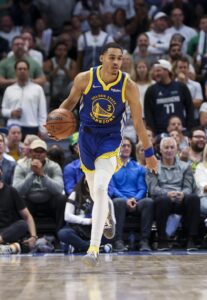 Things weren’t much better for Poole during the first few months of his second season in 2020/21, appearing in just 15 of Golden State’s first 36 games and receiving scant playing time (9.6 MPG). Since he wasn’t getting much NBA run, he was sent to the G League in February 2021 to work on his craft.
Poole displayed a newfound confidence and looked like a completely different player upon his return a month later, emerging as a major spark-plug scorer off the bench. Over his final 36 games (23.5 MPG), he averaged 14.7 PPG, 2.1 RPG and 2.4 APG on .433/.354/.870 shooting (.579 true).
In year three, Poole built upon the foundation he laid during that strong second half surge, appearing in 76 games (30.0 MPG) while averaging 18.5 PPG, 3.4 RPG, 4.0 APG on .448/.364/.925 shooting. He started 51 of those contests in the backcourt alongside Curry.
Out of all guards who averaged at least 18 points per night, Poole ranked fifth in true shooting percentage at .598 – an excellent mark. His .925 free throw percentage led the NBA.
More importantly, he was also a standout performer in the postseason, averaging 17.0 PPG, 2.8 RPG and 3.8 APG on .508/.391/.915 shooting (.654 true) in 22 games (five starts, 27.5 MPG) during Golden State’s title run.
Strengths:
Poole is an extremely shifty ball-handler who can create space for himself and teammates with ease. While he has a strong first step, what really separates Poole from other ball-handlers is how quickly he can change direction and how decisive he is – if he gains even a slight advantage, he goes straight to the hole.
Another element of Poole’s ball-handling that’s really impressive is that he has counter moves upon counter moves. He can string together a combination of intricate dribble moves in just a second or two, and even if the defender stops the first couple, he might unleash a crossover that leads them reaching on the third.
The 23-year-old is just as comfortable dribbling with his left hand as his right, and doesn’t really show a preference, which makes it really difficult to try to guess which way he’s going to go.
Poole isn’t the most explosive athlete vertically, but he’s very fast with the ball in his hands and excels in the open court. He’s a talented finisher around the basket, converting 62% of his looks at the rim — an above average mark (55th percentile, per DunksAndThrees.com). Many of those shots are very high-difficulty attempts as well.
Poole is an excellent scorer from all over the court. While he didn’t attempt many mid-rangers, he knocked down 46% of those looks (78th percentile). A big part of why he was so efficient is because the majority of his shots came either at the rim or from deep – he also gets to the line at a decent clip.
He employs side-steps and step-backs to create space for three-pointers, and 3.0 of his 7.6 attempts per game from deep came off the bounce, per NBA.com. He’s slithery coming off screens, and he’s very smart about using the screen a second time to free himself for a better look or a drive.
As with all of his teammates, Poole certainly benefits from all the attention Curry draws, but he’s perfectly capable of scoring in bunches on his own. During the last 12 games of the regular season, when Curry was injured, Poole averaged 25.8 PPG, 5.0 RPG and 6.2 APG on .421/.374/.954 shooting (.586 true) and didn’t look out of place as a primary option.
Poole is also a solid passer when he’s so inclined, though he definitely has a score-first mentality – his 21% assist percentage was in the 80th percentile, per DunksAndThrees.com.
Improvement Areas:
Poole has been a below average defensive player to this point in his career, and in order for him to take another leap as a player, he needs to get better.
According to NBA.com, opponents shot 1.7% better than their expected field goal percentage with Poole defending them — the second-worst mark on the Warriors — and that’s with the team trying to hide him on weaker offensive players. That figure rose to 4.7% better than expected in the playoffs.
Poole doesn’t really excel at anything on defense. He isn’t strong individually or as a help defender, and he doesn’t force many turnovers (0.8 steal and 0.3 block per night).
Poole was definitely a beneficiary of having several strong defenders around him – the Warriors had the second-best defense during the regular season, and that was their main collective strength in winning the championship.
He’s also a below average rebounder, pulling down just 3.4 per night, and at 6’4” he could stand to bump that number up closer to five, though it’s something he’s never been great at, even in college.
Another area of Poole’s game that needs work is his decision making. His 1.39-to-1 assist to turnover ratio in ‘21/22 was quite poor for a high usage player, especially someone who handles the ball as much as he does.
Lastly, while Poole has very deep range and certainly doesn’t lack in confidence, his 36.4% mark from three was only one percent above league average. If that number rises even a little bit, it would help his already very good efficiency.
Conclusion:
Poole’s statistics last season were fairly similar to Tyler Herro’s, and like Herro, I think Poole is almost certain to receive a nine-figure payday on his next contract. Since he was a late first-rounder, he has “only” earned a little over $6MM to this point. The prospect of receiving $100MM+, assuming the Warriors offer it, would undoubtedly be appealing.
When comparing Poole, Herro and the other young guards who set the market value this summer (Anfernee Simons, Jalen Brunson and RJ Barrett all received $100-107MM in guaranteed money over four years), I personally think Poole might have the highest upside. But that doesn’t mean he’ll get the most money of the group, particularly in a theoretical extension.
The primary reason the Warriors might be hesitant to give Poole a lucrative extension is that they’re already a record-setting taxpayer, and they’d owe significantly more in taxes than the actual value of his salary. It would also lock in an extremely expensive roster for years to come.
There’s an argument to be made that Poole is a luxury, not a necessity, especially with Thompson healthy for a full season – I don’t buy that argument, but it’s not entirely baseless. The front office might have to choose between paying just one or two of Poole, Draymond Green or Andrew Wiggins, and all were very valuable contributors last season who are good at different things, so it would be a tough call.
If Poole bets on himself and declines an offer for, say, $110MM — which would carry a good deal of risk since he doesn’t have a long track record (plus injuries are always a concern) — there’s a chance he could get a max deal as a restricted free agent in 2023, which is projected to be worth $142,975,000 over four years.
Extension Candidate: Tyler Herro
This is the first installment in our series examining players who are prime candidates for contract extensions. This series will explore the player’s strengths and weaknesses, and will evaluate what a fair deal between the player and his team might look like. We’re getting underway with a look at the NBA’s reigning Sixth Man of the Year.
Rundown:
The No. 13 overall pick of the 2019 draft after one year at Kentucky, Tyler Herro made an immediate impact in 55 games (27.4 minutes) as a rookie, averaging 13.5 points, 4.1 rebounds and 2.2 assists on .428/.389/.870 shooting for a Heat team that came within two games of a championship. He had a strong playoff run in the Orlando bubble, bumping those averages up to 16.0 PPG, 5.1 RPG and 3.7 APG on .433/.375/.870 shooting in 21 contests (33.6 minutes).
Herro improved his counting stats during his second season in ‘20/21, averaging 15.1 points, 5.0 rebounds and 3.4 assists, though his efficiency declined slightly, with a .439/.360/.803 shooting line. As opposed to his strong postseason showing as a rookie, Herro, like the rest of Miami’s roster, struggled mightily while being swept by the Bucks in the first round, averaging just 9.3 PPG, 3.3 RPG and 1.8 APG on .316/.316/1.000 shooting in four games (23.3 minutes).
Herro emerged as the league’s most dangerous bench scorer last season, winning the Sixth Man of the Year award after appearing in 66 games (32.6 minutes) while averaging 20.7 points, 5.0 rebounds and 4.0 assists on .447/.399/.868 shooting. However, he once again struggled in the playoffs with defenses more focused on slowing him down, averaging 12.6 PPG, 3.9 RPG and 2.8 APG on .409/.229/.926 shooting in 15 contests (25.4 minutes).
Strengths:
Among players who officially qualified, Herro ranked 21st in the NBA in points per game last season. He is someone opposing defenses are forced to game-plan against.
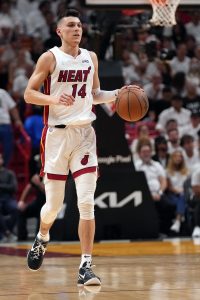 His primary skill is that he’s an excellent shooter from all over the court, ranking in the 63rd percentile from mid-range, 87th on threes, and 87th from the free throw line, per DunksAndThrees.com.
The threat of Herro’s shooting creates space for teammates, which is really important for a Heat team that struggles at times to space the floor. For as valuable as they are at basically every other aspect of basketball, neither Jimmy Butler nor Bam Adebayo is a three-point threat, so Miami’s offense can be a bit crowded at times, especially in half court settings.
Herro isn’t just a shooter either, as he shows some impressive play-making chops at times. He’s capable of creating high-quality looks for himself and others on both scripted plays and on the fly.
He posted a 21% assist percentage last season, which was in the 79th percentile of all players. He has good vision and is capable of making difficult one-handed cross-court passes, though he definitely looks for his own shot more often than not.
Herro is capable of acting as a lead ball-handler in spot minutes, and while he isn’t the greatest decision-maker yet (1.5-to-1 assist-to-turnover ratio), he shows flashes of being able to handle those duties. He’s also a solid rebounder, especially on the defensive glass, with a 15% defensive rebounding rate (59th percentile).
Improvement Areas:
Physical limitations will likely always be an issue for Herro, which is something that’s mostly out of his control. Though he has decent height for a shooting guard at 6’5”, his wingspan is only 6’4”, he isn’t the greatest athlete, and he isn’t the strongest player, leading to him getting pushed around at times.
Those limitations show up in two key areas. The first is that he’s a below-the-rim finisher, and while he has good touch on floaters, he rarely gets all the way to the rim.
According to Basketball-Reference, only 13.7% of Herro’s shots came within three feet of the basket, compared to 27.9% of his looks from 10 feet to the three-point line. He prefers to shoot pull-ups rather than initiating contact in the paint.
The fact that he attempts so many mid-rangers and doesn’t get to the line a ton hurts his overall efficiency (of the 27 players who qualified for the scoring title and averaged at least 20 points, Herro was 25th in free throw attempts). His true shooting percentage (56.1%) was a little below league average (56.6%) last season.
The second area that Herro really needs to improve upon is his defense, which has been particularly problematic in the playoffs. He has been repeatedly targeted as a weak defensive link in each of his three postseason trips.
Opponents shot better (45.7%) than expected (44.8%) with Herro defending them in the regular season, and that gap grew during the playoffs (rivals shot 48.9% versus 46% expected), per NBA.com. And that’s with Herro coming off the bench and the Heat trying to hide him on the opposing teams’ weakest offensive players.
Out of 67 players who averaged at least 32 minutes and appeared in at least 30 games, Herro ranked 62nd in deflections per game with 1.2. He rarely draws charges, and averaged less than one stock (steals plus blocks) per game last season, which is quite poor (0.7 SPG and 0.1 BPG). His steal percentage (1.0%) ranked in the 21st percentile of all players, and his block percentage (0.4%) was in the ninth percentile, per DunksAndThrees.
Conclusion:
Young players are inherently polarizing because they are not finished products. When you watch them play, you’re ideally looking for positive traits that can be translated into future success, but it’s easy to lose sight of that if they’re on a good team and play a big role.
That’s especially true of Herro, even if it’s a little unfair to someone who’s still only 22 years old. More than most former first-round picks still on their rookie deals, Herro is an eye-of-the-beholder player due to his distinct strengths and weaknesses, some of which have been put under a bigger spotlight because of his team’s success.
Anfernee Simons set the market for emerging young guards this summer with a four-year, $100MM deal as a restricted free agent. That’s probably Herro’s floor for his next contract.
If the Heat believe Herro will continue improving and is worthy of a significant long-term investment, I could see him exceeding RJ Barrett’s deal with the Knicks, which is reportedly worth $107MM guaranteed over four years with unlikely incentives pushing it up to a possible $120MM.
If they want to continue to keep their options open and possibly deal him during the season, the Heat would be wise not to extend Herro to avoid the “poison pill provision,” which would make trading him extremely difficult. Miami would still have the ability to match any offer he might receive as a restricted free agent in 2023.
The risk of not extending him, assuming his agents are open to accepting less than a maximum-salary deal right now, is there’s a non-zero chance he gets a max as a restricted free agent next summer. A four-year maximum contract from a rival team is projected to be worth $142,975,000.
Giving Herro around $30MM a year would lock in an expensive core of Butler, Adebayo, Herro and Kyle Lowry for at least the next two seasons (Lowry is a free agent in 2024). Having said that, extending Herro now could make moving him in the 2023 offseason easier for the Heat in some ways – he’d already be trade-eligible, and his larger contract would make salary-matching for another star less tricky than it is on the end of his rookie deal.
Trade Breakdown: Patrick Beverley To Lakers
This is the tenth installment in our series breaking down the major trades of the 2022 offseason. As opposed to giving out grades, this series will explore why the teams were motivated to make the moves. Let’s dive into a deal between the Lakers and Jazz…
On August 25, the Jazz traded Patrick Beverley to the Lakers in exchange for Talen Horton-Tucker and Stanley Johnson. Both Beverley and Johnson are on expiring deals, while Horton-Tucker has a player option for 2023/24.
The Lakers’ Perspective:
Marc Stein reported last week that the Lakers were initially reluctant to trade Horton-Tucker for Beverley as the front office was emphasizing youth and athleticism to revamp the roster after a disappointing ‘21/22 season that saw L.A. go 33-49 and miss out on the postseason. However, after LeBron James signed an extension, the team felt more comfortable making a win-now move to improve its roster.
Horton-Tucker is still just 21 years old, so he certainly has some untapped upside. The problem is, while he possesses some unique attributes, he needs the ball in his hands to be most effective on offense, and with ball-dominant players like James and Russell Westbrook on the roster, those opportunities were always going to be limited.
Complicating matters further is the fact that Horton-Tucker has been a poor outside shooter to this point (26.9% on three-pointers last season, 27.6% for his career), which hurt the team’s offensive spacing. He has the tools to be a good defender, but he was inconsistent on that end as well, which isn’t unusual for a young player.
Johnson was mainly included in the deal for salary-matching purposes, as the Lakers needed to add another $75K to Horton-Tucker’s salary to make the trade legal. He played with good energy and effort last season, but he’s a very limited offensive player who is about league-average defensively, so it’s not like he’ll be sorely missed.
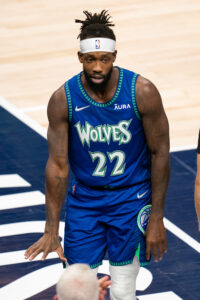 At 34 years old, Beverley is probably past his peak, but he’s certainly a short-term upgrade and a much better fit for the way the Lakers’ roster is constructed. He’s the exact type of guard who has typically thrived alongside James throughout his career, fitting the mold of a three-and-D player who doesn’t need the ball to be effective.
Beverley certainly isn’t the most talented scorer, with a career average of 8.8 points per game. But while he has his share of limitations on offense, he’s self-aware and typically doesn’t try to do too much, which is a valuable trait in a role player.
Beverley holds a career mark of 37.8% from beyond the arc, which is above average, and he’s even better from the corners, nailing 40% of those shots in his career. Corner threes are particularly important for floor spacing, so he should help in that regard.
Beverley also takes care of the ball, posting a 3.54-to-1 assist-to-turnover ratio in ’21/22, and is a tenacious offensive rebounder, creating extra possessions seemingly out of nowhere.
Defense has been Beverley’s calling card throughout his career and is the main reason why he’s about to enter his 11th NBA season. He has been selected to three All-Defensive Teams, the last coming in ’19/20, and though he isn’t quite as good as he once was, he’s still a major backcourt upgrade on that end.
Beverley also brings a relentless energy, effort, toughness and competitiveness that’s hard to quantify with stats, but is certainly impactful. That’s part of the reason why his teams have made the postseason in eight of his ten seasons.
A hard-nosed (at times reckless) playing style has led to Beverley sustaining several injuries, which has to be a significant concern for the Lakers after having James and Anthony Davis miss significant chunks of the last two seasons. Over the past five years, Beverley has appeared in just 235 of a possible 390 regular season contests, which is just over 60%.
Beverley’s expiring deal will pay him $13MM in ‘22/23, and the Lakers will hold his Bird rights, so they’ll be able to go over the salary cap to re-sign him next summer if both parties are amenable to that arrangement.
The Jazz’s Perspective:
Prioritizing minutes for an aging veteran when your team is in the midst of a full-fledged rebuild — a direction made even more evident by trading Donovan Mitchell to Cleveland — doesn’t make sense, and the Jazz realized that pretty quickly, moving on from Beverley less than two months after landing him in the Rudy Gobert blockbuster with Minnesota.
That’s not to say Utah didn’t value Beverley, but he’s a player who actually helps you win games, and the Jazz appear to be trying to lose as many games as possible next season to get the best chance of landing a top prospect like Victor Wembanyama.
What does make sense is taking an upside swing on a developmental prospect like Horton-Tucker, who was one of the youngest players in his draft class (46th overall pick in 2019). Now entering his fourth season, Horton-Tucker is still younger than several incoming rookies, including No. 14 overall pick Ochai Agbaji, whom the Jazz just acquired in the Mitchell deal.
As previously mentioned, Horton-Tucker (also known as THT) has some unique qualities. Standing 6’4″ and weighing 234 pounds, he has a broad-shouldered, strong frame. He also possesses a freakish 7’1″ wingspan, and the combination of his strength and length allows him to do some things that other players are not physically capable of.
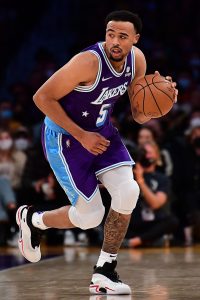 Just because he was a poor fit with the Lakers doesn’t mean he lacks talent, and Horton-Tucker certainly has a chance to be a better player than Beverley ever was. The Jazz are betting that giving him a runway for a bigger role might bring out the best in him, allowing Utah to reap the long-term rewards.
Horton-Tucker is not a three-and-D player, but that’s what the Lakers needed him to be, so that’s the role they asked him to play. He is, however, a skilled play-maker, showcasing a knack for getting into the lane with an array of behind-the-backs, crossovers and spin moves. He’s particularly adept at changing pace on the fly, which is a difficult skill to teach.
A solid but unspectacular athlete, Horton-Tucker’s primary attribute at this point is his ability to get to his spots, especially around the basket, though he hasn’t been the best at converting when he does — he shot 57% at the rim last season, which was in the 31st percentile of all players, per DunksAndThrees.com. Like Beverley, Horton-Tucker is a Chicago native who plays with a physical edge and a level of fearlessness that’s impressive to watch.
He has shown some nascent ability as a passer as well, especially off a live dribble, and could realistically average five-plus assists for Utah considering the lack of quality passers on the roster, especially if Mike Conley is traded. Horton-Tucker is also a solid off-ball cutter, something he was able to showcase a bit more a couple of years ago when playing with Marc Gasol, an excellent passing center who could space the floor.
Horton-Tucker needs work defensively — he has the physical tools to be effective, but he’s prone to mistakes, especially off the ball. He’s often slow to rotate as a help defender and is a little reach-happy on the ball, but those are fixable errors.
THT has an $11MM player option for ‘23/24, and there’s a reasonable chance that he picks it up, depending on how he performs next season. The Jazz will have his Bird rights if they’d like to keep him around.
The eighth pick of the 2015 draft, Johnson hasn’t developed into the player scouts thought he could be, and he’s unlikely to have much of a role for Utah. With the Mitchell deal complete, the Jazz will have 17 players on guaranteed deals, and that number needs to be cut down to 15 by the start of the regular season, so Johnson’s spot on the roster is far from secure.
Neither Horton-Tucker (-0.5) nor Johnson (-0.2) made much of an impact on winning last season, with both ranking in the bottom 100 in the league in value over replacement player, per Basketball-Reference. Beverley, meanwhile, recorded a career-best 1.7 VORP, good for 65th in the NBA.
There are several other advanced stats that indicate the same thing, with Beverley posting more win shares (4.1) than THT and Johnson combined (2.9). Beverley’s estimated plus/minus was +2.0, which ranked 68th in the league, per DunksAndThrees.com, while Horton-Tucker (-2.4, ranked 327th) and Johnson (-1.2, ranked 248th) were both net negatives by that metric. I could go on, but you get the point.
Ultimately, considering the Jazz are trying to lose in ’22/23 and the Lakers are trying to win, it was a logical trade for both sides.
Western Notes: Z. Williams, Suns, Kings, Blazers
Second-year wing Ziaire Williams might be the key for the Grizzlies to become a better mid-range shooting team, writes Damichael Cole of The Memphis Commercial Appeal.
Memphis led the league in points in the paint last season, but seldomly made mid-range jumpers, ranking just 26th in the league during the regular season and last in the playoffs, per Cole. The 6’8″ Williams, meanwhile, is a talented pull-up shooter, with the ability to create his shot in multiple ways, Cole notes.
“I was blessed to have that mid-range, man,” Williams said during Summer League. “We’ve been working on that shot since I was 5 or 6 years old. It’s definitely there for sure, especially with my height and my length. I get that shot off a lot.”
On a very limited volume, Williams shot 48% on mid-rangers as a rookie in 2021/22, which ranked in the 87th percentile of all players, according to DunksAndThrees.com.
Here’s more from the Western Conference:
- Duane Rankin of The Arizona Republic considers several possible free agent targets for the Suns‘ final roster spot, including Carmelo Anthony, Jarrett Culver, Facundo Campazzo, and Ben McLemore, among others.
- Did the offseason moves the Kings made make them a playoff team? Jason Anderson of The Sacramento Bee explores that topic, noting that shooting was a priority and the Kings addressed that need by adding Malik Monk (free agent), Kevin Huerter (trade with Atlanta) and Keegan Murray (No. 4 overall pick). Ultimately, Anderson thinks Sacramento should definitely improve its win total from last season after going 30-52, but landing one of the final spots in the play-in tournament might be a more realistic outcome than breaking the long playoff drought.
- A source tells Marc J. Spears of Andscape (Twitter link) that the Trail Blazers have parted ways with assistant coach Edniesha Curry. Portland confirmed the news (Twitter link via Spears), though the reasoning behind the move was vague. Curry, a former WNBA player, was a first-year assistant in ’21/22.
Lakers Interested In Jazz Vets, Hope To Preserve 2023 Cap Room
The Lakers have “some interest” in Jazz veterans Bojan Bogdanovic, Mike Conley and Jordan Clarkson, but are still trying to maintain their cap room for 2023, according to Jeff Zillgitt of USA Today Sports (Twitter links). The Lakers currently project to have about $30MM in cap room next summer.
As Zillgitt observes, Conley’s $24.36MM salary for 2023/24 is partially guaranteed at $14.32MM, while Clarkson has a player option worth $14.26MM, which may affect how much interest L.A. has in the two guards.
Bogdanovic is on a $19.55MM expiring contract, and several teams are reportedly pursuing the 33-year-old forward, a talented scorer and shooter who has converted at least 38.7% of his three-point tries in each of the last five seasons.
In order to match salaries, Russell Westbrook‘s $47.1MM expiring deal would have to be sent to Utah, because the Lakers don’t have any tradable mid-sized contracts. If they don’t want to take on money beyond next season, a package of Bogdanovic, Malik Beasley and Nickeil Alexander-Walker theoretically works for salary-matching purposes, and all are on expiring or pseudo-expiring deals (there’s a ’23/24 team option for Beasley at $16.52MM).
However, it’s unclear if the Lakers would be interested in that scenario, considering the Jazz might ask for both of the Lakers’ available first-round picks (2027 and 2029). Utah is in the middle of a roster teardown, with a particular emphasis on accumulating unprotected first-rounders.
In other Lakers-related news, Jovan Buha of The Athletic reassesses the team’s depth chart and rotation after acquiring Patrick Beverley from Utah in exchange for Talen Horton-Tucker and Stanley Johnson. Sources tell Buha that Thomas Bryant and Austin Reaves have been “standout performers” in offseason workouts, and Buha currently has both players slotted in the starting lineup at center and shooting guard, respectively.
Heat Notes: Herro, Crowder, Mitchell
With Donovan Mitchell heading to Cleveland, the odds of the Heat giving Tyler Herro a rookie scale extension have seemingly increased, according to Barry Jackson and Anthony Chiang of The Miami Herald.
As Jackson and Chiang write, the Heat were keeping their options open, but with Kevin Durant agreeing to stick with the Nets, at least for now, and Mitchell off the table, there aren’t any obvious star players to target in a trade.
The reason Herro likely hasn’t received an extension to this point is due to the “poison pill provision,” and our Luke Adams actually used Herro as an example of why extending him would make trading him extremely difficult in our updated glossary entry.
If he theoretically received a four-year, $120MM extension, then Herro’s 2022/23 salary of $5,722,116 would count as the Heat’s outgoing salary figure in a trade, but any team acquiring Herro would have to view his incoming value as $25,144,423 — that’s the annual average of the five years and $125,722,116 he has left when accounting for both his current contract and his (hypothetical) new extension.
The Heat have given extensions to players on rookie contracts in the past, including Bam Adebayo, Josh Richardson and Justise Winslow, Jackson and Chiang note.
Here’s more from Miami:
- Jae Crowder remains a possible trade target to upgrade the power forward spot after losing P.J. Tucker in free agency, per Jackson and Chiang, who note Crowder “holds some appeal” to Miami. However, the Suns haven’t indicated they want to move him, and acquiring him would be complicated and require multiple players because the Heat don’t have anyone who is currently trade-eligible to cleanly match Crowder’s $10.18MM expiring salary in a one-for-one deal.
- According to John Gambadoro of Arizona Sports 98.7 FM Phoenix (Twitter link), the Heat never made a formal offer for Mitchell. It’s worth noting that Gambadoro was the first to report that the Cavaliers, who ultimately acquired Mitchell, were pursuing him, so he seemed to have pretty good connections on the situation.
- Meeting Utah’s high asking price for Mitchell reeks of a team “desperate to be relevant,” argues Ira Winderman of The South Florida Sun-Sentinel, who says the Heat didn’t need to acquire the star guard because they’re already relevant. According to Winderman, Durant was worthy of pushing all the chips in the center for because he’s a “generational talent,” but that isn’t the case for Mitchell.
Lonzo Ball Expected To Miss Camp, Doubtful For Start Of Season
Bulls guard Lonzo Ball continues to experience pain and discomfort in his surgically repaired left knee and is expected to miss training camp, sources tell Jamal Collier and Ramona Shelburne of ESPN. According to ESPN’s duo, he’s also considered doubtful for the start of the 2022/23 regular season, which begins on October 18.
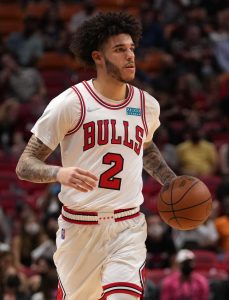 Ball had surgery in January for a torn meniscus and was originally expected to return before the end of last season. However, a bone bruise interfered with his rehab process, and unfortunately it appears as though it might still be impacting his recovery.
According to ESPN’s duo, Ball has seen “multiple specialists” in an effort to determine the cause of the lingering pain and discomfort, and to seek possible treatments. A source tells Collier and Shelburne that Ball’s knee is “structurally sound,” but he continued to struggle with the knee this summer while rehabbing in Los Angeles.
Ball will be evaluated by team doctors in Chicago next week, per ESPN.
The Bulls have been vague regarding Ball’s status throughout the offseason, with coach Billy Donovan and executive VP of basketball operations Arturas Karnisovas saying that he was “progressing” back in July, but they did concede that his recovery was going slower than they’d hoped, and evidently that’s still the case.
K.C. Johnson of NBC Sports Chicago recently said on the Bulls Talk podcast that the team appeared to be a bit more optimistic about the 24-year-old lately, though he cautioned that the situation remained fluid.
“I’m not saying that means he’s out there opening night. I’m not saying he’s playing all 82,” Johnson said. “What I’m saying is the skepticism that was earlier in the offseason has moved a little bit toward the optimism side.”
It sounds as though Johnson’s report is right on the money, with Ball’s status for the season opener very much in jeopardy.
Ball had a major impact on the Bulls when he was healthy last season, averaging 13.0 points, 5.4 rebounds, 5.1 assists and 1.8 steals while shooting 42.3% from three-point range and playing strong defense in 35 games (34.6 minutes).
As Collier and Shelburne note, the Bulls were 27-13 when Ball played his last game on January 14, but faltered down the stretch, going just 19-23 the rest of the way before losing their first-round playoff series against Milwaukee.
Lakers Notes: Westbrook, Beverley, Fournier
Despite frequent clashes in the past, Russell Westbrook and Patrick Beverley have been in contact since Beverley was acquired by the Lakers via trade from the Jazz, sources tell veteran reporter Marc Stein (Twitter link), who adds that head coach Darvin Ham has informed the two guards that he plans to utilize them together at times.
A report last week from Jovan Buha of The Athletic indicated that Beverley’s addition made Westbrook’s exit more likely, but Stein reported a few days ago that the Lakers have thus far resisted the Rockets’ approach with John Wall last season, having him sit out despite being healthy.
If that’s the case, it stands to reason that a trade would be the most viable path for L.A. to take with Westbrook’s $47.06MM expiring deal, though finding a taker will be easier said than done at the reported price point.
Here’s more on the Lakers:
- Steve Popper of Newsday suggests the Lakers might be interested in adding a shooter like Knicks wing Evan Fournier in a potential three-team trade between the Jazz, Knicks and Lakers that would send Donovan Mitchell to New York and Westbrook to Utah. Popper mentions Fournier because he’s been involved in trade talks for salary-matching purposes, but because it isn’t sourced, it might just be speculation on his part. Having said that, the Lakers do need shooting, and Fournier shot 38.9% from beyond the arc last season on high volume (7.7 attempts per game).
- Could Westbrook be the missing piece in a Mitchell deal between the Jazz and Knicks? Eric Pincus of Bleacher Report explores that topic, floating the possibility of a three-team trade with the Lakers receiving Fournier and Cam Reddish from the Knicks and Bojan Bogdanovic from the Jazz.
- In case you missed it, the Lakers are reportedly still interested in Reddish after trying to deal for him ahead of the deadline in February, we rounded up some Lakers rumors this morning, and recently examined their pre-camp roster situation as well.
Raptors Sign Josh Jackson To Non-Guaranteed Deal
3:00pm: Jackson’s contract is non-guaranteed, a source tells Blake Murphy of Sportsnet (Twitter link).
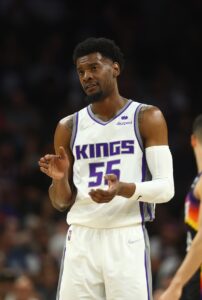 2:26pm: The Raptors have signed free agent swingman Josh Jackson, the team announced (via Twitter). While the terms of the deal were not disclosed, it would be surprising if Jackson received a fully guaranteed contract.
The No. 4 overall pick of the 2017 draft after one season at Kansas, Jackson has struggled to gain traction in the NBA after being a highly touted but raw prospect.
Jackson was drafted by Phoenix, where he spent his first two seasons, then was traded to Memphis in the 2019 offseason. Memphis declined the team option on the fourth year of his rookie contract, so despite being a high pick, he only spent three of a possible four years on his rookie deal.
Jackson signed a two-year, $9.77MM contract with Detroit ahead of the 2020/21 season, but his on-court results were a mixed bag. He was in and out of the Pistons’ rotation last season and was later traded to the Kings at the February deadline in the four-team deal that sent Marvin Bagley III to Detroit.
Unfortunately, Jackson played even less for Sacramento than he had for Detroit, appearing in just 12 games for a total of 123 minutes.
In 291 career games, including 92 starts (23.1 MPG), the 25-year-old holds averages of 11.3 PPG, 4.0 RPG and 1.8 APG on .416/.292/.680 shooting. Jackson has good size (6’8″, 207 pounds) and above-average athleticism for a wing, but struggles to score efficiently, turns the ball over a lot (two more turnovers than assists in his career), and isn’t a great defender even though he has the tools for it.
The Raptors currently have 17 players on standard deals, including 13 with fully guaranteed contracts, according to our roster count. Jackson will likely be among the group that includes Dalano Banton, Justin Champagnie and D.J. Wilson as players battling for the final spots on the 15-man roster.
Rockets To Retire Elvin Hayes’ No. 44
The Rockets will retire jersey No. 44 in honor of legendary Hall of Famer Elvin Hayes during halftime of Houston’s game against Indiana on November 18, the team announced.
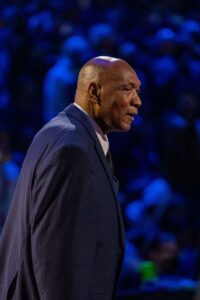 Hayes, also known as “The Big E,” was a star in college for the University of Houston, averaging 31.0 points and 17.2 rebounds across his four seasons with the Cougars. The Rockets, then in San Diego, selected Hayes’ No. 1 overall in the 1968 draft, and he promptly led the league in scoring (28.4 points, plus 17.1 rebounds). He’s the last rookie to accomplish the feat.
“We are thrilled to celebrate Elvin Hayes’ stellar career by retiring his jersey,” said Rockets owner Tilman Fertitta. “Elvin was the original basketball superstar in the City of Houston and has a lasting legacy with not only the NBA and the Rockets, but the University of Houston as well. We’re excited to honor Elvin and his family this November and see his jersey hang where it belongs, alongside the other legends from our franchise’s storied history.”
Hayes will become the seventh Rockets player to have his number retired, joining fellow Hall of Famers Hakeem Olajuwon, Moses Malone, Yao Ming, Clyde Drexler, Rudy Tomjanovich, and Calvin Murphy. Hayes played alongside both Tomjanovich and Murphy on the Rockets.
“Representing the Rockets and the City of Houston has meant so much to me throughout my life,” said Hayes. “Knowing that my number will stand with the other great players in franchise history is truly an honor. I want to thank Tilman and the Fertitta family, along with the Rockets organization, and most importantly the fans for the love they have shown me throughout my playing career and beyond. I look forward to celebrating this special moment with all of you in November.”
A 12-time All-Star and six-time All-NBA member, Hayes was selected as one of the 50 greatest players in NBA history in 1996 and earned a berth on the 75th anniversary team last season. He started and ended his career with the Rockets, averaging 27.4 points and 16.3 boards over his first four seasons.
An incredibly durable player, he missed just nine games across 16 seasons, never playing fewer than 80 games. Hayes is one of only four players to hold career averages of at least 21 points and 12 rebounds, with the others being Elgin Baylor, Wilt Chamberlain and Bob Pettit, per the press release.
As Jonathan Feigen of The Houston Chronicle (subscriber link) writes, Hayes was Fertitta’s favorite player growing up and surprised Hayes last week in a meeting to inform him of the plan to celebrate the team’s 55th anniversary, which includes throwback a throwback green jersey from the San Diego days.
“I am really so happy,” Hayes said. “I really, really had no idea. I went to the games. I really enjoy going to the games and visiting with the Rockets and players, working with the organization. It was really an honor when I was called, and this happened. I was just really shocked.”
Hayes will be honored the day after his 77th birthday, Feigen notes. In addition to his time with the Rockets, Hayes made three Finals appearances with the Washington Bullets, including a championship in 1978. Washington retired his No. 11 in 1981, so he’ll join a short list of players who’ve had their numbers retired by multiple teams.