
Mavs “Seriously Considering” Shutting Down Doncic, Irving
The Mavericks are “seriously considering” shutting down Luka Doncic and Kyrie Irving for the rest of the season, reports Shams Charania of The Athletic (Twitter video link via FanDuel TV).
As Charania notes, the Mavs owe a top-10 protected pick to the Knicks as part of the Kristaps Porzingis trade. As things currently stand, Dallas would have a 76.3% chance of keeping the pick, a 13.9% chance of moving into the top four, and a 3% chance of winning the lottery and the No. 1 overall pick, tweets Tim MacMahon of ESPN.
Both players have dealt with injuries in recent weeks. Doncic missed five games last month due to a thigh strain, while Irving missed four and continues to deal with plantar fasciitis in his foot, Charania adds.
Dallas has been in a tailspin, losing seven of its past eight games to currently hold a 37-42 record with only three games remaining. The Mavs trail the Thunder by one game for the No. 10 seed and the final spot in the Western Conference play-in tournament, but the 38-41 Thunder hold the tiebreaker, making it essentially a two-game lead.
The pick the Mavs owe is top-10 protected through 2025, so if they keep it this year it will just push back the obligation until ’24. They would be able to trade the ’23 pick after they make the selection if they want to make a win-now move, but the only other pick they’d be able to trade is their own ’27 first-rounder due to the Stepien rule.
Despite a very disappointing stretch after the All-Star break after trading for Irving, Charania believes the team’s top offseason priority will be re-signing the veteran point guard, who was named to his eighth All-Star team this season (Twitter video link via FanDuel TV). Chris Haynes of Bleacher Report has heard the same thing, with sources telling Haynes that Irving plans to wait until free agency to maximize his potential earnings (his extension eligibility is limited after being traded).
Andrew Wiggins Nears Return To Warriors
12:56pm: Wiggins plans to attend (not play) Tuesday’s game against the Thunder, according to Shams Charania of The Athletic (Twitter link). Sources tell Charania that Wiggins has been away from the team because his father has been dealing with a “serious” health problem.
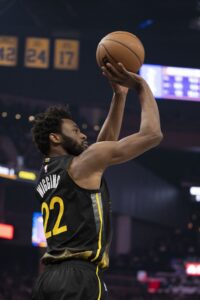
11:49am: Andrew Wiggins is expected to rejoin the Warriors in the next few days, tweets ESPN’s Adrian Wojnarowski.
Wiggins has missed 22 games while attending to a personal matter, but team officials said repeatedly that they hoped he could return before the end of the season. The front office and his teammates frequently expressed their concerns for Wiggins without providing any specifics about his situation.
Wiggins was an All-Star for the first time last season, averaging 17.2 points and 4.5 rebounds in 73 games. He has put up similar numbers this season, but has only been available for 37 contests.
Wiggins played a huge role in Golden State’s title run, bringing a strong defensive presence that has largely been missing this year. His return should help spark a Warriors team that is currently tied for fifth in the West at 41-38 and is hoping to avoid falling into the play-in tournament.
Wiggins hasn’t played since February 13, although the team said he continued to work out while he was away. He will presumably see some game action this week to help him prepare for the playoffs.
Running List Of Changes In NBA’s New Collective Bargaining Agreement
The NBA and National Basketball Players Association reached a tentative deal on a new Collective Bargaining Agreement early on the morning of Saturday, April 1. As a result of that agreement, we can rest assured that we won’t be faced with an NBA work stoppage this summer.
However, it may still be a little while until we have a complete picture of what’s changing and what’s staying the same in the new CBA.
Some of the coming changes have already been reported and more details will likely continue to trickle out in the coming days and weeks, so while we wait for an official term sheet, we’re tracking all those changes in the space below.
We’ll continue to add or clarify items to this list as necessary, so keep checking back for updates. Here’s what we know so far about the new CBA based on unofficial information from NBA reporters:
Updated 6-27-23 (5:27pm CT)
In-season tournament
The NBA will introduce an in-season tournament, likely as part of the 2023/24 schedule. Here are some details:
- Teams will be divided into six intra-conference groups of five teams apiece and play each of the other teams in their group once. That first round of the tournament will consist of four games (two home and two road) that are part of the regular season schedule.
- The six group winners and the top two wild card teams will advance to the eight-team single-elimination portion of the tournament. Tiebreakers are still being determined.
- The “Final Four” will be played at a neutral location. Las Vegas is reportedly receiving consideration.
- The round robin, quarterfinal, and semifinal games will count toward teams’ regular season record, but the final won’t.
- NBA teams are expected to initially have 80 regular season games on their schedule. The leftover games for the teams that don’t make the single-elimination portion of the in-season tournament would be scheduled at a later date, while the two teams that make the final of the tournament would end up playing 83 games.
- Prize money for the in-season tournament will be $500K per player for the winning team; $200K per player for the runner-up; $100K per player for the semifinal losers; and $50K per player for the quarterfinal losers.
Second tax apron
The NBA’s current “tax apron” is set a few million dollars above the luxury tax line. For instance, in 2022/23, the tax line is $150,267,000 and the tax apron is $156,983,000. Teams above the tax apron aren’t permitted to acquire players via sign-and-trade, use more than the taxpayer portion of the mid-level exception, or use the bi-annual exception.
In the new CBA, the NBA will implement a second tax apron that will be $17.5MM above the tax line. Teams above that second apron will face a new set of restrictions, as follows:
- They won’t have access to the taxpayer mid-level exception.
- They won’t be able to trade away their first-round pick that’s seven years away, beginning in 2024/25. If the team remains above the second apron in two of the next four seasons, that draft pick that was frozen for trade purposes will fall to the end of the first round. If they stay under the second apron for three of the next four seasons, the pick would become unfrozen.
- They won’t be allowed to sign free agents on the buyout market.
- They won’t be permitted to send out cash in trades.
- They won’t be able to take back more salary in a trade than they send out.
- They won’t be able to aggregate salary for matching purposes in trades.
The second tax apron is expected to be phased in over the next two seasons.
All-NBA and postseason award voting
Two key changes will impact voting on postseason awards beginning in 2023/24:
- Players will need to appear in a minimum of 65 games to be eligible to earn postseason awards such as MVP, Rookie of the Year, All-NBA, etc.
- Players would reportedly have to log at least 20 minutes in at least 63 of those games for them to count toward the 65-game minimum. They would be permitted to play between 15-20 minutes in two games and still have them count toward the minimum of 65. A player who suffers a season-ending injury can qualify for postseason awards with 62 games played. There will also be exceptions related to “bad faith circumstances.”
- The three All-NBA teams will be positionless rather than featuring two guards, two forwards, and one center.
- The two All-Defensive teams will be positionless rather than featuring two guards, two forwards, and one center.
(Original stories can be found here)
Salary cap changes
The following changes will apply to the salary cap:
- The cap will increase by no more than 10% per league year in order to avoid a repeat of the 32% spike in 2016.
- The value of the mid-level exception will receive a 7.5% bump and the room exception will be increased by 30%. Those bumps will be in addition to the exceptions’ usual increase, which is tied to the salary cap. The taxpayer mid-level exception will be reduced to $5MM in 2023/24 and will increase at the same rate as the cap after that.
- The room exception will allow for contracts that cover up to three seasons, while the taxpayer mid-level exception will only allow for contracts that cover up to two seasons.
- The luxury tax brackets, previously at $5MM intervals above the tax line, will now increase at the same rate of the salary cap.
- A new cap exception will be introduced for second-round picks so that teams no longer need to use cap room or the mid-level exception to give those players salaries worth more than the rookie minimum or deals longer than two years. The exception will allow teams to offer contracts that cover up to four seasons, with a starting salary worth up to:
- The equivalent of the veteran’s minimum for a second-year player for any three-year contract.
- The equivalent of the veteran’s minimum for a third-year player for any four-year contract.
- Players signed using the second-round exception won’t count against the cap until July 31, allowing those players to participate in Summer League activities without compromising cap room.
- Teams below the minimum salary floor (90% of the cap) on the first day of the regular season will not receive an end-of-season tax distribution from the league’s taxpaying teams.
- Teams will become hard-capped at the first tax apron if they take back more than 110% of the salary they send out in a trade.
- Salary cap exceptions that used to begin prorating downward on January 10 will now begin proration on the day after the trade deadline.
(Original stories can be found here)
Free agency and contract-related changes
The following changes will apply to player contracts:
- A player signing a veteran contract extension will be allowed to receive 140% of his previous salary in the first year of a new extension instead of 120%. Our expectation is that players earning less than the NBA’s average salary will be able to make up to 140% (instead of 120%) of the average salary in the first year of a veteran extension, though that has yet to be confirmed.
- A player who declines a player option as part of a veteran extension will be able to have a first-year salary worth less than the player option in his new contract.
- Players will be permitted to sign rookie scale extensions of up to five years (instead of four) even if the extension is worth less than the maximum salary.
- The qualifying offer amount for restricted free agents who finish their rookie contracts will increase by 10% over its usual scale amount. This will apply for the first time to the 2023 rookie class.
- The qualifying offer amount for restricted free agents who weren’t first-round picks will increase to 135% of their prior salary or $200K above their minimum salary, whichever is greater.
- The time a team has to match an offer sheet for a restricted free agent will be reduced from two days to one day if the team receives it before noon Eastern time. The decision would be due by the following night at 11:59 pm ET. If the offer sheet is received after noon, the team would still have two days to decide whether to match.
- Teams will no longer face restrictions on how many players on Designated Rookie or Designated Veteran contracts they can carry.
- Teams will be permitted to begin negotiating with their own free agents one day after the NBA Finals conclude.
- Teams above either tax apron won’t be permitted to sign “buyout” players. A “buyout” player will be defined as anyone waived that season whose pre-waiver salary exceeded the non-taxpayer mid-level exception.
- Teams above either tax apron also won’t be able to take back more salary than they send out in any trade.
- The extend-and-trade rules will be modified to allow for an extra year (four total years instead of three) and a higher salary (120% instead of 105%) than was previously permitted.
- A team and player can agree to remove the player’s trade veto rights if he re-signs on a one-year contract that would give him Early Bird or Bird rights at the end of the contract.
(Original stories can be found right here and here)
Trade rules
- During the 2023/24 league year, teams above either tax apron will only be permitted to take back up to 110% of their outgoing salary in a trade, rather than 125%.
- Starting in the 2024 offseason, teams above either tax apron will only be permitted to take back up to 100% of their outgoing salary in a trade.
- There will be a limit on how many minimum-salary players can be aggregated for salary-matching purposes during offseason trades.
- Traded player exceptions will allow teams to take back salaries worth the amount of the exception plus $250K (instead of $100K).
- The salary matching rules for teams below both tax aprons will become more lenient, allowing those clubs to take back the following amounts in trades:
- 200% of the outgoing salary (plus $250K), for any amount up to $7,500,000.
- The outgoing salary plus $7.5MM, for any amount between $7,500,001 and $29,000,000.
- 125% of the outgoing salary (plus $250K), for any amount above $29,000,000.
- A player and team cannot renegotiate the player’s contract for six months after he has been traded. Conversely, a player who has his contract renegotiated cannot be traded for six months.
Two-way and Exhibit 10 contract changes
- Teams will be permitted to carry three players on two-way contracts instead of two. That means the in-season roster limit will increase to 18 players (instead of 17) and the offseason roster limit will be 21 players (instead of 20).
- Players on two-way contracts will have the ability to negotiate with teams to guarantee half of their salaries on the first day of the regular season.
- The signing deadline for two-way contracts will be pushed back to March 4.
- The maximum bonus for a player who signs an Exhibit 10 contract will be $75K instead of $50K. That amount will increase at the same rate as the salary cap.
Draft changes
Here are the details on how the new CBA will affect the NBA draft:
- A player who is invited to the draft combine and declines to attend without an excused absence will be ineligible to be drafted. He would become eligible the following year by attending the combine. There will be exceptions made for a player whose FIBA season is ongoing, who is injured, or who is dealing with a family matter (such as a tragedy or the birth of a child).
- Players who attend the draft combine will be required to undergo physical exams, share medical history, participate in strength, agility, and performance testing, take part in shooting drills, receive anthropometric measurements, and conduct interviews with teams and the media.
- Medical results from the combine will be distributed to select teams based on where the player is projected to be drafted. The NBA and NBPA intend to agree on a methodology to rank the top 10 prospects in a draft class. Only teams drafting in the top 10 would get access to medical info for the projected No. 1 pick; teams in the top 15 would receive medical info for players in the 2-6 range, while teams in the top 25 would get access to info for the players in the 7-10 range.
- Prospects who forgo college in favor of signing professional contracts with programs like the G League Ignite, Overtime Elite, or the NBL Next Stars will no longer automatically become draft-eligible during the calendar year when they turn 19. Those players now won’t become draft-eligible until they enter of their own accord or until the calendar year when they turn 22.
- The one-and-done rule prohibiting prospects from entering the NBA directly out of high school will not change, despite some speculation to the contrary.
Miscellaneous changes
Here are a few more details on the new CBA:
- The NBA G League will hold an annual draft for international players between the ages of 18 and 21 who opt to enter the draft pool.
- Players will no longer be tested for marijuana use.
- Players will be allowed to invest in NBA and WNBA franchises via a private equity firm selected by the NBPA. Individual players won’t be permitted to invest directly in NBA franchises; the NBPA can do so in behalf of all players. Individual players can invest directly in WNBA teams, though they’ll face some restrictions.
- Players will be allowed to promote or invest in companies involved with sports betting and cannabis. However, any involvement with sports betting companies will require “complete separation” from the gambling component.
- Team and league licensing revenue will be added to the NBA’s Basketball Related Income for the first time.
New CBA Includes Cap Smoothing
The NBA and its players union put provisions in the new Collective Bargaining Agreement to avoid a repeat of the salary cap spike that occurred in 2016 when the last television deal was negotiated, tweets Shams Charania of The Athletic.
Sources tell Charania that the league and the NBPA agreed to cap “smoothing” that limits salary cap increases to no more than 10% per season through the seven years of the CBA. The NBA’s next media rights deal will start after the 2024/25 season.
The salary cap that took effect in 2016 increased by 32% and provided teams with massive amounts of money to sign free agents. That led to the league-altering move that allowed Kevin Durant to join the Warriors, but it also resulted in a slew of high-priced contracts that teams quickly came to regret for players such as Timofey Mozgov, Ryan Anderson and Allen Crabbe.
The league sought to implement cap smoothing in 2016, but the union rejected the idea.
More information has been leaked tonight about the new CBA:
- The agreement will allow players to invest in NBA and WNBA teams, Charania has learned (Twitter link). They can also promote or invest in companies involved with sports betting and cannabis.
- There will be a 7.5% increase in the mid-level exception as well as a 30% increase to the room exception, Charania tweets.
- Luxury tax brackets will begin increasing at the same rate as the salary cap, according to Tim Bontemps of ESPN (Twitter link). He notes that the brackets have been at fixed $5MM intervals above the tax line since the current system was adopted in 2011.
- Rookie scale extensions worth less than the maximum salary can now cover up to five years instead of four, tweets Bobby Marks of ESPN. He uses the Timberwolves’ Jaden McDaniels as an example of a player who might agree to a five-year extension this summer without getting a full max deal.
Latest On New Collective Bargaining Agreement
We learned overnight that the NBA’s new Collective Bargaining Agreement will introduce a second tax apron that imposes more severe restrictions on the league’s highest-spending teams. ESPN’s Adrian Wojnarowski explains (via Twitter) what some of those restrictions will be.
Teams that exceed the second apron won’t be permitted to send out cash in deals, trade away first-round picks seven years in the future or sign players who become free agents in the buyout market, sources tell Wojnarowski. The new apron will reportedly be set $17.5MM above the luxury tax line, and ESPN reported earlier that teams in that category will also lose their mid-level exception in free agency.
Teams exceeding the second apron will also be prohibited from taking back more salary than they send out in a trade, sources tell Tim Bontemps of ESPN (Twitter link).
Bobby Marks of ESPN points to the Suns’ acquisition of Kevin Durant in February and the Nets’ trade for James Harden in 2021 as deals that would likely have needed to be altered if the new rules were in place at the time they were made (Twitter link).
There’s more on the new CBA agreement:
- Positions will no longer be taken into consideration in voting for All-NBA teams, tweets Shams Charania of The Athletic. Under the current rules, voters must pick two guards, two forwards and a center for each of the three teams. Nikola Jokic and Joel Embiid were the top vote-getters in the MVP race last year, but because they both play center, Embiid had to settle for second-team All-NBA honors.
- Draymond Green isn’t a supporter of the new agreement, claiming the union didn’t get enough in negotiations. “Players lose again…. Smh! Middle and Lower spectrum teams don’t spend because they don’t want to,” he tweeted. “They want to lose. So increase their spending capabilities, just to increase them. They continue to cut out the middle. And this is what we rushed into a deal for? Smdh! Never fails.” In an exchange with fans, Green pointed out that the Warriors sold for $500MM shortly before he arrived and claimed that the team is now worth $8 billion. “Never seen someone go to a table with the assets that makes an entire machine go, and lose EVERY time! Blasphemous,” Green added.
- The one-and-done rule that prevents players from entering the NBA draft directly out of high school remains in place, but Devin Booker believes it will eventually be changed, writes Dana Scott of The Arizona Republic. “I think most kids are still finding their way out or they’re not even going to college and their spending a year removed training somewhere at a prep school or something of that such,” Booker said. “So with the NIL, I think that’s a step forward. Those players are able to get paid now off their name and likeness, so that’s really important. But we’ll see. I think it will eventually get back to no college.”
Blazers Sign Jeenathan Williams, Waive Ryan Arcidiacono
3:42pm: The Trail Blazers have confirmed both moves in a press release.
12:00pm: The Trail Blazers are making a change to their standard roster, according to Shams Charania of The Athletic, who reports (via Twitter) that the team will waive veteran guard Ryan Arcidiacono and use the open roster spot to sign guard Jeenathan Williams to a two-year contract.
Williams, who went undrafted out of Buffalo in 2022, has spent his first professional season with the Salt Lake City Stars, Utah’s G League affiliate. In 32 regular season appearances for Salt Lake City, Williams averaged 14.4 points, 4.5 rebounds, and 2.2 assists in 29.8 minutes per game, posting an impressive .523/.417/.848 shooting line.
While the terms of Williams’ new deal aren’t yet known, it’s unlikely to include much, if any, guaranteed money beyond this season, essentially giving the Blazers a free look at the 24-year-old this summer before they decide whether they want to hang onto him for next season.
Arcidiacono began this season with the Knicks and was traded to Portland in the four-team trade deadline deal that sent Josh Hart to New York. The 29-year-old guard has actually played more in Portland than he did for the Knicks, averaging 2.6 PPG and 2.3 APG in nine games (16.2 MPG), though he’s currently sidelined due to lumbar soreness. He logged just 26 minutes in 11 contests for New York.
Arcidiacono won’t be playoff-eligible if he signs with a new team before the end of the regular season.
Due to a plethora of injuries, the Blazers have qualified for multiple hardship exceptions and signed Skylar Mays and Shaquille Harrison to fortify their standard roster. However, hardship signings can only be 10-day deals, so the team couldn’t give Williams a two-year contract without waiving someone on a rest-of-season deal.
Popovich, Nowitzki, Wade Headline 2023 Hall Of Fame Class
APRIL 1: Popovich, Wade, Nowitzki, Gasol, Parker, and Hammon have officially been announced as Hall of Famers. In addition to those previously reported names, the following inductees will join them:
- Gene Bess: Longtime head coach at Three Rivers Community College who won two NJCAA national championships and won a record 1,300 games.
- Gary Blair: Longtime women’s basketball head coach at Texas A&M, Arkansas, and Stephen F. Austin who won a national championship in 2011 and was inducted into the Women’s Basketball Hall of Fame in 2013.
- David Hixon: Longtime Amherst College head coach who won a pair of Division III national championships and was twice named the D-III Coach of the Year
- Gene Keady: Longtime Purdue head coach who appeared in 17 NCAA tournaments and was named Big Ten Coach of the Year seven times.
The Hall of Fame is also recognizing Jim Valvano, the late NCAA broadcaster who created The V Foundation for Cancer Research, and the 1976 Olympic U.S. women’s basketball team (Twitter links).
This year’s class will formally be enshrined in the Hall of Fame on the weekend of August 11-12 in Springfield, Mass.
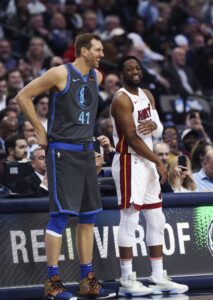 MARCH 28: Spurs head coach Gregg Popovich, Dwyane Wade, Dirk Nowitzki, Pau Gasol, Tony Parker and Becky Hammon have been inducted to the Naismith Memorial Basketball Hall of Fame, according to Adrian Wojnarowski of ESPN.
All six were finalists of the 2023 class, and a formal announcement of all the inductees will take place on Saturday morning at the NCAA Men’s Final Four.
Popovich, the NBA’s all-time leader in wins for a head coach, has won five championships, all with San Antonio. The 74-year-old is in his 27th season as the lead coach of the Spurs, compiling a 1363-757 record to this point, good for a 64.3 winning percentage. In 284 postseason games, his teams have gone 170-114 — a 59.9 winning percentage.
A three-time Coach of the Year, Popovich is the longest tenured active coach in the league. He led Team USA to a gold medal at the Tokyo Olympics.
Popovich was actually eligible to be inducted years ago but didn’t want to be considered until his longtime point guard Parker was eligible after Tim Duncan and Manu Ginobili were previously inducted into the Hall of Fame.
Nowitzki spent his entire 21-year career with the Mavericks, winning the team’s lone championship in 2011 en route to Finals MVP. He earned numerous accolades during his career, including being named the league’s 2006/07 MVP. The German big man was also 14-time All-Star and 12-time All-NBA member.
Wade, a shooting guard, was a 13-time All-Star, eight-time All-NBA member, and three-time NBA champion with the Heat. He was named Finals MVP in 2006 and spent the bulk of his career with Miami. Wade is currently a part owner of the Jazz.
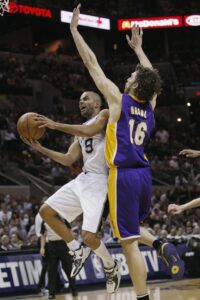 Parker, a point guard, spent his first 17 seasons with the Spurs before surprisingly signing one-year contract to finish his career with Charlotte. He was a six-time All-Star, four-time All-NBA member, four-time NBA champion and 2007 Finals MVP.
Gasol, a forward/center, was a six-time All-Star, four-time All-NBA member, two-time NBA champion with the Lakers and was the ’01/02 Rookie of the Year. He also had a storied international career with the Spanish national team, winning a couple of Olympic silver medals and several medals during World Cup and EuroBasket compeitions.
Hammon was a six-time WNBA All-Star and two-time first-team All-WNBA member. The former guard won an Olympic gold medal in 1998 with the U.S. national team.
Hammon was a Spurs assistant for parts of eight seasons, becoming the first female acting head coach in NBA history when Popovich was ejected from a game in December 2020. She departed San Antonio when she was named head coach of the WNBA’s Las Vegas Aces, becoming the first rookie head coach to win a championship last season.
Kentucky’s Cason Wallace Entering 2023 NBA Draft
Kentucky freshman guard Cason Wallace is entering the 2023 NBA draft and will forgo his remaining NCAA eligibility, he tells Jonathan Givony of ESPN.
Wallace is the latest projected lottery pick to announce that he’s declaring for the draft and going pro, joining Brandon Miller, Jarace Walker, and Keyonte George, among others. Wallace is currently the No. 10 overall prospect in the 2023 draft class on Givony’s big board at ESPN.com.
Wallace’s numbers in 32 games as a freshman don’t necessarily jump off the page. He averaged 11.7 points, 4.3 assists, 3.7 rebounds, and 2.0 steals in 32.2 minutes per night, with a shooting line of .446/.346/.757.
However, he finished the year strong, enjoying perhaps his best game of the season in the Wildcats’ second-round loss in the NCAA Tournament (21 points and nine rebounds on 9-of-11 shooting). He is also one of the best defenders in the draft, per Givony, and showed NBA evaluators a different aspect of his game when he assumed primary ball-handling duties following an injury to Kentucky point guard Sahvir Wheeler.
“Learning how to play the point guard position the whole game helped,” Wallace told ESPN. “It forced me to step up to another challenge in a new role.”
Wallace added that he’s intent on developing “each part” of his game further and intends to get “stronger, faster and quicker in the pre-draft process.”
Raptors’ Nurse Says He’ll Evaluate Future After Season
Nick Nurse‘s future in Toronto has been a subject of speculation as of late, with multiple reports this week suggesting there has been some league-wide chatter about Nurse’s status. Asked on Friday about those rumors, the Raptors head coach could have poured cold water on them, but his response only added more fuel, writes Josh Lewenberg of TSN.ca.
 “I think when this season gets done, we’ll evaluate everything,” Nurse told reporters. “Even personally, I’m going to take a few weeks to see where I’m at, where my head’s at, and just see how the relationship with the organization is and everything. It’s been 10 years for me now, which is a pretty good run.”
Nurse has been the head coach in Toronto since 2018 and was an assistant with the franchise under Dwane Casey for five years before that. It has been the Raptors’ most successful decade since entering the NBA in 1995, and Nurse has had a major hand in that success, leading the team to its first ever championship in 2019 and a 224-161 (.582) record across his five seasons.
However, the last three years have been more up and down than the first two. Toronto was just 27-45 in 2020/21 — that appeared at the time to be an aberration due to the fact that the team was forced to play its home games in Tampa due to COVID-19. Following a 48-win showing in 2021/22 though, this season has also been an underwhelming one. The Raptors currently sit under .500 (38-39) with just five games left to play, resulting in speculation about Nurse’s future.
Nurse’s contract expires after the 2023/24 season, and sources with knowledge of the situation tell Lewenberg that the 55-year-old doesn’t want to go into next season as a “lame-duck” coach. So, assuming he wants to continue coaching in Toronto, he’ll be seeking an extension this spring.
That means the Raptors will essentially have to make a decision this year, one way or the other, on Nurse’s future. Both directions – retaining Nurse or making a change – seem plausible at this time, Lewenberg writes, while Eric Koreen of The Athletic says a coaching change feels more likely than not.
Determining Nurse’s future will be just one part of a big offseason for the Raptors, who also have Fred VanVleet, Jakob Poeltl, and Gary Trent Jr. facing potential free agency.
Ime Udoka has been linked to the Raptors as a possible target if they do move on from Nurse. As Koreen points out, Udoka interviewed for the team’s head coaching job in 2018 and has been associated with Basketball Without Borders, which works closely with Masai Ujiri‘s Giants of Africa initiative. Of course, the off-court incident that ended Udoka’s tenure in Boston would be a complicating factor for the Raptors or any other team interested in pursuing the former Celtics head coach.
Nurse, meanwhile, has been linked to Houston, where head coach Stephen Silas isn’t a lock to return next season. Nurse coached the Rockets‘ G League affiliate, the Rio Grande Valley Vipers, from 2011-13 before joining the Raptors.
NBA, NBPA Reach Tentative Deal On New CBA
The NBA and the National Basketball Players Association reached a deal on a new Collective Bargaining Agreement early on Saturday morning, according to statements from the league and the players’ union.
The official announcements are light on specific details, simply stating that the new agreement is tentative and still needs to be ratified by the players and team owners. The NBA and NBPA said that they’ll announce more details once the new CBA is official.
However, Adrian Wojnarowski of ESPN and Shams Charania of The Athletic, who initially broke word of the agreement, have already shared several of the most interesting changes in the new CBA.
According to Wojnarowski, the NBA and NBPA agreed at the last minute to push back the Friday, March 31 deadline for either side to opt out of the current CBA, since they felt they were closing in on an agreement. A few hours later, a tentative deal was in place.
The new CBA will begin in 2023/24 and will cover the next seven years, with a mutual opt-out after year six, Wojnarowski adds.
Here are some of the most notable ways the NBA will change in the new CBA, as reported by Wojnarowski and Charania:
In-season tournament
An in-season tournament could show up on the NBA schedule as soon as the 2023/24 season, if all the details are hammered out in time, according to ESPN. The first round of the tournament will be part of the regular season schedule, with the top eight teams advancing to a single-elimination event in December. The “Final Four” will be played at a neutral site — Las Vegas is among the cities receiving consideration.
It sounds like the plan is for NBA teams to have 80 regular season games scheduled as normal, with some of those games serving as the first round of the in-season tournament, per Tim Reynolds of The Associated Press (Twitter link). The leftover games for the teams that don’t make the single-elimination portion of the tournament would be scheduled at a later date, while the two teams that make the final of the tournament would ultimately end up playing 83 games.
Prize money for the in-season tournament would be $500K per player, reports Charania (Twitter link).
Second tax apron
The NBA’s current “tax apron” is set a few million dollars above the luxury tax line. For instance, in 2022/23, the tax line is $150,267,000 and the tax apron is $156,983,000. Teams above the tax apron aren’t permitted to acquire players via sign-and-trade, use more than the taxpayer portion of the mid-level exception, or use the bi-annual exception.
In the new CBA, the league will implement a second tax apron that’s $17.5MM over the tax line, per ESPN. Clubs whose team salary is above that second apron will no longer have access to the taxpayer mid-level exception in free agency.
As Wojnarowski points out, that means taxpayer MLE signings like Donte DiVincenzo (Warriors), Joe Ingles (Bucks), Danilo Gallinari (Celtics), and John Wall (Clippers) wouldn’t have been permitted last summer, given how far those teams were over the tax line.
This changes will be “eased into” the salary cap over the next few years, according to ESPN’s report. Wojnarowski adds that there are expected to be new spending opportunities in free agency and on the trade market for non-taxpaying teams, though there are no details yet on how those new opportunties will work.
Minimum games-played requirement for postseason awards
As expected, the NBA will set a minimum number of games played for players to qualify for postseason awards, including MVP, Rookie of the Year, and All-NBA. That minimum will be 65 games, though it will come with some “conditions,” says Wojnarowski.
The ostensible goal of this change is to reduce teams’ generous deployment of “load management.” It will have the added effect of helping to simplify the criteria for award voters.
Bigger first year-raises on veteran contract extensions
Under the current CBA, a veteran who signs a contract extension can receive up to 120% of his previous salary in the first year of a new deal — or 120% of the NBA’s average salary, if he’s earning less than the league average.
The new CBA will increase that limit to 140% of the player’s previous salary, per Wojnarowski and Charania. It’s unclear at this point whether players earning less than the league average will also be able to make up to 140% of the average NBA salary in the first year of a veteran extension.
This rule change could benefit players like Jaylen Brown, OG Anunoby, and Domantas Sabonis, who will be eligible for extensions but who are earning well below their market value and likely wouldn’t have agreed to an extension that features a 20% first-year raise (40% may still not be enough in some cases, but it at least should increase the odds of a deal).
Extra two-way contract slot
Teams will be permitted to carry three players on two-way contracts in the new CBA rather than two, according to Wojnarowski and Charania. That will result in 90 league-wide two-way slots instead of just 60.
Drug testing
Players will no longer be tested for marijuana under the new CBA, tweets Charania. The process of phasing out marijuana testing has been ongoing for a few years. Random marijuana testing was a part of the current CBA, but the NBA and NBPA agreed not to resume those tests during the 2020 bubble in Orlando and has stuck with that policy ever since.
More details on the new CBA will likely be reported in the coming days and weeks as the league and the union work on formally ratifying the new agreement and getting it in place in time for the coming offseason.