
NBA Players Who Can Veto Trades In 2023/24
No-trade clauses are rare in the NBA, since a player must meet a specific set of criteria in order to qualify for one. And even those players who become eligible may not have the leverage to demand a no-trade clause, which significantly limits a team’s flexibility in future trade negotiations.
 To be eligible to negotiate a no-trade clause, a player must have at least eight years of NBA experience and has to have spent at least four years (not necessarily the most recent four years) with his current team. He also must be signing a free agent contract, rather than an extension.
[RELATED: Hoops Rumors Glossary: No-Trade Clause]
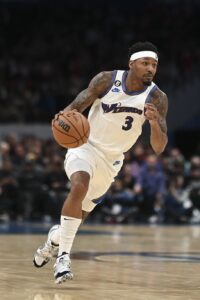
Bradley Beal is the only NBA player who currently has a no-trade clause in his contract. The presence of that clause limited his trade market this past offseason when the Wizards sought to move him and helped steer him to a preferred destination (Phoenix) for a relatively modest return.
Although Beal is the only player who has an explicit no-trade clause, there are several others who will have implicit no-trade clauses in 2023/24, giving them the ability to veto trades during the current league year.
A player who re-signs with his previous team on a one-year contract – or a two-year deal with an option year – is given no-trade protection, unless he agrees to give up that protection when he inks his deal. That group doesn’t include players on two-way contracts, but it does include players who accept standard (non two-way) one-year qualifying offers.
A player who signs an offer sheet and has that offer matched by his previous team also has the ability to veto a trade for a full calendar year.
With those criteria in mind, here are the players who must give their consent if their teams want to trade them during the ’23/24 league year:
Players with a no-trade clause:
- Bradley Beal (Suns)
Players whose offer sheets were matched:
- Paul Reed (Sixers)
- Matisse Thybulle (Trail Blazers)
Players re-signing for one year (or two years, with a second-year player/team option):
- Thanasis Antetokounmpo (Bucks)
- Miles Bridges (Hornets)
- Jae Crowder (Bucks)
- DeAndre Jordan (Nuggets)
- Damion Lee (Suns)
- Kevin Love (Heat)
- Markieff Morris (Mavericks)
- Josh Okogie (Suns)
- Mason Plumlee (Clippers)
- Russell Westbrook (Clippers)
If any player who re-signed for one year approves a trade during the 2023/24 league year, he’ll have Non-Bird rights at season’s end instead of Early Bird or full Bird rights.
A handful of players with veto rights consented to trades during the 2022/23 season, including Mike Muscala, Serge Ibaka, Ryan Arcidiacono, and Kessler Edwards. Muscala and Edwards eventually had their team options for ’23/24 picked up, so their Bird rights – only lack thereof – didn’t come into play this summer. Ibaka and Arcidiacono, meanwhile, were waived before season’s end, meaning they didn’t enter the offseason with any form of Bird rights anyway.
Any player who approves a trade will retain his veto ability on his new team, and would have to consent to any subsequent deal during the 2023/24 season.
The following players were re-signed to one-year contracts (or two-year deals with an option year), but agreed to give up their right to veto a trade in 2023/24:
- Deonte Burton (Kings): Waived
- Taj Gibson (Wizards): Waived
- Montrezl Harrell (Sixers): Waived
- Reggie Jackson (Nuggets)
- Alex Len (Kings)
- Sandro Mamukelashvili (Spurs)
- Boban Marjanovic (Rockets)
- D’Angelo Russell (Lakers)
- Moritz Wagner (Magic)
And-Ones: 2024 Draft, Flagg, J. Harper, What-Ifs
The projected NBA draft class of 2024 doesn’t have a clear-cut No. 1 prospect like Victor Wembanyama in 2023, but it features a handful of potential high-impact players who could make legitimate cases for that No. 1 spot with strong seasons, writes Kevin O’Connor of The Ringer.
For now, O’Connor’s “way-too-early” big board for the 2024 draft is headed by G League point forward Matas Buzelis, followed by his Ignite teammate Ron Holland at No. 2. Baylor freshman Ja’Kobe Walter, UConn freshman Stephon Castle, and another Ignite prospect, power forward Izan Almansa, round out O’Connor’s top five.
Here are a few more odds and ends from around the basketball world:
- Although he won’t be eligible for the 2024 draft, 16-year-old phenom Cooper Flagg looks like a potential No. 1 overall pick in 2025 or 2026, says Sean Deveney of Heavy.com. Deveney spoke to multiple NBA evaluators to get a sense of what to expect from Flagg. “The kid is going to be a star, as long as he puts in the work,” one GM told Heavy.com. “The book on him is that he has a really good work ethic so you don’t expect that to be a problem, but you can’t tell with guys that young, how they will develop.”
- Veteran point guard Jared Harper, who has appeared in NBA games for the Suns, Knicks, and Pelicans, has re-signed with Valencia Basket, the Spanish club announced in a press release. Harper first signed with Valencia last September after finishing the 2021/22 season on a two-way deal with New Orleans.
- In a pair of entertaining articles for ESPN.com, Tim Bontemps takes a look back at the biggest “what-ifs” in the Eastern Conference and Western Conference over the past five years. Lonzo Ball‘s knee injury, Kawhi Leonard‘s free agency departure from Toronto, the Warriors’ decision to draft James Wiseman over LaMelo Ball, and the Rockets’ and Lakers’ trades for Russell Westbrook were among the sliding doors moments explored by Bontemps.
Community Shootaround: Which Non-Heat Team Should Pursue Lillard?
We’re now more than a month removed from Damian Lillard‘s trade request, which he submitted on July 1, and the Trail Blazers don’t appear to be much closer to moving the star guard today than they were at that time.
Lillard’s insistence that he only wants to play for the Heat has limited his market, as have the four years and $216MM left on his contract, which has reportedly made teams wary about giving up a significant package for him.
The Blazers are essentially stuck at an impasse, apparently “disinclined” to seriously engage with the Heat but also without any other viable options available to them for the time being, as ESPN’s Brian Windhorst said during an NBA Today appearance on Tuesday (YouTube link).
“As I look across the league and have conversations with executives and agents, I can’t identify another team that is seriously making an offer for Dame Lillard at this point,” Windhorst said. “And so my belief is that the Heat can’t either.
“And so while people can look at what the Heat’s offer might be and scoff at it, if their offer is the only one on the table, it therefore is the best one on the table. And the fact that Portland isn’t going forward with anything is a verification of that, that they don’t have another offer. So, very low incentive for the Heat to improve their offer at this point, and no incentive really right now for Portland to take that offer. And we have a stare-down.”
As ESPN’s Windhorst and Adrian Wojnarowski have said, and as Barry Jackson of The Miami Herald reiterates, Miami has no desire to bid against itself in an effort to bring Portland back to the negotiating table, but remains hopeful that the Blazers will be willing to reopen those conversations at some point in the coming weeks.
A veteran assistant coach who spoke to Jackson suggests that the Heat and Blazers both have some incentive to try to get something done before the regular season begins. If Miami is going to acquire Lillard, the assistant observes, the team would prefer to do it sooner rather than later in order to begin establishing chemistry with its new-look roster following the loss of guards Gabe Vincent and Max Strus. Portland, meanwhile, would presumably like to have a clean slate to begin the 2023/24 season rather than keeping a disgruntled star on the roster and remaining in a holding pattern.
The clearest way for the negotiations to move forward would be for a second suitor besides the Heat to emerge as a serious contender for Lillard. Even if the Blazers don’t ultimately make a deal with that non-Heat team, the presence of another bidder could help push Miami to increase its offer to the point that Portland would be more willing to seriously consider it.
So our Community Shootaround question for today is this: Which non-Heat team makes the most sense as a suitor for Lillard?
The team would presumably have to meet a few criteria.
It would need to have the young player(s) and/or draft picks necessary to put together a strong offer for Lillard, as well as a strong enough core to seriously contend for a title after giving up several assets to land the veteran guard.
It would need to be comfortable with the idea of paying Lillard $60MM+ per year in 2025/26 and ’26/27.
And it would need to be confident in its leaders and culture to sell the seven-time All-Star on embracing a new NBA home somewhere besides Miami.
What do you think? Which non-Heat team is the best bet – or the most logical candidate – to emerge as a contender for Lillard? Head to the comment section below to weigh in with your thoughts!
Pacific Notes: Jemison, Metu, Paul
The Suns have filled two of their three two-way slots with guard Saben Lee and, reportedly, center Udoka Azubuike. According to Duane Rankin of the Arizona Republic (Twitter link), Trey Jemison, who was on Phoenix’s Summer League team, is on the team’s radar for the other two-way slot.
The 7’0” Jemison, 23, played his last three college seasons at UAB and went undrafted. He averaged 8.0 points and 6.8 rebounds in 23.1 minutes per game during five Summer League contests.
We have more from the Pacific Division:
- Signed to a minimum salary contract at the start of free agency, Chimezie Metu will have to force his way into the Suns’ rotation. The best way for Metu to do that would be as a small-ball center. Gerard Bourguet of GoPhnx.com believes Metu must show he can defend well enough for those lineups to work, and grab defensive rebounds to finish off those stops.
- ESPN analyst Jay Bilas doesn’t see Chris Paul having any trouble fitting in with the Warriors, even if he comes off the bench for the first time in his career. “You have an opportunity to get a Hall of Fame player in Chris Paul, even though when you look at his body of work, maybe his teams and his personal style has been a little different than the style will be in Golden State,” Bilas told NBC Sports Bay Area’s Monte Poole. “But it’s a player who is hungry to win. It’s not going to be about him. It’s going to be about the team and doing what it takes for the team to win. I think it’s a great move. And I think he’ll blend in wonderfully.”
- In case you missed it, we relayed a number of items on the Lakers earlier on Tuesday. Get the details here.
Southwest Notes: Sengun, Spurs’ Arena, Konchar
Rockets center Alperen Sengun will play for the Turkish national team in the pre-Olympic qualifying tournament in Istanbul from Aug. 12-20, Sportando relays, via a Fanatik report.
It was previously reported that Sengun wouldn’t play. Turkey hosts the second of the two pre-Olympic qualifiers in Europe. Turkey will face Ukraine, Bulgaria and Iceland in Group C while Group D include Croatia, Belgium, Sweden and the Netherlands. The two top teams from each group will advance to the knockout stages and the tournament winner will move on to next year’s Olympic qualifiers.
We have more from the Southwest Division:
- The Spurs’ arena is undergoing a name change. The Spurs have found a new naming-rights sponsor in Frost Bank, according to Madison Iszler of the San Antonio Express News. Spurs Sports & Entertainment plans to sign an agreement with the San Antonio-based bank. The AT&T Center’s marquee became available in 2021, when the telecommunications company decided not to renew its naming rights deal. The Spurs were unable to find a new partner at that time, so they extended their agreement with AT&T through last season.
- John Konchar gets favorable reviews in advanced analytics and four of the top five Grizzlies lineups in net rating last season included Konchar. He also has offensive upside to go along with his solid defense, which is why he’ll be a big part of Memphis’ plans in 2023/24, according to Damichael Cole of the Memphis Commercial Appeal.
- The Rockets added Joshua Obiesie to their camp roster. Get the details here.
Atlantic Notes: Udofia, Raptors, White, Porzingis, Knicks
The Long Island Nets, Brooklyn’s NBA G League affiliate, have named Mfon Udofia as head coach, according to a league press release. Brooklyn’s intent to hire Udofia for the G League club was previously reported.
“We’re pleased to welcome Mfon to the Nets family,” Long Island Nets GM J.R. Holden said. “His passion for the game and dynamic coaching style have prepared him to lead our development team on Long Island. Our organization is excited to support Mfon and his staff as they lead the next generation of talent this upcoming season.”
Udofia spent last season as an assistant coach with the Ontario Clippers in the G League. He had prior stints with several other NBAGL franchises.
We have more from the Atlantic Division:
- The Raptors may not be done dealing, but The Athletic’s Eric Koreen examines how the rotation might shake out if the roster remains unchanged. Koreen believes either Pascal Siakam or Scottie Barnes must be on the court at all times for play-making purposes and either OG Anunoby or Gary Trent Jr. need to be on the floor for shooting purposes. He also doesn’t see lottery pick Gradey Dick as a member of a nine-man rotation, given the team’s other commitments.
- With Derrick White the undisputed starting point man with the Celtics, The Athletic’s Jared Weiss breaks down how a pick-and-roll partnership between White and Kristaps Porzingis can unlock the team’s full offensive potential.
- Miles McBride, Jericho Sims or Isaiah Roby could force their way into the Knicks’ rotation, The Athletic’s Fred Katz writes, though if coach Tom Thibodeau goes with his usual nine-man rotation, minutes will be hard to come by for that trio. Katz looks at various lineup combinations and which starter might play with the second unit when the usual four reserves are on the floor.
Celtics Waive Justin Champagnie
The Celtics have waived swingman Justin Champagnie, Shams Charania of The Athletic tweets.
Champagnie, 22, appeared in two regular season and four postseason games for Boston last season. The front office had a deadline today regarding Champagnie’s contract. He had a $50K guarantee if he remained on the roster through Tuesday.
Champagnie signed a two-year, minimum-salary contract in April but it was non-guaranteed for next season. By shedding Champagnie, the Celtics now have two openings on the 15-man roster.
He could benefit in the long run, Blake Murphy of Sportsnet notes (Twitter link). This frees him up to seek a two-way or camp deal where he could conceivably end up with more guaranteed money — the maximum Exhibit 10 bonus and the partial guarantee on a two-way contract are each worth $75K.
After going undrafted out of Pittsburgh in 2021, the 6’6″ swingman inked a two-way deal with the Raptors for the 2021/22 season. The team brought him back aboard for 2022/23, but after he had appeared in just three games for Toronto, he was cut in December.
Lakers Notes: Rotation, Point Guards, Christie, Hayes, Davis
Breaking down the Lakers‘ potential lineup decisions for the 2023/24 season, Jovan Buha of The Athletic forecasts a 10-man rotation, led by stars LeBron James and Anthony Davis.
At this point, Buha favors incumbent Lakers D’Angelo Russell, Austin Reaves, and Rui Hachimura – all of whom signed lucrative new contracts this offseason – to fill out the starting lineup. He predicts the 10-man rotation will be filled out by Jarred Vanderbilt, Max Christie, and newcomers Gabe Vincent, Taurean Prince, and Jaxson Hayes.
As Buha notes, the Lakers will want to avoid overworking James and Davis to ensure that they’re healthy for the playoffs, so players outside his projected 10-man rotation, including free agent addition Cam Reddish and rookies Jalen Hood-Schifino and Maxwell Lewis, could get a chance to earn some minutes too.
Here’s more on the Lakers:
- Although Buha has Russell penciled in as the starting point guard, he acknowledges that could change, observing that Vincent’s 3-and-D skill set is a better fit next to the Lakers’ stars. It’s a “coin flip” as to who will end up as the go-to point guard, Buha writes, suggesting that both players will have important roles.
- Christie is the most difficult Laker to project for the 2023/24 season, says Buha. If he breaks out like he believes he can, he should have no problem securing a spot as the eighth or ninth man in the rotation. If not, he may end up battling Reddish for minutes as the 10th man.
- According to Buha, the Lakers hope that Hayes will be able to start alongside Davis in scenarios when the team opts to roll with a two-big lineup. However, Buha doesn’t foresee a major regular role for Hayes, noting that there are only so many frontcourt minutes to go around as long as James, Davis, Hachimura, and Vanderbilt are healthy. If the Lakers were to sign another free agent center such as Christian Wood or Bismack Biyombo, Hayes’ spot in the regular rotation would be even less certain, though injuries and/or load management could ultimately open the door for him to play frequently.
- In the latest Hoop Collective podcast (YouTube link), ESPN’s Brian Windhorst, Tim Bontemps, and Tim MacMahon discuss the fact that Davis will become extension-eligible later this week and consider the odds of he and the Lakers working out a deal before the season begins. Windhorst doesn’t necessarily expect the two sides to reach a deal immediately, but believes there’s mutual interest in working something out. “There’s no time crunch. He doesn’t have to make a decision by August 5 or anything,” Windhorst said. “But I do think there is an expectation that the Lakers do make some sort of offer this week, or at least show their intention to make such an offer.”
Hoops Rumors Chat Transcript: 8/1/2023
Thee transcript of our weekly Tuesday live chat can be accessed here.
Join Luke Adams for our next live chat on Thursday.
Hoops Rumors Glossary: NBA Roster Limits
The rules governing the number of players an NBA team can carry on its roster vary depending on the time of year.
Between the start of the regular season and the last day of a team’s season, a club isn’t allowed to carry more than 15 players on its roster, except in rare instances. Generally, when a club with 15 players on its roster acquires a new player, it must waive someone to clear a spot. In the offseason though, teams are permitted to carry up to 21 players on their rosters.
The regular season limit applies to players on standard contracts, while the offseason limit applies to players on any form of contract.
During both the regular season and offseason, a team is permitted to carry up to three players on two-way contracts, which are a non-standard form of deal that allows a player to be transferred back and forth between the NBA and G League.
In the regular season, two-way players don’t count toward the 15-man limit, meaning teams can essentially have 18 players under contract at a time. However, two-way players do count toward the 21-man limit in the offseason. If a club is carrying 21 players on standard NBA contracts in August, it can’t sign a player to a two-way deal without waiving someone.
[RELATED: 2023/24 NBA Roster Counts]
In some cases, a team ravaged by injuries will receive one or more extra spots on its regular season roster via the hardship provision. The NBA can grant a hardship exception – which allows the club to sign a player to a 10-day contract without requiring a roster spot – when a team has at least four players who have missed three consecutive games and who are expected to remain sidelined for at least the next two weeks due to injury or illness.
A team qualifies for a single hardship exception when it has four players who meet that criteria, but it can become eligible for additional hardship exceptions if it has a fifth or sixth injured/ill player. For example, if a club has six players who have missed at least three consecutive games due to injury and are expected to remain out for two more weeks, it could be granted three hardship exceptions, allowing the club to temporarily carry three extra players beyond its usual 15 (not counting two-ways).
A club is also permitted to add a 16th man to its regular season roster if it has a player on the suspended list. A player who is suspended by his team for four or more games may be placed on the suspended list following the third game of his ban, while a player suspended by the NBA for six or more games can be placed on the suspended list following the fifth game of his ban. Teams can’t make use of the suspended list for shorter suspensions.
Generally speaking, the fewest number of players an NBA team can have on its roster during the regular season is 14, not counting two-way players. However, a team is permitted to dip to 12 or 13 players for a limited period. That club can’t carry fewer than 14 players on standard contracts for more than two weeks at a time or more than 28 total days during a regular season.
The rules for in-game roster minimums and maximums are as follows:
- A team can have between 12 or 15 players listed as active for a game.
- A team can carry as few as 11 active players for up to two weeks at a time or up to 28 total days during a regular season.
- A team must have at least eight players dressed for a game (at least three or four players beyond those eight must technically be listed as active).
Note: This is a Hoops Rumors Glossary entry. Our glossary posts will explain specific rules relating to trades, free agency, or other aspects of the NBA’s Collective Bargaining Agreement. Larry Coon’s Salary Cap FAQ was used in the creation of this post.
Earlier versions of this post were published in 2012 and 2013 by Luke Adams.