
Pacific Notes: Curry, Warriors, Kings, KCP
In an in-depth piece for The Athletic, Marcus Thompson II takes a look back at the contract extension Stephen Curry signed five years ago with the Warriors, a deal that helped set Golden State’s dynasty in motion.
As Thompson details, Curry had been plagued by injury issues in his first few NBA seasons, so the Warriors presented him with two options: He could pass on a rookie scale extension and get a maximum salary contract the following summer if he stayed healthy in 2012/13, or he could accept a four-year, $44MM extension offer from the club. Curry opted for the latter, and while it became one of the most team-friendly deals in the NBA, the two-time MVP doesn’t regret signing it.
“At the end of the day, it gave me peace to just play basketball,” Curry said. “That was an underrated factor. I didn’t have to worry about it anymore. It was good money and I wouldn’t have to think about that for four years.”
Of course, Curry eventually cashed in on a much bigger scale — earlier this year, he signed a new five-year contract with the Warriors that was worth an NBA-record $201MM. Still, Thompson suggests that even that record-setting deal didn’t include everything Curry wanted, with the Dubs resisting adding a player option and a full no-trade clause.
Here’s more from around the Pacific division:
- During the Warriors‘ 2016 free agent pitch to Kevin Durant, head coach Steve Kerr told the star forward that he’d probably try to play him about 34 minutes per game. At the time, Durant pushed to increase that number, but he and many of his teammates have come to appreciate Kerr’s limitations, according to Mark Medina of The San Jose Mercury News.
- A minority shareholder in the Kings is putting 10% of the franchise up for sale, according to Scott Soshnick of Bloomberg. While the identity of the seller isn’t known, the stake would likely come with a seat on the team’s board, Soshnick notes.
- With Chris Paul leaving Los Angeles, Patrick Beverley and Austin Rivers were determined to make the new-look Clippers backcourt work this season, writes Broderick Turner of The Los Angeles Times. So far, so good.
- Former Pistons guard Kentavious Caldwell-Pope has a good game against his former team on Tuesday night and is making a strong impression with the Lakers so far, as Rod Beard of The Detroit News details.
Thunder Trade Exception Set To Expire
A traded player exception created a year ago by the Thunder is set to expire, as Bobby Marks of ESPN tweets. If it goes unused today, the TPE – which allows Oklahoma City to acquire a player without sending out any salary in return – will disappear.
The Thunder initially generated the exception in a trade with the Sixers, sending Ersan Ilyasova to Philadelphia and getting Jerami Grant in return. The original amount of the trade exception was $7,419,569, the difference between the two players’ salaries. However, Oklahoma City used a portion of the TPE at last season’s trade deadline to acquire Doug McDermott. It’s now worth $4,936,529.
While it’s not a huge exception, the $4.94MM TPE represents the Thunder’s best means of acquiring another rotation player. The team has two more TPEs that won’t expire until next July, but they’re more modest, at $2.55MM and $1.49MM. The Thunder are over the cap, over the tax, and no longer have their mid-level or bi-annual exceptions available, so they’re limited to offering minimum salary deals to any free agent for the rest of 2017/18.
Still, a last-minute deal to use the trade exception would be a surprise. There aren’t many trades out there this early in the season, and the Thunder are likely reluctant to increase team salary anyway, since the club is approximately $13MM above the tax line.
As our tracker shows, the Thunder’s TPE is the only one left with a 2017 expiry date. The next one to expire will be a Cavs TPE worth about $4.84MM — Cleveland has until January 7 to use it.
Jahlil Okafor Talks Trade, Buyout, Frustration
As we detailed earlier today, Jahlil Okafor told reporters on Wednesday that he has asked the Sixers about buying him out, and would like to be traded or bought out as soon as possible.
We passed along a small portion of Okafor’s comments in that story, but Rich Hofmann of The Athletic has a more detailed account of what the third-year big man told reporters today. Hofmann’s piece, which is available to non-subscribers, is worth checking out in full, particularly for Sixers fans, since Okafor is refreshingly frank about his situation. Here are a few highlights:
On the Sixers’ reaction to his request for a buyout:
“I only talked about it with [president of basketball operations] Bryan [Colangelo] and he just said that he felt that if he bought me out, another team would be getting me for free. But that’s where we stand today, because he waited so long to trade me. There’s nothing else to do. I’m not playing here and at the end of this season, I’m an unrestricted free agent. I want to be on the court and play.”
On when he decided he’d like to be bought out:
“Yesterday. I didn’t expect November 1st to hit, that I would be here. That’s why these past few weeks when we got asked the question about the rotation and stuff like that, I’ve been calm because I didn’t think I would still be here today. I didn’t think that Bryan would keep me, honestly. But here I am, November 1st I’m still here and looking to play somewhere. I’m 21, I’m healthy, and I’m trying to get on the court.”
On his trade value and why he wants out of Philadelphia:
“Teams are not really looking to give up anything when somebody can walk out of the door at the end of the season. So it puts me in a tough spot because I want to be on the court. This is my life, this is my career, and I’m not getting an opportunity here, which is fine. The team looks great and I’m not a part of that. They’re going to continue to do great things, but at the same time, I want to play.”
On whether he feels like there were trades the Sixers could have made:
“Yeah, talking with my agent, there were definitely deals on the table. Bryan didn’t deem they were fair, which I understand, I’m a number three pick. But at the same time, that’s what teams were offering. Me and my agent started getting the hint that they weren’t going to offer more, so it’s rather that you’re going to make a move on it or not. And he waited too long, and now I’m here today. I’m not saying a trade is impossible, but I just know it’s going to be really difficult knowing that I’m an unrestricted free agent after the season.”
While we wait to see what the Sixers do with Okafor, the Celtics are a team to watch, according to Keith Pompey of The Philadelphia Inquirer, who notes (via Twitter) that Boston has shown “a lot of interest” in the young center.
Pompey believes the C’s would be the most likely landing spot for Okafor in the event of a buyout, though it’s not clear if the team is willing to give up anything of value in a trade.
Explaining The Celtics’ Disabled Player Exception
As a result of Gordon Hayward‘s ankle injury, the Celtics were granted a disabled player exception by the NBA last week. Disabled player exceptions aren’t used with nearly the same frequency as other salary cap exceptions, such as the mid-level or bi-annual, and the rules surrounding DPEs are a little more complicated than they are for most other exceptions.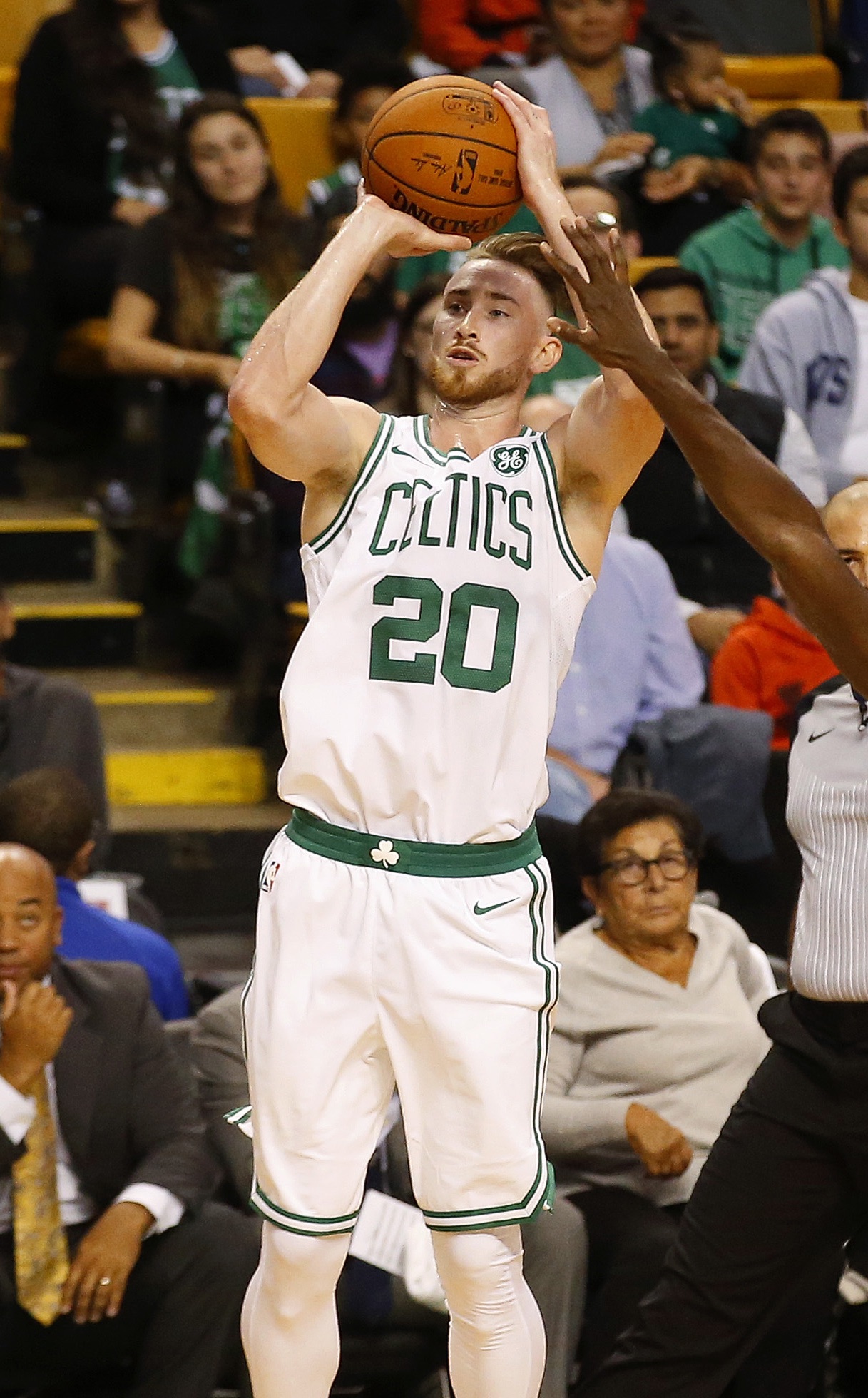
With that in mind, we’re here to answer a few questions related to disabled player exceptions. We’ll be taking a closer look at the Celtics’ DPE specifically, in the hopes of clearing up any misconceptions about it and explaining exactly what Boston can and can’t do with the new exception. Let’s dive in…
Why did the Celtics receive a disabled player exception?
A team can apply for a disabled player exception when it has an injured player who is expected to miss the entire season. If an NBA-designated physician determines that the injured player is more likely than not to be sidelined through the following June 15, the league will grant the team a DPE.
In this instance, Hayward is considered likely to miss the rest of the 2017/18 season and to be out through June 15, so the Celtics were given a disabled player exception to replace him.
So the Celtics get an extra roster spot?
No. A disabled player exception is about cap flexibility rather than roster flexibility. The Celtics are still limited to 15 players on NBA contracts, but they’re allowed to spend an extra $8.4MM to add a replacement for Hayward. If not for that exception, the over-the-cap C’s would be limited to offering a minimum salary contract to a free agent.
Why is the Celtics’ DPE worth $8.4MM?
A disabled player exception is worth 50% of the injured player’s salary or the amount of the full mid-level exception, whichever is less.
For instance, last season, when Justise Winslow sustained a season-ending shoulder injury, the Heat applied for and were granted a disabled player exception. However, because Winslow was only earning $2.6MM, the exception was worth 50% of his salary — $1.3MM. As a result, Miami couldn’t do much with that DPE.
Hayward, on the other hand, is earning $29.7MM in the first year of his maximum salary contract with the Celtics. Half of his salary would be nearly $15MM, but the value of a disabled player exception can’t exceed the mid-level exception. This year, the full MLE is worth $8.406MM, so that’s also the value of Boston’s DPE.
Are there any free agents left worth $8MM?
Probably not. There are a few interesting names on the list of available free agents, but Boston could probably sign just about any of them for a minimum salary contract.
Still, if the Celtics are willing to be patient, it’s possible their DPE could come in handy for a free agent addition later in the season. Each year, a few potential impact players are bought out after the trade deadline, and Boston’s ability to offer up to $8.4MM to one of those players could be valuable.
Additionally, the disabled player exception doesn’t need to be used on a free agent — it can also be used to acquire a player in a trade. The player must be in the final year of his contract, but as long as he’s earning $8.506MM or less (the DPE allows for a $100K buffer in trades), the Celtics wouldn’t have to send out any salary in a trade.
So a disabled player exception functions like a combo mid-level/traded player exception?
Sort of. It can be used to sign a free agent, like the mid-level exception, or to acquire a player in a trade, like a traded player exception. Also, like MLEs and TPEs, it can’t be combined with another exception or a player’s salary to increase its value. Still, there are a few differences that set the DPE apart.
For one, the disabled player exception can only be used once. Mid-level and trade exceptions can be used to acquire multiple players, but if the Celtics decide to use their DPE to trade for a player earning $3.4MM, they wouldn’t still have $5MM left to use on someone else. The DPE would be gone.
Additionally, because the disabled player exception is intended to be a short-term solution to replace an injured player, a team can’t use it to add a player for multiple seasons. If it’s used to sign a free agent, he has to sign a one-year deal. If it’s used to acquire a player via a trade, he has to have just one year left on his contract (or one year plus an option, if the option is declined as part of the deal).
If the DPE is designed to help a team replace its injured player, what happens if Hayward comes back this season?
If Hayward makes a miraculous recovery and returns to the court in April, with the Celtics having already used their DPE to add another player, that’s great news for the team — Boston would be able to activate Hayward without the replacement player being affected.
Hayward’s injury has already been deemed season-ending by the NBA. If it hadn’t been, the Celtics’ application for the disabled player exception wouldn’t have been approved. If his diagnosis changes later, that’s not a problem.
The only scenario in which a Hayward return would compromise the Celtics’ ability to use the DPE is if he gets back on the court before the team has used the DPE and before it expires. Then they’d lose it.
And when does it expire?
March 10. If the Celtics haven’t used it by that point, they lose it.
That date applies to all disabled player exceptions — teams have until January 15 to apply for a DPE, and until March 10 to use it.
So which players might the Celtics target with their DPE?
It’s probably still too early to come up with a comprehensive list. The Celtics have adjusted well since losing Hayward and aren’t in immediate need of reinforcements. They can afford to wait until closer to the trade deadline (February 8) – or even after the deadline, if they have their eye on a buyout candidate – to determine which player would be the best fit.
As the season progresses, more and more teams will fall out of contention and more players will land on the trade block. Additionally, the Celtics will have more time to assess which position is their greatest area of need.
Still, there are at least a handful of trade candidates already out there. Jahlil Okafor is the most popular name now that the Sixers have turned down his 2018/19 option. Young big men on rebuilding teams, such as Nerlens Noel and Alex Len, would be intriguing possibilities, though they have the ability to veto trades and would lose their Bird rights if dealt. If the Celtics are eyeing a wing, veterans like Corey Brewer and Vince Carter meet the necessary criteria.
Again though, it probably makes sense for the C’s to wait and see how the season plays out. Many players – including a few listed above – aren’t yet trade-eligible, and most teams aren’t looking to deal quite yet anyway.
Have more DPE questions that aren’t answered above? Ask away in the comment section below.
Photo courtesy of USA Today Sports Images.
New York Notes: Jack, Dinwiddie, Rose, Hardaway
Jarrett Jack is the only Knicks player on a non-guaranteed contract, which puts him at risk of losing his roster spot next week when Joakim Noah returns from his suspension. New York is currently allowed to carry 16 players, with Noah on the suspended list, but will have to get back down to 15 once the veteran center is activated.
While Jack’s place on the roster may be in jeopardy, he has been a common denominator in the Knicks’ wins so far, writes Fred Kerber of The New York Post. Jack has started three games at point guard, and those are the only three games the club has won so far. Although the veteran’s numbers are modest, his guidance and leadership abilities have drawn praise from head coach Jeff Hornacek, as Al Iannazzone of Newsday details.
“When things get crazy, he can get us into something and he kind of guides us too,” Hornacek said. “He’s a thinking point guard. If some guy hasn’t had a shot in a while, he’s going to figure out a way to get him the ball. If somebody’s hot, he’s going to figure out a way to give him the ball. He’s just a good team leader that way.”
As Iannazzone notes, Knicks president Steve Mills seems confident that the team will find a way to retain Jack once Noah returns. While the franchise figures out exactly how to do that, let’s round up a few more notes out of New York City…
- Because he remained on the Nets‘ roster through October 31, Spencer Dinwiddie saw the guarantee on his 2017/18 salary increase from $50K to $250K, per Bobby Marks of ESPN. The young point guard has been one of Brooklyn’s most pleasant surprises early in the season, and his play is forcing the team to expand his role, writes Alex Squadron of The New York Post. The rest of Dinwiddie’s salary for this season will become guaranteed on January 10.
- Derrick Rose admitted that he was interested in re-signing with the Knicks this past offseason, but in the wake of Phil Jackson‘s departure, the team didn’t reciprocate that interest. “I would’ve loved to come back. I loved playing there even though we lost,” Rose said, per Stefan Bondy of The New York Daily News. “The city itself, the fans, like everything about it. They made changes, Phil being gone. I would’ve loved being part of it.”
- While Tim Hardaway Jr. has had a bumpy start to his first season in New York, the team’s $71MM man showed on Monday that he doesn’t necessarily need to score a ton to have an impact on a game, Kerber writes for The New York Post.
Joe Johnson Expected To Miss At Least Two Weeks
Jazz forward Joe Johnson has been diagnosed with tendon instability in his right wrist, and is expected to be sidelined for Utah’s next several games, the team announced today in a press release. According to the Jazz, Johnson will be reevaluated in two weeks.
Johnson, who is in the second and final year of his contract with the Jazz, is off to a slow start this season. While the sample size is very small, Johnson is putting up career-worst numbers so far in PPG (6.3), FG% (.391), and 3PT% (.118). He’ll look to improve those marks once he gets back on the court, which may happen later this month.
In Johnson’s absence, regulars like Joe Ingles, Rodney Hood, Donovan Mitchell, and Thabo Sefolosha could see their minutes increase slightly. Since Johnson has spent most of the year playing at either the three or four, a backup forward like Jonas Jerebko may also have an opportunity to enter the rotation.
The Jazz aren’t currently eligible to apply for a hardship exception and gain an extra roster spot, since they only have two players – Johnson and Dante Exum – on the shelf with injuries.
Eight 2018/19 Rookie Scale Options Not Exercised
October 31 represented the deadline for teams to exercise their rookie scale team options for the 2018/19 season, and the majority of those options were picked up, as expected.
Although making option decisions a year early can be challenging, rookie scale salaries are affordable enough that most of those decisions are no-brainers, assuming the player is part of his club’s rotation. Of the 2018/19 rookie scale options, the most expensive one was Karl-Anthony Towns‘ fourth-year option, which will count for $7,839,435 against the Timberwolves‘ cap. That’s less than the value of the mid-level exception, and most are much cheaper than that.
Still, not every rookie scale option is a great investment. For clubs looking to reduce future tax bills or create some additional cap flexibility going forward, it may make sense to turn down an option for a former first-round pick who has underwhelmed in his first couple NBA seasons.
This year, eight available rookie scale options weren’t exercised, with Jahlil Okafor and Mario Hezonja – a pair of top-five picks in 2015 – heading the group of players who will now become unrestricted free agents next summer.
Here’s the full list of those players whose options weren’t picked up:
- Jahlil Okafor, Sixers (fourth year, $6,313,832)
- Mario Hezonja, Magic (fourth year, $5,167,231)
- Rashad Vaughn, Bucks (fourth year, $2,901,565)
- Josh Huestis, Thunder (fourth year, $2,243,326)
- Chris McCullough, Wizards (fourth year, $2,243,326)
- Kevon Looney, Warriors (fourth year, $2,227,081)
- Wade Baldwin, Grizzlies (third year, $1,955,160)
- Note: Baldwin was waived by the Grizzlies this month.
- Brice Johnson, Clippers (third year, $1,544,951)
For the full list of the players whose rookie scale options for 2018/19 were exercised, be sure to check out our tracker.
And-Ones: De Colo, Okafor, Shumpert, Wright
French guard Nando De Colo has enjoyed some of the best seasons of his playing career in recent years, including earning EuroLeague MVP honors for CSKA Moscow in 2016. However, while De Colo is happy to continue playing in Europe and is concentrating on that for the time being, he admits that he hasn’t closed the door on the possibility of an NBA return.
De Colo spent two seasons with the Spurs and Raptors from 2013 to 2015, but never got to play a significant role during his first stint in the NBA, as he tells Spanish media outlet Farhampton Magazine (link via TalkBasket.net).
“The truth is that going to San Antonio was a somewhat complicated decision because I knew I could continue in Europe,” De Colo said. “I had contacts with Barcelona, for example. On the other hand, I wanted to go to the NBA and see how it was. In the Spurs, I didn’t have the opportunities I expected. I think that is a part of life that you can’t control.”
At age 30, De Colo still has time to return to the NBA, but given his starring role for CSKA, it’d be no surprise if he decided to remain overseas to finish his career.
Here are a few more odds and ends from around the basketball world:
- The Timberwolves don’t have any interest in Jahlil Okafor, according to Darren Wolfson of 5 Eyewitness News (Twitter link). Okafor, who had his 2018/19 turned down by the Sixers, remains on the trade block and may even end up seeking a buyout.
- Cavaliers swingman Iman Shumpert will be sidelined for at least the next five to seven days due to knee soreness, the team announced today in a press release. Shumpert, the subject of trade rumors throughout the offseason, is averaging a career-low 18.2 minutes per contest early this season for Cleveland.
- Longtime NBA forward Dorell Wright, who appeared in 549 regular season games over the course of 11 NBA seasons, has signed in Germany with Brose Bamberg, the team recently announced (via Twitter). Wright last played in the NBA for Portland during the 2014/15 season.
- Former NBA forward Al Harrington has taken an unusual career path since his days as a player ended, having gotten into the medical marijuana business. David Aldridge of NBA.com has an interesting and in-depth look at Harrington, who wants to encourage the NBA to consider the benefits of medical marijuana.
NBA G League Assignments/Recalls: 10/31/17
Here are the G League assignments and recalls for Halloween, from across the NBA:
- Backup Hornets point guard Michael Carter-Williams has been assigned to the Greensboro Swarm on a rehab assignment, the team announced today in a press release. Carter-Williams, who is recovering from knee issues, has yet to make his debut for Charlotte.
- The Spurs assigned a pair of players to the G League today, announcing in a press release that they’ve sent Davis Bertans and Derrick White to Austin.
- With Trevor Ariza healthy and back in the Rockets‘ lineup, the team has sent Troy Williams back to the Rio Grande Valley Vipers, per Jonathan Feigen of The Houston Chronicle (Twitter link).
- Following a brief stint with the Salt Lake City Stars, rookie center Tony Bradley was recalled today by the Jazz, according to the team.
Thunder To Decline Josh Huestis’ 2018/19 Option
The Thunder will not exercise their fourth-year option for 2018/19 on forward Josh Huestis, according to Michael Scotto of Basketball Insiders. The move will put Huestis on track to reach unrestricted free agency in the summer of ’18.
The 29th overall pick in 2014, Huestis would already be in his fourth NBA season if he had signed his rookie contract the year he was drafted. Instead, he spent his first professional season in the G League before eventually inking his four-year rookie deal with Oklahoma City in 2015.
That move was meant to give Huestis a little experience before he had to adjust to the NBA, but he has still been slow to develop for OKC. He only appeared in seven total games in his first two seasons with the Thunder, having been frequently assigned to the team’s G League affiliate, where he could get regular playing time.
Huestis’ fourth-year option would have counted for $2,243,326 against the Thunder’s cap next season. That’s not a huge amount, but if the club hopes to retain Paul George and/or Carmelo Anthony, every dollar saved will come in handy.