
Community Shootaround: Donovan Mitchell
The Jazz have made all kinds of noise over the past week.
They got a huge haul for All-Star center Rudy Gobert from the Timberwolves, as they will receive Malik Beasley, Patrick Beverley, Jarred Vanderbilt, Leandro Bolmaro, 2022 first-round pick Walker Kessler, four future first-rounders, and a pick swap once the deal becomes official. Three of those first-round picks are unprotected.
 They also acquired a first-round pick from the Nets in exchange for wing starter Royce O’Neale,
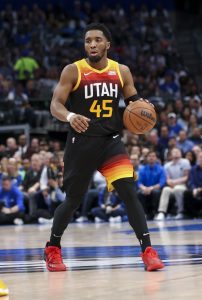
Utah’s front office now has to answer one lingering question — should it trade All-Star guard Donovan Mitchell and go into full rebuild mode, or quickly retool around Mitchell?
Several NBA experts, including ESPN’s Adrian Wojnarowski, say the Jazz are taking the latter approach and have resisted inquiries regarding Mitchell. Other NBA insiders and executives believe Mitchell is available for the right price.
Things can change in a hurry regarding front office approaches or player trade requests, as we’ve seen in the Kevin Durant saga. The Jazz’s long-range future is certainly brighter with those extra picks at their disposal, along with Gobert’s contract coming off their books.
If they choose to deal Mitchell, they can expect a similar – and perhaps even bigger – package from the highest bidder. Mitchell is locked up contractually through the 2025/26 season and there aren’t many players out there who consistently produce 25 points and five assists a game.
On the flip side, those additional assets now provide the ammo for other bold moves designed to get more quality players around Mitchell, who never seemed to truly mesh with Gobert on or off the court.
That brings us to our question of the day: Should the Jazz trade Donovan Mitchell and enter a total rebuild? Or should they focus on retooling quickly around Mitchell?
Please take to the comments section to weigh in on this topic. We look forward to your input.
Eastern Notes: Pistons, Sixers, Raptors, Haliburton
The Pistons entered last week with plenty of cap space and used a good portion of it on their impending trade with the Knicks for Alec Burks and Nerlens Noel and their free agent deals with Marvin Bagley and Kevin Knox. They have a full roster but still need more shooting, plus they have an overload of big men, Omari Sankofa II of the Detroit Free Press notes. It’s possible the Pistons could get involved in another trade, rather than dipping again into the free agent market.
We have more from the Eastern Conference:
- The Sixers added grit and toughness by securing commitments from P.J. Tucker and Danuel House in free agency but there’s more work to be done, Keith Pompey of the Philadelphia Inquirer writes. They still need to replace starting wing Danny Green and they’re still too dependent on Joel Embiid‘s health and a bounce back from James Harden to reach the top of the Eastern Conference.
- Going all in for a spirited run at Kevin Durant is far from a no-brainer for the Raptors, Eric Koreen of The Athletic argues. While the Raptors have the pieces to make the Nets a substantial offer, they have been built around draft successes and development. They have to decide whether to risk the future for another championship run or count on incremental growth to keep open their window of opportunity for several more seasons.
- By agreeing to trade Malcolm Brogdon to the Celtics, the Pacers essentially gave Tyrese Haliburton the keys to the franchise, according to James Boyd of the Indianapolis Star. It was a clear signal that they’re building around their potential All-Star guard. He is now the team’s unquestioned backcourt leader and the Pacers could potentially have three first-round picks next year. They also now have the cap flexibility to make a max contract offer to restricted free agent Deandre Ayton, if they choose that route.
Western Notes: Wiseman, Lundberg, Dorsey, Brunson, Tampering
Warriors center James Wiseman remains on track to play in the Las Vegas Summer League, Anthony Slater of The Athletic tweets. Wiseman played 5-on-5 full contact on Sunday for the first time since he had a setback in his right knee rehab late in the regular season. The No. 2 pick of the 2020 draft missed all of last season.
We have more from the Western Conference:
- Gabriel Lundberg is not on the Suns’ summer league roster and he could be on the move, Duane Rankin of the Arizona Republic tweets. Lundberg, who signed a two-way contract with Phoenix in March and appeared in four regular season games, has a possible deal overseas, Rankin hears. Lundberg left CSKA Moscow after Russia’s invasion of Ukraine.
- Tyler Dorsey had a private workout with the Mavericks on Sunday, Krysten Peek of Yahoo Sports tweets. Dorsey appeared in a combined 104 regular season games for Atlanta and Memphis from 2017-19. He played for Olympiacos (Greece) last season and was the team’s second-leading scorer.
- Will the Knicks be penalized for tampering after securing a commitment from Mavericks free agent guard Jalen Brunson? Fred Katz and Tim Cato of The Athletic tackle that subject, with Katz hearing that there’s an expectation around the league that the Knicks will get charged with tampering, unless they work out a sign-and-trade with Dallas. Katz notes that New York started dumping salary on draft night and continued to do so amid reports prior to the start of free agency that Brunson was going to the Knicks.
Hoops Rumors Glossary: July Moratorium
NBA free agents begin coming off the board in rapid succession as soon as the negotiating period opens on June 30 at 6:00 pm Eastern time. However, most of those deals can’t become official right away, due to what’s known in the league’s Collective Bargaining Agreement as the “moratorium period.” We know it colloquially as the July moratorium.
The July moratorium – which lasts from 12:01 am Eastern time on July 1 until 12:00 pm on July 6 – essentially puts a freeze on most transactions for several days at the start of the new league year. NBA free agents are allowed to negotiate with clubs during the moratorium, and they can agree to terms on new contracts, but they are unable to officially sign new deals until the moratorium ends. The same goes for trades — two teams can agree to terms on a deal, but can’t formally put it through until at least July 6.
While nearly every agreement reached during the July moratorium eventually gets finalized, the unofficial nature of those initial deals can occasionally wreak havoc on the league’s free agent market.
DeAndre Jordan‘s 2015 free agency isn’t the only example of this, but it’s certainly the most memorable one from the last decade. Jordan initially agreed to terms with the Mavericks during the July moratorium, but before the moratorium ended and the two sides could make it official, the Clippers changed Jordan’s mind and convinced him to re-sign with L.A.
Because Jordan and the Mavs had only reached an informal verbal agreement, there was nothing Dallas could do to stop him from reversing course during the moratorium. Still, this sort of about-face is rare, as it can result in fractured relationships between players, agents, and teams.
While most NBA transactions can’t be completed during the moratorium, there are a handful of exceptions to that rule. The following moves are permitted between July 1 and July 6:
- A team can sign a first-round pick to his rookie scale contract.
- A team can sign a player to a one- or two-year minimum salary contract.
- A restricted free agent can sign a qualifying offer from his current team.
- A restricted free agent can sign a five-year, fully guaranteed maximum-salary contract with his current team.
- A restricted free agent can sign an offer sheet with a new team; the 48-hour matching period would begin once the moratorium ends.
- A team can sign a player to a two-way contract, convert a two-way contract into a standard NBA deal, or convert an Exhibit 10 deal into a two-way contract.
- A team can waive a player or claim a player off waivers.
- A second-round pick can accept a required tender (a one-year contract offer) from his current team.
Under the old Collective Bargaining Agreement, the NBA finalized the salary cap at some point during the July moratorium, and the new cap would take effect once the moratorium ended. However, the current CBA calls for the salary cap for the new league year to be set before the start of July, with the new figure going into effect immediately on July 1. This gives teams more clarity on exactly how much room they have available as they negotiate with free agents during the moratorium.
In recent years, the NBA moved the start of its free agency negotiating period forward by six hours, opening that window at 6:00 pm ET on June 30 instead of at 12:01 am ET on July 1. Although the July moratorium still doesn’t technically begin until July 1, free agents who reach agreements quickly can’t officially sign on June 30, since their old contracts haven’t technically expired yet.
However, if an extension-eligible veteran agrees to a new deal with his former team, he can officially complete that extension on the evening of June 30, before the moratorium goes into effect — Thaddeus Young (Raptors) and Gary Harris (Magic) took this route this year, formally finalizing their new contracts last Thursday before the moratorium period began.
Finally, it’s worth noting that while we refer to this period at the start of free agency as the “July” moratorium, it doesn’t always take place in July. In recent years, due to the COVID-19 pandemic, the moratorium period has instead occurred in November (2020) and August (2021).
Note: This is a Hoops Rumors Glossary entry. Our glossary posts will explain specific rules relating to trades, free agency, or other aspects of the NBA’s Collective Bargaining Agreement. Larry Coon’s Salary Cap FAQ was used in the creation of this post. Earlier versions of this post were published in previous years.
Hawks Hiring Mike Longabardi As Assistant Coach
The Hawks are hiring Mike Longabardi as an assistant coach, reports Adrian Wojnarowski of ESPN (Twitter link).
With former Hawks lead assistant Chris Jent leaving Atlanta to take a job on Darvin Ham‘s Lakers staff, Joe Prunty will be promoted to become Nate McMillan‘s new top lieutenant and Longabardi will essentially fill Prunty’s old role, Wojnarowski explains.
Longabardi is a veteran NBA assistant coach who spent the 2021/22 season with the Kings. He previously served as an assistant on staffs in Houston from 2003-07, Boston from 2007-13, Phoenix from 2013-15, Cleveland from 2016-19, and Washington from 2019-21.
Longabardi, who a reputation as a defensive-minded coach, won titles with the Celtics in 2008 and the Cavaliers in 2016.
Contract Notes: Konchar, Roby, Landale
John Konchar‘s contract with the Grizzlies called for his $2.3MM salary for 2022/23 to become guaranteed if he remained on the roster through Sunday, and there has been no reporting indicating that he and the team agreed to move that date back. As such, we’re assuming Konchar’s salary for ’22/23 is now locked in.
If that’s the case, it doesn’t come as a surprise. Konchar was a solid role player for the Grizzlies in 2021/22, averaging 4.8 PPG, 4.6 RPG, and 1.5 APG with a .413 3PT in 72 games (17.9 MPG). His salary is relatively modest and he had already been owed a partial guarantee of $840K.
Konchar is one of many players on non-guaranteed contracts for 2022/23 whose salaries will become guaranteed this summer if they’re retained through certain dates. We’re tracking all of those players and decisions right here.
Here are a few more contract notes from around the NBA:
- Although Isaiah Roby was earning a minimum salary ($1,930,681) when he was waived by the Thunder on Sunday, he had been on a four-year contract that was worth more than the minimum in year one, which means any team interested in claiming him off waivers can’t use the minimum salary exception to do so, as Eric Pincus of Bleacher Report tweets. A club that wants to put a claim in on Roby would need the cap space to absorb his salary or a trade exception worth at least $1,830,681. Waivers claims are rare for non-minimum players, but Roby showed promise in Oklahoma City last season and could draw some interest.
- Jock Landale‘s non-guaranteed minimum salary became partially guaranteed for $46,120 when he was traded from San Antonio to Atlanta last week, Hoops Rumors has learned. That was the exact amount that needed to be guaranteed for salary-matching purposes, as Landale’s $46,120 was added to Dejounte Murray‘s 2021/22 cap hit ($15,428,880) to get to within $5MM of Danilo Gallinari‘s incoming $20,475,000 figure (it was also partially guaranteed, but San Antonio needed to be able to match the whole incoming amount). The Hawks have since agreed to flip Landale to the Suns, and it doesn’t appear his partial guarantee will increase any further in that trade, since no salary-matching is involved.
- In case you missed it, we relayed earlier today that Otto Porter‘s new deal with the Raptors is worth $12.4MM over two years. We’ll get more info on the specific details of contracts like Porter’s and many others beginning later this week, when the July moratorium lifts and those signings start becoming official.
13 Trade Exceptions Set To Expire In July
A total of 13 traded player exceptions created during the 2021 NBA offseason are set to expire this month if they go unused.
A trade exception is an NBA salary cap exception that can be generated when a team trades a player away. It allows that team to acquire a certain amount of salary without sending out any in return for one year after the exception was created. The club is permitted to trade for a player earning the amount of the exception, plus $100K.
[RELATED: Hoops Rumors Glossary: Traded Player Exception]
For instance, the Trail Blazers are set to use their $20,864,198 trade exception, created in February’s CJ McCollum trade, to acquire Jerami Grant, who is earning $20,955,000 in 2022/23. Grant narrowly fits into that TPE after accounting for the $100K in wiggle room.
Most trade exceptions expire without being used, but teams can sometimes find a use for them — especially the bigger ones like Portland’s. So it’s worth keeping tabs on which ones are still available.
Here are the 13 exceptions set to expire this month:
- Boston Celtics: $17,142,857 (expires 7/18)
- Los Angeles Clippers: $8,250,000 (expires 7/18)
- Indiana Pacers: $7,333,333 (expires 7/7)
- New Orleans Pelicans: $6,382,262 (expires 7/7)
- Chicago Bulls: $5,000,000 (expires 7/7)
- Memphis Grizzlies: $4,054,695 (expires 7/7)
- Brooklyn Nets: $3,246,530 (expires 7/6)
- Toronto Raptors: $3,070,052 (expires 7/6)
- Atlanta Hawks: $1,782,621 (expires 7/7)
- Golden State Warriors: $1,782,621 (expires 7/7)
- Milwaukee Bucks: $1,517,981 (expires 7/7)
- Boston Celtics: $1,440,549 (expires 7/7)
- Brooklyn Nets: $118,342 (expires 7/6)
The Celtics’ $17MM exception, created in last year’s Evan Fournier sign-and-trade, is the most noteworthy one here, but it appears unlikely to be used. Boston reached a deal last week to acquire Malcolm Brogdon without having to use the exception, and now appears to be a long shot to strike another major trade agreement.
The third exception on this list, the Pacers’ $7.3MM TPE, will disappear if Indiana decides to operate under the cap. The team would have to renounce the exception in order to actually make use of its cap room.
While it’s possible some of the other exceptions on this list will be used before they expire, they won’t accommodate any of the deals that have been agreed upon to date.
The full list of outstanding trade exceptions can be found right here.
Atlantic Notes: Porter, Raptors, Knicks, Celtics, Reed
Otto Porter Jr.‘s two-year contract with the Raptors, which includes a player option for 2023/24, will have a total value of $12.4MM, reports Josh Lewenberg of TSN.ca (Twitter link).
Because Porter’s first-year salary will only be about $6MM, Toronto isn’t using more than the taxpayer portion ($6.48MM) of the mid-level exception to complete his deal and won’t be hard-capped as a result of the signing.
However, if the Raptors want to give second-round pick Christian Koloko a starting salary higher than the minimum and/or a deal longer than two years, they would need to use a portion of the MLE, meaning they’ll exceed the taxpayer MLE limit and would have a hard cap of $156.98MM for the 2022/23 league year.
Here’s more from around the Atlantic:
- In assessing the Knicks‘ offseason moves to date, Zach Braziller of The New York Post suggests that the club could still use one more wing after trading Alec Burks to Detroit. Here’s our list of the free agent wings who are still on the board.
- Ethan Fuller of BasketballNews.com takes a look at how Malcolm Brogdon will fit in with the Celtics and what the acquisition means for the team going forward.
- Sixers big man Paul Reed won’t be on the team’s Las Vegas Summer League roster, but he’s suiting up for the 76ers at the Salt Lake City Summer League this week and will look to show he deserves a regular spot in the team’s rotation next season. “I mean it’s an opportunity for me to get better, honestly,” Reed said, per Keith Pompey of The Philadelphia Inquirer. “I feel like going into next season, I have a chance to show them what I’ve been working on, so I can prove my value. That’s kind of my mindset. I just want to get better.”
Nets Sign Alondes Williams To Two-Way Deal
JULY 4: Williams’ two-way deal with the Nets is now official, the team announced today in a press release.
As our tracker shows, Brooklyn’s other two-way slot remains open, though the club has a two-way qualifying offer out to David Duke.
JUNE 24: The Nets are signing Alondes Williams to a two-way deal, sources tell Shams Charania of The Athletic and Stadium (Twitter link).
The 6’5″ guard averaged 18.5 PPG, 6.4 RPG, 5.2 APG and 1.2 SPG on .507/.282/.691 shooting as a junior for Wake Forest in 2021/22. He spent his first two college seasons with Oklahoma prior to transferring to the Demon Deacons.
Williams won ACC Player of the Year and was selected to the All-ACC First Team for his strong performance this past season. He was ranked 59th on ESPN’s big board prior to the draft, so he was considered a fringe second-round pick, but ultimately went undrafted and landed in Brooklyn.
Spurs, Pacers, Pistons Still Have Cap Room Available
While many free agent agreements have been reported since last Thursday evening, few will become official until the NBA’s moratorium period ends this Wednesday. That means the terms that have been reported – and the cap space or cap exceptions teams will use to complete those signings – haven’t yet been locked in.
Still, we have a pretty good sense of what the cap room situation looks like for teams around the league. Here’s a snapshot, as of the morning of July 4, of which clubs still have the most spending power:
Teams with cap room:
By our count, the Spurs project to have about $38MM in remaining cap room, and could push that number even higher by stretching Danilo Gallinari‘s partial guarantee across three years when they officially waive him. However, it’s very unlikely they’d do so unless they have a specific need for that extra room. San Antonio could also create some extra space by waiving Keita Bates-Diop or Tre Jones, who have non-guaranteed salaries for 2022/23, though there has been no indication that will happen.
The Pacers, meanwhile, should have a little over $26MM in cap room once the Malcolm Brogdon trade is finalized, based on our projections. Like San Antonio, Indiana has a couple players without full guarantees (Duane Washington and Terry Taylor) and could create more cap space by waiving one or both.
The Pistons have already committed a chunk of their cap room to taking on Nerlens Noel, Alec Burks, and Kemba Walker from New York, but haven’t used it all yet. If Walker gives back his minimum salary in a reported buyout agreement and Detroit uses its room exception to sign Kevin Knox to his two-year, $6MM deal, the team could have $14MM+ in space — or even more, if Walker’s dead money is stretched across three seasons.
It remains unclear what the Spurs, Pacers, and Pistons will do with their remaining cap room. All three teams have been linked to restricted free agent center Deandre Ayton at some point during the offseason and could theoretically still make a run at him, with Indiana and Detroit perhaps sending back players in a sign-and-trade deal to fit a max deal for the big man under the cap. Still, there’s a sense the Pistons have backed off Ayton after landing Jalen Duren on draft night, and it’s unclear whether the Spurs or Pacers have serious interest.
Accommodating salary-dump trades to acquire more assets could be an option for all three teams, either in the offseason or close to the trade deadline.
The Knicks are the other team expected to use cap room this summer, but after signing Jalen Brunson and Isaiah Hartenstein, they won’t have much left over. Even if they waive Taj Gibson and sign Brunson and Hartenstein to the lowest starting salaries possible based on their reported contract terms, New York projects to have less than $5MM in remaining room.
Mid-level exception teams:
The Hornets, Grizzlies, Thunder, Magic, and Jazz all still have their full non-taxpayer mid-level exceptions available, giving them the ability to offer up to about $10.5MM to a free agent. It’s worth noting though that Utah’s cap situation remains in flux as we wait to see what other moves the team has up its sleeve after trading Royce O’Neale and then agreeing to a blockbuster deal involving Rudy Gobert.
The Hawks, Nets, Heat, Pelicans, and Suns haven’t committed any mid-level money to free agents yet, but unless they shed salary, they’ll probably be limited to the taxpayer MLE (worth about $6.5MM) due to their proximity to the tax line.
The Bulls have used a small portion of their mid-level exception and should still have $7MMish available to spend, but doing so would push them into luxury tax territory, which ownership may be against.
There are some teams that could theoretically open up part or all of their mid-level exception if they’re able to turn reported free agent agreements into sign-and-trades. For example, Ricky Rubio agreed to a three-year, $18.4MM deal with the Cavaliers that will presumably use the MLE, but if Cleveland and Indiana were able to work out a sign-and trade deal involving Rubio, it would free up the Cavs’ mid-level to use on another move.