
Northwest Notes: Jackson, Watson, Green, Towns, Sexton
Nuggets coach Michael Malone strongly hinted at possible rotation changes for Game 5 against the Suns on Tuesday night. Malone mentioned that he might use Reggie Jackson as an extra ball-handler and Peyton Watson as a defender, Ryan Blackburn of Mile High Sports tweets. Blackburn notes that the Nuggets were -37 when the starters weren’t on the floor together over the past two games.
We have more from the Northwest Division:
- Veteran forward Jeff Green has a simpler solution for how the Nuggets can win the series, which is currently tied at 2-2. “It’s about pride. It’s about effort,” Green told Harrison Wind of the TheDnvr.com. “And it’s about wanting to take on the challenge.” Denver has allowed 43 fast break points in the last two games.
- Dealing Karl-Anthony Towns, if the Timberwolves choose to go that path, could be made easier if the Knicks get eliminated by the Heat, Michael Rand of The Star Tribune opines. New York seems like a logical landing spot and rumors are already flying about the Knicks having interest in the Timberwolves big man. Towns will make $36MM next season and the Knicks have a combination of starters with suitable salaries (such as Julius Randle and RJ Barrett) and extra draft picks that could entice the Minnesota front office.
- Coming back from a serious knee injury, Collin Sexton saw his first season with the Jazz marred by hamstring strains. However, he showed improvement in his overall game compared to his time in Cleveland, particularly with his passing and decision-making, according to Sarah Todd of the Deseret News. Sexton shot a career-high 50.6% from the field and made 39.3% of his 3-point attempts. He averaged 14.3 points in 23.9 minutes while appearing in 48 games. Sexton inked a four-year, $71MM contract last summer in a sign-and-trade transaction.
NBA Reveals Players Expected At 2023 Draft Combine
The NBA has announced 78 players that are expected to attend this year’s draft combine, scheduled for May 15-21 at in Chicago, Jon Rothstein of CBS Sports tweets.
Additionally, a select number of standout players from the G League Elite Camp, which takes place May 13-14 in Chicago, will be invited to participate in the combine.
Players will have interviews with NBA teams and participate in five-on-five scrimmages, as well as shooting, strength and agility drills. Some top prospects opt out of the scrimmages.
Victor Wembanyama, the projected top pick, is not on the list. His French League season is still ongoing.
The list of invitees is as follows:
- Trey Alexander (Creighton)
- Amari Bailey (UCLA)
- Emoni Bates (Eastern Michigan)
- Reece Beekman (Virginia)
- Anthony Black (Arkansas)
- Adem Bona (UCLA)
- Kobe Brown (Missouri)
- Kobe Bufkin (Michigan)
- Toumani Camara (Dayton)
- Sidy Cissoko (G League Ignite)
- Jaylen Clark (UCLA)
- Noah Clowney (Alabama)
- Ricky Council IV (Arkansas)
- Gradey Dick (Kansas)
- Nikola Djurisic (Mega [Serbia])
- Zach Edey (Purdue)
- Adam Flagler (Baylor)
- Keyonte George (Baylor)
- Mouhamed Gueye (Washington State)
- Coleman Hawkins (Illinois)
- Jordan Hawkins (Connecticut)
- Scoot Henderson (G League Ignite)
- Taylor Hendricks (UCF)
- DaRon Holmes II (Dayton)
- Jalen Hood-Schifino (Indiana)
- Jett Howard (Michigan)
- Andre Jackson Jr. (Connecticut)
- GG Jackson II (South Carolina)
- Trayce Jackson-Davis (Indiana)
- Jaime Jaquez Jr. (UCLA)
- Keyontae Johnson (Kansas State)
- Colby Jones (Xavier)
- Ryan Kalkbrenner (Creighton)
- Arthur Kaluma (Creighton)
- Mojave King (G League Ignite)
- Bobi Klintman (Wake Forest)
- Maxwell Lewis (Pepperdine)
- Dereck Lively II (Duke)
- Chris Livingston (Kentucky)
- Seth Lundy (Penn State)
- Kevin McCullar (Kansas)
- Mike Miles Jr. (TCU)
- Brandon Miller (Alabama)
- Jordan Miller (Miami)
- Leonard Miller (G League Ignite)
- Judah Mintz (Syracuse)
- Dillon Mitchell (Texas)
- Omari Moore (San Jose State)
- Kris Murray (Iowa)
- Grant Nelson (North Dakota State)
- James Nnaji (Barcelona [Spain])
- Julian Phillips (Tennessee)
- Jalen Pickett (Penn State)
- Brandin Podziemski (Santa Clara)
- Olivier-Maxence Prosper (Marquette)
- Rayan Rupert (New Zealand Breakers [Oceania])
- Adama Sanogo (Connecticut)
- Marcus Sasser (Houston)
- Brice Sensabaugh (Ohio State)
- Terrence Shannon Jr. (Illinois)
- Ben Sheppard (Belmont)
- Jalen Slawson (Furman)
- Nick Smith Jr. (Arkansas)
- Terquavion Smith (North Carolina State)
- Julian Strawther (Gonzaga)
- Amen Thompson (Overtime Elite)
- Ausar Thompson (Overtime Elite)
- Drew Timme (Gonzaga)
- Oscar Tshiebwe (Kentucky)
- Azuolas Tubelis (Arizona)
- Tristan Vukcevic (Partizan [Serbia])
- Jarace Walker (Houston)
- Cason Wallace (Kentucky)
- Jordan Walsh (Arkansas)
- Dariq Whitehead (Duke)
- Cam Whitmore (Villanova)
- Jalen Wilson (Kansas)
- Isaiah Wong (Miami)
NBA G League To Hold International Draft
Overseas NBA draft prospects will have another option to develop their skills. Yahoo Sports’ Jake Fischer reports that the NBA G League will start holding international drafts, beginning this summer.
The inaugural one-round virtual draft will be held on June 28. Overseas prospects between the ages of 18-21 can enter the G League for player development, rather than joining a college team or playing for another professional organization next season. Eligible players will not have previously entered an NBA draft.
The order for the G League’s international draft will be determined during a random drawing on June 19. Players selected will have until July 7 to opt out of joining their NBAGL affiliate for next season. Prospects will not be required to enter the subsequent NBA draft but teams will hold G League rights on those players for two seasons.
It should be a win-win situation for all parties, as NBA teams will get an up-close look at these players in the G League.
2023 NBA Offseason Preview: Utah Jazz
The Jazz were supposed to bottom out in 2022/23.
They’d just traded away nearly their entire starting lineup, including All-Stars Rudy Gobert and Donovan Mitchell and forwards Bojan Bogdanovic and Royce O’Neale. Those roster moves – and the fact that several other veterans were still on the trade block – suggested that CEO Danny Ainge, general manager Justin Zanik, and the rest of the front office were all-in on the Victor Wembanyama sweepstakes.
Then the season started and Utah looked more like a powerhouse than a bottom-feeder. The Jazz won 10 of their first 13 games out of the gate and held the No. 1 spot in the Western Conference over a month into the regular season.
Utah eventually slid down the standings, as expected, but the team easily exceeded preseason expectations by winning 37 games, even after trading away starting point guard Mike Conley and other key rotation players during the season.
When the Jazz dealt Gobert and Mitchell during the 2022 offseason, the focus was on the draft assets they received, since the packages they got for their two stars were heavy on unprotected future first-rounders.
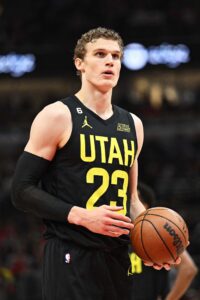 But it was Lauri Markkanen (acquired in the Mitchell deal) and Walker Kessler (part of the Gobert package) who paid big early dividends for the franchise. Markkanen earned his first All-Star berth and was named the NBA’s Most Improved Player, while Kessler finished third in Rookie of the Year voting and was fourth in the league in blocks per game (2.3) despite averaging only 23.0 MPG.
With Markkanen and Kessler under contract for multiple seasons, the Jazz have two intriguing cornerstones to build around and an opportunity to accelerate their rebuild even if they don’t have any luck in the 2023 draft lottery.
The Jazz’s Offseason Plan:
The Jazz are ninth in the lottery standings, so their odds of landing a top-three pick aren’t great (14.5%). That’s not the end of the world though. While Utah would obviously love to add one of 2023’s top prospects to its current core, the team is well positioned to continue adding talent even if that pick stays at No. 9.
For one, that lottery selection is just one of three first-rounders the Jazz own this June. They also control the Timberwolves’ pick at No. 16 and the Sixers’ at No. 28, putting them in position to either add a handful of rookies to the roster or to turn one or two of those picks into a trade asset.
The Jazz will also enter the offseason with the ability to generate significant cap space. Their guaranteed salary total of $47.6MM is a little misleading, since there could be as many as four player options to account for, along with some non-guaranteed salaries and cap holds for draft picks. But if we assume Talen Horton-Tucker, Rudy Gay, and Damian Jones all opt in, Kelly Olynyk and Kris Dunn are retained, and Utah keeps all three of its first-rounders, there could still be in excess of $42MM in cap room.
The big question will be at what pace the Jazz want to proceed as they build their roster. Ainge and Zanik are smart enough to recognize that just because the team won 37 games in 2022/23, that doesn’t mean that number will continue to rise as long as the front office makes an upgrade or two to the roster. Growth isn’t necessarily linear and a similar group could just as easily take a step back next season.
In theory, Utah is in a strong position to use its projected cap room to sign one impact player and to package its trade assets (including five future unprotected first-round picks from Minnesota and Cleveland) for a second impact player.
But after going into sell mode last offseason, I don’t expect the Jazz to do a 180 and essentially pull off the inverse of those Gobert and Mitchell trades this summer. The club seems more likely to exercise patience in building its new-look roster, despite last season’s success.
That means Utah’s cap room might be best used to accommodate salary dumps. With a more punitive new CBA taking effect in 2023/24, there will be teams around the NBA looking to move off unwanted money. The Jazz could capitalize on their cap flexibility by lessening the financial burden for one or two of those teams and acquire more draft picks in the process.
Assuming the front office takes the long view, I wouldn’t be surprised to see them trade one of their three 2023 first-rounders for a pick or two in a future year. That would allow the Jazz to continue building up their collection of future draft assets and to avoid bringing three first-round picks to camp this fall.
The team will also have to decide whether or not Jordan Clarkson is in its long-term plans. A Sixth Man of the Year winner during his time in Utah, Clarkson has proven to be an effective scorer for the Jazz and was a good value on his four-year, $52MM contract, but will likely turn down his $14.3MM player option in search of a more lucrative deal.
The Jazz have the financial flexibility necessary to accommodate Clarkson, but re-signing him could cut their cap room nearly in half, and Ainge has spent the last year moving off virtually every other veteran on the roster — perhaps Clarkson will be next.
The 2022/23 season showed that the Jazz probably won’t need to spend several years mired in a long rebuilding process, but they’re not on a fast-track to contention yet. The next steps are crucial and will help determine just how quickly Utah can move past its roster teardown and reclaim its place as an annual playoff team in the West.
Salary Cap Situation
Guaranteed Salary
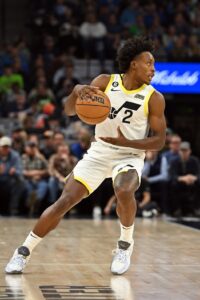 Collin Sexton ($17,325,000)
- Lauri Markkanen ($17,259,999)
- Ochai Agbaji ($4,114,200)
- Simone Fontecchio ($3,044,872)
- Kelly Olynyk ($3,000,000)
- Note: Partial guarantee. Rest of salary noted below.
- Walker Kessler ($2,831,160)
- Micah Potter (two-way)
- Total: $47,575,231
Dead/Retained Salary
- None
Player Options
- Jordan Clarkson ($14,260,000): Bird rights
- Talen Horton-Tucker ($11,020,000): Bird rights
- Rudy Gay ($6,479,000): Early Bird rights
- Damian Jones ($2,586,665): Non-Bird rights
- Total: $34,345,665
Team Options
- None
Non-Guaranteed Salary
- Kelly Olynyk ($9,195,122)
- Note: Partial guarantee. Olynyk’s salary would become fully guaranteed if he’s not waived on or before June 28.
- Kris Dunn ($2,586,665)
- Note: Dunn’s salary would become fully guaranteed if he’s not waived on or before October 23.
- Luka Samanic ($2,066,585)
- Note: Samanic would receive a partial guarantee ($400K) if he’s not waived on or before July 18. That partial guarantee would increase to $600K if he’s not waived on or before October 23.
- Vernon Carey Jr. ($1,997,238)
- Note: Carey’s salary would become fully guaranteed if he’s not waived on or before October 23.
- Total: $15,845,610
Restricted Free Agents
- None
Two-Way Free Agents
Draft Picks
- No. 9 overall ($5,487,120)
- Note: This is only a placeholder until the draft order is determined via the lottery.
- No. 16 overall ($3,831,960)
- No. 28 overall ($2,412,240)
- Total: $11,731,320
Extension-Eligible Players
- Jordan Clarkson (veteran)
- Rudy Gay (veteran)
- Talen Horton-Tucker (veteran)
- Lauri Markkanen (veteran)
- Kelly Olynyk (veteran)
Note: These are players who are either already eligible for an extension or will become eligible before the 2023/24 season begins. Gay and Horton-Tucker would only become eligible if their player options are exercised.
Unrestricted Free Agents / Other Cap Holds
- Udoka Azubuike ($3,923,484 cap hold): Bird rights
- Note: The Jazz can’t offer Azubuike a starting salary worth more than his cap hold, since his 2023/24 rookie scale option was declined.
- Juan Toscano-Anderson ($1,989,698 cap hold): Non-Bird rights
- Hassan Whiteside ($1,989,698 cap hold): Non-Bird rights
- Total: $7,902,880
Note: Whiteside’s cap hold remains on the Jazz’s books from a prior season because it hasn’t been renounced. He can’t be used in a sign-and-trade deal.
Cap Exceptions Available
- Room exception: $7,609,000
- Trade exception: $9,614,379
- Note: Expires on July 6.
- Trade exception: $6,745,122
- Note: Expires on September 22.
- Trade exception: $5,009,633
- Trade exception: $4,374,000
- Trade exception: $2,740,000
- Note: Expires on August 25.
- Trade exception: $202,202
- Note: Expires on June 30.
Hoops Rumors Chat Transcript: 5/9/2023
The transcript of our weekly Tuesday chat can be accessed here.
Join Luke Adams for our next chat on Thursday.
Pistons Notes: Coaching Search, Free Agency, Cunningham
First named as the frontrunners for the Pistons‘ head coaching job back on April 21, former UConn and Overtime Elite head coach Kevin Ollie, Bucks assistant Charles Lee, and Pelicans assistant Jarron Collins are still considered the finalists for the position, according to Shams Charania of The Athletic (Twitter link).
A previous report indicated that the top candidates for the Pistons’ coaching vacancy would meet with the organization’s top decision-makers, including owner Tom Gores. Charania confirms that those meetings are happening this week and that they’ll involve Ollie, Lee, and Collins.
Interviews with ownership typically represent the final stage of a head coaching search, so barring a new candidate entering the mix at the 11th hour, it seems possible that the Pistons could make a decision by the end of the week.
Here’s more out of Detroit:
- James L. Edwards III of The Athletic identifies 10 free agents who make sense as potential targets for the Pistons this summer, starting with former Detroit forward Jerami Grant. Edwards’ list includes noteworthy restricted free agents like Cameron Johnson and Austin Reaves as well as less heralded unrestricted free agents such as Torrey Craig and Yuta Watanabe.
- Shawn Windsor of The Detroit Free Press (subscription required) believes the time is right for Pistons general manager Troy Weaver to pursue an established veteran in free agency to supplement the team’s young core. Johnson and Khris Middleton are among Windsor’s suggestions.
- Keith Langlois of Pistons.com looks ahead and considers what to expect from former No. 1 overall pick Cade Cunningham in 2023/24 following a lost season. As Langlois details, Cunningham has tried to make the most of his injury absence, using his time off to bulk up and to work on his three-point shot.
- In case you missed it, we published our Pistons offseason preview last week.
NBA Announces 2022/23 All-Defensive Teams
The NBA has officially announced its All-Defensive teams for the 2022/23 season.
A total of 100 media members vote on the All-Defensive awards, with players receiving two points for a First Team vote and one point for a Second Team vote. This year’s All-Defensive teams are as follows:
First Team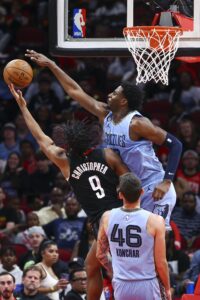
- Forward: Jaren Jackson Jr., Grizzlies (195 total points)
- Forward: Evan Mobley, Cavaliers (132)
- Guard: Jrue Holiday, Bucks (192)
- Guard: Alex Caruso, Bulls (125)
- Center: Brook Lopez, Bucks (181)
Second Team
- Forward: Draymond Green, Warriors (89)
- Forward: OG Anunoby, Raptors (81)
- Guard: Derrick White, Celtics (99)
- Guard: Dillon Brooks, Grizzlies (54)
- Center: Bam Adebayo, Heat (53)
Unsurprisingly, Jackson – who was this season’s Defensive Player of the Year – received the most First Team votes (96) and showed up on the most overall ballots (99). Only one voter didn’t have Jackson on either All-Defensive team.
Milwaukee teammates Holiday (94) and Lopez (85) received the second- and third-most First Team votes. No other player earned more than 50.
While the Bucks have two players on the First Team, it’s a bit surprising to see former DPOY Giannis Antetokounmpo miss out altogether. Antetokounmpo earned 16 First Team votes and 28 Second Team votes for a total of 60 points, the most of any player who didn’t earn All-Defensive honors. Although he received more total points than Brooks or Adebayo, Giannis didn’t make the cut because there were four forwards with more points than him.
Timberwolves forward Jaden McDaniels (40 points), Celtics guard Marcus Smart (35), Nets guard Mikal Bridges (33), and Nets center Nic Claxton (25) would have joined Antetokounmpo on a hypothetical All-Defensive Third Team as the highest vote-getters who fell just short.
A total of 38 players showed up on at least one ballot — the full voting results can be viewed here.
Being named to an All-Defensive team will benefit a pair of players financially, notes ESPN’s Bobby Marks (via Twitter). White earned a $250K bonus for his Second Team nod, while Holiday will receive $129,600 for making the First Team.
And-Ones: Sarr, Sharavjamts, 2022 Re-Draft, Bradbury
French big man Alex Sarr is joining the Perth Wildcats of Australia’s National Basketball League for the 2023/24 season as part of the NBL’s Next Stars program, he tells Jonathan Givony of ESPN.
A promising young prospect who began his playing career with Real Madrid’s youth team in 2019, Sarr has spent the last two years with Overtime Elite. The 18-year-old – who currently projects as a top-20 pick in 2024, per Givony – told ESPN that he was seeking a “new challenge” before becoming draft-eligible next year.
“The OTE experience was great,” Sarr said. “I had all the resources in the world and improved a lot the past two years. I need to take the next step with my game now; the NBL is what I need.”
As Givony observes, the NBL’s Next Stars program has been a popular choice for top French prospects in recent years. Ousmane Dieng played for the New Zealand Breakers before being drafted 11th overall by Oklahoma City in 2022, while Rayan Rupert – a projected first-rounder in 2023 – spent this past season with the Breakers.
Here are more odds and ends from around the basketball world:
- Dayton forward Mike Sharavjamts, who declared for the draft following his freshman year, is leaning toward turning pro but has entered the NCAA’s transfer portal so that he has an opportunity to explore his options if he decides to continue his college career, reports Givony (via Twitter). Sharavjamts is among the prospects attending this weekend’s G League Elite Camp, which should give him a better idea of where he stands in the 2023 draft class.
- Thunder forward Jalen Williams and Jazz center Walker Kessler are among the biggest risers in a re-draft of the 2022 draft conducted by Sam Vecenie of The Athletic. Williams jumps from No. 12 to No. 2 in Vecenie’s exercise, while Kessler moves from No. 22 to No. 9. Vecenie remains high enough on Chet Holmgren to keep the Thunder big man at No. 3 despite his lost rookie season.
- Veteran agent Kevin Bradbury, who represents players like Patrick Beverley and Robert Williams, has agreed to join LIFT Sports Management, reports Adrian Wojnarowski of ESPN (Twitter link). Bradbury will become the head of basketball for the agency, which was founded by Donnie McGrath and former NBA sharpshooter Mike Miller.
Sixers Notes: Harden, Embiid, Tucker, Melton
While Sixers stars Joel Embiid and James Harden have had a tendency to occasionally fall back on “my turn, your turn” style offense this season, their chemistry in Game 4 was what the team envisioned when it acquired Harden at last year’s deadline to pair him with Embiid, as David Aldridge of The Athletic writes.
Embiid and Harden combined for 76 points on 27-of-49 (55.1%) shooting in Sunday’s crucial home win. They were also involved in the biggest offensive possession of the night, when Embiid passed out of a double team with about 20 seconds left in overtime and found Harden, who hit a three-pointer to give Philadelphia a one-point win lead. That shot proved to be the game-winner.
“When we space the floor, and we do the things we need to do, it’ll find an open shot,” Harden said. “Not just me and Joel, but just everybody who’s open. Once we did that, tonight, we did that at a high level, consistently. And that’s just great offense for us.”
Here’s more on the 76ers:
- As Rich Hofmann of The Athletic writes, it has been a roller-coaster series so far for Harden, who has averaged 43.5 points per game on .622/.565/1.000 shooting in the Sixers’ two wins and 14.0 PPG on .179/.154/.842 shooting in the two losses. Jake Fischer of Yahoo Sports takes a look at what Harden’s performance in the present could mean for his future, noting that the guard’s name up frequently during the Rockets‘ interview process with head coaching candidates.
- The 76ers’ decision to give P.J. Tucker a fully guaranteed three-year, $33MM contract last summer raised some eyebrows, but veteran postseason leadership the club sought from the 38-year-old was on full display in Game 4, writes Eric Koreen of The Athletic. After Embiid shied away from attacking Celtics center Al Horford during the final minutes of regulation, Tucker delivered a spirited on-court message to this season’s MVP. “Nobody can guard Jo, one-on-one. There’s no way,” Tucker said. “That’s not disrespect to Al or anybody else, but I guarded him for a lot of years. When he’s aggressive and assertive, it’s impossible. And I’d seen him, two or three plays in a row, not do that. And we can’t have that. We can’t have that. Not with the season in the line. We can’t have it.”
- After letting a 16-point lead slip away, the Sixers looked like they might be headed for another devastating playoff loss on Sunday, but they pulled out a victory that head coach Doc Rivers attributed to the group’s improved “mental toughness,” as Tim Bontemps of ESPN relays. “We’ve just got veteran presence,” Embiid told ESPN. “Guys that know how to win, that know how to play. A lot of teams could have quit. But we just stuck together. We just got a different mindset this year.”
- De’Anthony Melton, a new addition to the team ahead of the 2022/23 season, has emerged as a consistent bright spot for the 76ers in the postseason, per Gina Mizell of The Philadelphia Inquirer. Melton went scoreless in Game 4 but had put up at last 13 points in four of the five games before that and has played strong, versatile defense.
Hoops Rumors Glossary: Cap Holds
The Mavericks have a little less than $104MM in guaranteed money committed to player salaries for 2023/24. However, even though next season’s salary cap is expected to come in at $134MM, Dallas won’t begin the 2023 offseason with $30MM+ in cap room to spend.
In fact, the Mavericks technically won’t open the new league year with any cap space at all. Each of Dallas’ own free agents will be assigned a free agent amount – or “cap hold” – until the player signs a new contract or the Mavericks renounce his rights.
The general purpose of a cap hold is to prevent teams from using room under the cap to sign free agents before using Bird rights to re-sign their own free agents. If a team wants to take advantage of its cap space, it can renounce the rights to its own free agents, eliminating those cap holds. However, doing so means the team will no longer hold any form of Bird rights for those players — if the team wants to re-sign those free agents, it would have to use its cap room or another kind of cap exception.
The following criteria are used for determining the amount of a free agent’s cap hold:
- First-round pick coming off rookie contract: 300% of the player’s previous salary if prior salary was below league average; 250% of previous salary if prior salary was above league average.
- Bird player: 190% of previous salary (if below league average) or 150% (if above average).
- Early Bird player: 130% of previous salary.
- Non-Bird player: 120% of previous salary.
- Minimum-salary player: Two-year veteran’s minimum salary, unless the free agent only has one year of experience, in which case it’s the one-year veteran’s minimum.
- Two-way player: One-year veteran’s minimum salary.
A cap hold for a restricted free agent can vary based on his contract status. A restricted free agent’s cap hold is either his free agent amount as determined by the criteria mentioned above or the amount of his qualifying offer, whichever is greater.
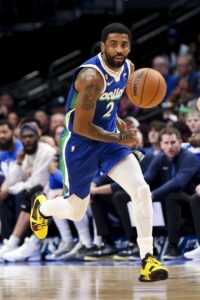 No cap hold can exceed the maximum salary for which a player can sign. For example, the cap hold for a Bird player with a salary above the league average is generally 150% of his previous salary, as noted above. But for someone like Mavericks star Kyrie Irving, whose cap charge was $39,204,557 this season, 150% of his previous salary would be nearly $59MM, well beyond his projected maximum salary.
Instead, Irving’s cap hold will be equivalent to the maximum salary for a player with 10+ years of NBA experience. If we assume a cap of $134MM, that figure works out to $46.9MM.
One unusual case involves players on rookie contracts whose third- or fourth-year options are declined. The amount of their declined option becomes their cap hold, and if the player’s team wants to re-sign him, his starting salary can’t exceed that amount.
For instance, the Jazz declined Udoka Azubuike‘s 2023/24 fourth-year option last fall. As a result, Utah won’t be able to offer Azubuike a starting salary this offseason worth more than $3,923,484, the amount of that option. That figure will also be his cap hold.
That rule is in place so a team can’t circumvent the rookie scale and decline its option in an effort to give the player a higher salary. It applies even if the player is traded after his option is declined, but only to the club the player is part of at season’s end. Any team besides the Jazz could offer Azubuike a starting salary greater than $3,923,484 this offseason.
If a team holds the rights to fewer than 12 players, cap holds worth the rookie minimum salary are assigned to fill out the roster. So, even if a front office chooses to renounce its rights to all of its free agents and doesn’t have any players under contract, the team wouldn’t be able to fully clear its cap. An incomplete roster charge in 2023/24 projects to be worth $1,102,929, meaning a team without any guaranteed salary or any other cap holds would have closer to $121MM in cap room than $134MM due to its 12 rookie minimum holds.
A player who has been selected in the draft but has not yet officially signed his rookie contract only has a cap hold if he was a first-round selection. A cap hold for a first-round pick is equivalent to 120% of his rookie scale amount, based on his draft position. An unsigned second-round pick doesn’t have a cap hold.
Cap holds aren’t removed from a team’s books until the player signs a new contract or has his rights renounced by the club. For example, the Warriors are still carrying cap holds on their books for retired players like David West and Matt Barnes, who never signed new contracts since playing for Golden State.
Keeping those cap holds allows teams some degree of cushion to help them remain above the cap and take advantage of the mid-level exception and trade exceptions, among other advantages afforded capped-out teams. If and when the Warriors want to maximize their cap room, they’ll renounce West and Barnes, but they’ve remained over the cap – and haven’t needed to remove those holds – since those players became free agents in 2017.
Note: This is a Hoops Rumors Glossary entry. Our glossary posts will explain specific rules relating to trades, free agency, or other aspects of the NBA’s Collective Bargaining Agreement. Larry Coon’s Salary Cap FAQ and the Basketball Insiders salary pages were used in the creation of this post.
Earlier versions of this post were published in previous years by Luke Adams and Chuck Myron.