
Assistant Coach Kevin Young Leaves Sixers For Suns
3:11pm: The Suns have officially announced the hiring of Young as an assistant coach.
2:39pm: Sixers assistant Kevin Young won’t remain on Philadelphia’s staff under Doc Rivers, according to Adrian Wojnarowski of ESPN, who reports (via Twitter) that Young has agreed to join Monty Williams‘ coaching staff with the Suns.
Young, who began his career as a G League coach, was promoted from the Delaware 87ers to Brett Brown‘s staff in 2016. He received another promotion to the front of the bench two years later, and then interviewed for Philadelphia’s head coaching job following Brown’s ouster this year.
Wojnarowski reported last week that Young made a “strong impression” on the 76ers during that head coaching interview, but with Rivers putting together his own staff, Young won’t be returning to Philadelphia for the 2020/21 season.
In Phoenix, Young will reunite with Williams – who served as a Sixers assistant during the 2018/19 season – and should fill the hole on the coaching staff created by Darko Rajakovic‘s departure last month.
2020 NBA Offseason Preview: Utah Jazz
Hoops Rumors is previewing the 2020 offseason for all 30 NBA teams. We’re looking at the key questions facing each club, as well as the roster decisions they’ll have to make this fall. Today, we’re focusing on the Utah Jazz.
Salary Cap Outlook
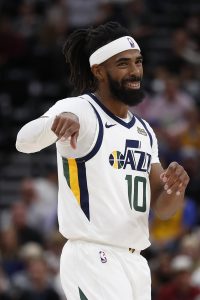
The only way the Jazz could realistically create cap space this offseason without cost-cutting roster moves would be if Mike Conley opts out of his $34.5MM salary for 2020/21. That won’t happen, so it’s a safe bet that Utah will operate as an over-the-cap club.
The Jazz’ ability to use their full mid-level exception ($9.26MM) and bi-annual exception ($3.62MM) may hinge on how they handle Jordan Clarkson‘s free agency, since a new deal for Clarkson would move team salary much closer to the tax. In that scenario, they may be limited to the taxpayer MLE ($5.72MM).
Our full salary cap preview for the Jazz can be found right here.
Roster Decisions To Watch
Options:
- Mike Conley, early termination option: $34,502,132
Non-Guaranteed Contracts:
- Georges Niang ($1,783,557)
- Rayjon Tucker ($1,517,981)
- Note: Partially guaranteed for $340K.
- Juwan Morgan ($1,517,981)
- Miye Oni ($1,517,981)
- Nigel Williams-Goss ($1,517,981)
Two-Way Contracts:
- Jarrell Brantley (expiring)
- Justin Wright-Foreman (expiring)
Free Agents:
- Jordan Clarkson (Bird)
- Emmanuel Mudiay (Non-Bird)
2020 Draft Assets
First Round:
- No. 23 overall pick
Second Round:
- None
The Jazz could have picked as high as No. 21 in the first round based on their record, which put them in a tie with Houston and Oklahoma City. However, Utah lost the three-way tiebreaker and ended up at No. 23 instead.
Utah’s second-round pick (No. 51) was originally traded to Cleveland during the 2018/19 season for Kyle Korver. It changed hands three more times in subsequent deals, ultimately ending up with Golden State.
Three Key Offseason Questions
1. Will Donovan Mitchell sign a contract extension this offseason?
Both Mitchell and Rudy Gobert will be eligible to sign new contracts this offseason, but they aren’t necessarily equally likely to get extensions.
Mitchell’s case is the simpler one. Having been drafted in the 2017 lottery, he’s entering the fourth and final year of his rookie contract, making him eligible for a rookie scale extension. If he signs a new contract, it would go into effect during the 2021/22 season and could have a starting salary worth up to 25% of that year’s cap — or even 30% of the cap, if he makes an All-NBA team next season.
It seems almost certain that Utah will offer Mitchell a maximum-salary deal sooner rather than later. In the unlikely event that the Jazz were still on the fence about that decision, Mitchell’s performance in seven playoff games this season certainly helped seal the deal — he couldn’t quite lead them to a series win, but averaged 36.3 PPG, 5.0 RPG, and 4.9 APG with a .529/.516/.948 shooting line.
While negotiations between the two sides should be pretty simple, they’ll need to agree on possible Rose Rule language in an extension. That shouldn’t be too much of a challenge, especially if they use last year’s Ben Simmons and Jamal Murray rookie scale extensions as points of comparison.
The language in Simmons’ agreement with Philadelphia boosted his starting salary to 28% of the cap for a Third Team All-NBA nod, and that figure would have increased to 30% if he made the First Team. The language in Murray’s deal with Denver – which included a salary at 26% of the cap for a Third Team All-NBA spot – was similar, albeit slightly more team-friendly.
The Jazz and Mitchell should be able to work out something in that same neighborhood, rewarding him with a slightly more lucrative long-term contract if he makes the leap to become an All-NBA player in 2020/21.
2. Will Rudy Gobert sign a new extension of his own this offseason?
Gobert’s extension eligibility will create a trickier situation for the Jazz. At age 28, the two-time Defensive Player of the Year is four years older than Mitchell and it’s unclear whether how much room his game still has to grow, so the club will have to keep that in mind as it considers a new long-term investment.
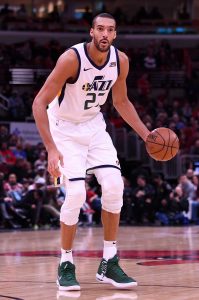 Mitchell’s next deal will also be a little more cost-controlled than Gobert’s could be. Even with an All-NBA berth next season, Mitchell can’t sign a rookie scale extension exceeding 30% of the cap. Due to Gobert’s All-NBA nods and DPOY awards, he has qualified for a veteran extension that can be worth up to 35% of the cap in 2021/22.
That may not seem like a substantial difference, but it adds up over the course of four or five years. If we assume the cap will be $115MM in 2021/22, an extension starting at 35% of the cap would be worth $40.25MM in year one and $233.45MM over five seasons. A 30% deal would start at $34.5MM and would be worth $200.1MM over five years.
Now, just because Gobert has qualified for a super-max extension doesn’t mean that the Jazz have to offer him one. Standard veteran extension rules would still allow Utah to offer Gobert up to $142.6MM on a four-year extension this offseason and that might be a more appropriate price for a player who is elite defensively but will never be nearly as dangerous on the offensive end.
Still, there are questions that must be addressed here. After two consecutive first-round playoff exits, are the Jazz still all-in on the Gobert/Mitchell duo? Because signing both players to lucrative long-term extensions will eat up a huge portion of the franchise’s cap room for years to come.
From Gobert’s perspective, would an extension offer below the super-max appeal to him? If he doesn’t get a super-max offer, perhaps he’d rather just wait for free agency in 2021 to sign a new deal, giving himself the chance to see what other opportunities are out there. We’ve seen some instances in the past where a team’s unwillingness to put a super-max on the table ultimately led to the player’s exit (ie. Jimmy Butler in Chicago or Kemba Walker in Charlotte).
And while it seemed by the end of Utah’s run in Orlando that any issues were long behind them, it’s worth noting that we’re only six months removed from reports about Mitchell and Gobert working on repairing their relationship after their positive coronavirus tests left them upset at one another. Are they ready to sign up for another five years of playing alongside one another?
I don’t expect the Jazz to seriously consider the idea of trading Gobert this fall. But it will be worth keeping a close eye on extension talks between the two sides — if they don’t work something out, the standout center will be on track to join a star-studded 2021 free agent class, with plenty of teams around the NBA expected to have cap room available.
3. Will the Jazz re-sign Jordan Clarkson?
Barring a shocking opt-out from Mike Conley, Clarkson will be the only key member of the Jazz rotation whose contract is expiring this offseason. His free agency creates a potential dilemma for the franchise.
Acquired last December in a trade with Cleveland, Clarkson immediately added some scoring punch to Utah’s second unit, enjoying one of the best runs of his career in 42 games with the Jazz. He posted 15.6 PPG on .462/.366/.785 shooting during that time, and his numbers didn’t fall off in the postseason either — he scored 16.7 PPG on .464/.347/1.000 shooting in seven playoff contests vs. Denver.
Clarkson’s ability to create his own shot and put the ball in the basket was a welcome addition to a Jazz roster that’s not exactly loaded with scorers, especially when Bojan Bogdanovic‘s season ended early due to wrist surgery. But he’s a somewhat one-dimensional player who’s not exactly an elite defender.
Utah president of basketball operations Dennis Lindsey spoke last month about prioritizing defensive-minded players this offseason. While Clarkson’s offense gave the team a boost, would his rotation spot be better utilized by a wing player who’s more capable of slowing down opposing scorers? And if Clarkson isn’t re-signed, will the Jazz have the cap flexibility to acquire a quality player who fits that bill?
If we assume Conley opts in and the Jazz keep their first-round pick while jettisoning their players on non-guaranteed contracts (except for Georges Niang), the team would be on the hook for about $116.4MM for 10 players. Re-signing Clarkson to a deal in the mid-level range would push that figure above $125MM. And if we assume the tax line will once again be $132.6MM, that doesn’t leave enough room below the tax for Utah to use its full mid-level exception.
Using the full MLE without going into the tax would be an option if the team lets Clarkson walk or cuts costs elsewhere, but it remains to be seen if that exception will be enough to acquire an impact rotation player.
A year ago, Seth Curry, Derrick Rose, Al-Farouq Aminu, and Tyus Jones were the players who received most or all of the non-taxpayer MLE. The Jazz may have to determine whether a player in that tier would be a better option than Clarkson — or if a leaguewide reluctance to spend might result in more intriguing options being available.
Given how well Clarkson fit in Utah this past season, I’d be a little surprised if the team simply lets him go. Perhaps a best-case scenario for the Jazz would be re-signing Clarkson at a fair price and then using a portion of the MLE to sign a free agent who lacks a strong track record but has some defensive upside (such as Derrick Jones). Trading for a wing is another possibility, though the Jazz aren’t loaded with a ton of expendable trade assets.
Information from Basketball Insiders and ESPN was used in the creation of this post. Photos courtesy of USA Today Sports Images.
Latest On Rockets’ Head Coaching Search
The Rockets are scheduled to meet with Tyronn Lue about their head coaching job early next week, sources tell Marc Stein of The New York Times (Twitter link). Lue’s interview with Houston was originally supposed to happen this past Sunday, but it has now seemingly been pushed back twice as the team takes its time and meets with other candidates.
The Rockets reportedly interviewed Kenny Atkinson, Wes Unseld Jr., and Stephen Silas this week and are meeting with David Vanterpool today. According to Stein, the club is also expected to meet in the “near future” with assistant John Lucas and ESPN analyst Jeff Van Gundy.
Once the NBA Finals end and Van Gundy’s schedule opens up, we should get a better sense of how serious the Rockets are about pursuing him. He has reportedly been on general manager Daryl Morey‘s radar in the past and was one of the first candidates linked to the Houston job, even before the team parted ways with Mike D’Antoni.
Appearing on Brian Windhorst’s Hoop Collective podcast this week, ESPN’s Tim MacMahon stated that Van Gundy is still believed to be high on the Rockets’ list.
“I still think Jeff Van Gundy is probably the favorite, but they’re definitely doing their due diligence,” MacMahon said (link via RealGM). “… Really, I think the most important thing for the coaching candidates is going to be aligning with Daryl Morey and his vision in terms of basketball philosophy as well as who is going to be on that staff because we all know Daryl Morey is very hands on in terms of putting together a coach’s staff.”
Another factor worth monitoring as the Rockets seek a new head coach is how much team owner Tilman Fertitta will be willing to pay to fill the role.
Since Fertitta’s arrival, Houston has made an apparent effort to avoid finishing seasons in luxury-tax territory. The Rockets also reportedly offered D’Antoni an extension heavy on non-guaranteed incentives last offseason. If the organization is unwilling to make a significant financial commitment to its next head coach, it would presumably reduce the odds of an experienced candidate like Lue or Van Gundy taking the job.
China’s CCTV To Air Game 5 Of NBA Finals
Following a year-long ban on broadcasts of NBA games, CCTV – the major state-owned media network in China – will air Game 5 of the NBA Finals, as ESPN’s Brian Windhorst writes.
CCTV has aired NBA games since the early 1990s, per Windhorst, but pulled them from their scheduled for the 2019/20 season following Daryl Morey‘s tweet in support of Hong Kong protestors last fall.
For most of the year, CCTV’s stance was that it wouldn’t resume showing NBA games as long as Morey remained unpunished for his tweet. However, the network’s statement today stated that the NBA’s role in fighting COVID-19 in China played a part in the decision to resume live broadcasts. According to Windhorst, the league donated over $1MM and medical equipment to China earlier this year.
If the CCTV’s resumption of NBA broadcasts is a permanent decision rather than a temporary one, it would be good news for the league, which lost a significant source of revenue when the network – along with Chinese streaming giant Tencent – stopped airing games last fall. Tencent resumed its broadcasts shortly after the initial boycott, but the company’s relationship with the NBA has remained tenuous throughout the last year.
Estimates have indicated that the NBA faced at least $200-300MM in revenue losses due to the impact the Morey tweet and the subsequent controversy had on its relationship with Chinese partners. With the league also facing significant losses due to the coronavirus pandemic, improving relations with China has been a priority for commissioner Adam Silver for much of 2020, Windhorst writes.
Lakers Notes: LeBron, Davis, Vogel
More than a year after the first game of the NBA’s 2019 preseason tipped off, the ’19/20 campaign may finally come to an end tonight.
The Lakers hold a 3-1 lead in the NBA Finals over the Heat and haven’t dropped more than one game in any of their three playoff series so far. If that trend holds, they’ll be crowned 2020 NBA champions before the end of the day.
As we wait to see if Los Angeles can finish off Miami tonight, here’s some Lakers-related reading:
- LeBron James wasn’t immediately embraced by die-hard Lakers fans when he signed with the team in 2018, but he said on Thursday that he understands why it took them some time to warm to him. “They don’t care about your résumé at all until you become a Laker,” James said, per Ohm Youngmisuk of ESPN. “Then you’ve got to do it as a Laker, and then they respect you. I’ve learned that.”
- Ahead of his upcoming free agency, Anthony Davis referred to Lakers head of basketball operations Rob Pelinka on Thursday as a “great executive,” as Mirjam Swanson of The Orange County Register writes. Davis added that Pelinka’s seventh-place finish in Executive of the Year award voting puts him in good company. “That’s kind of been a thing this year with myself with Defensive Player of the Year, LeBron with MVP (he was runner-up), now Rob with Executive of the Year,” Davis said. “But if we’re able to win one more game, then no one cares about those other awards. We’ll all be champions.”
- Revisiting Davis’ midseason trade request from 2019, Jordan Greer of Sporting News observes that the public nature of the demand earned AD a fine and created a messy situation in New Orleans for months, but ultimately got the star big man everything he wanted.
- With Frank Vogel on the verge of his first NBA title, Mark Whicker of The Orange County Register takes a look back at Vogel’s long, winding coaching career, which essentially began when he served as a student manager on Rick Pitino‘s Kentucky squad in 1994/95. Vogel’s first NBA job was a video coordinator role for the Celtics under Pitino several years later.
Heat Notes: Crowder, Iguodala, Dragic, Adebayo
Jae Crowder has only been a member of the Heat for about eight months, but this year’s run to the NBA Finals has helped convince him he’d like to stick around a little longer. The veteran forward told reporters today that he’s interested in re-signing with the club this offseason, according to Barry Jackson of The Miami Herald.
“Hopefully we can work something out,” Crowder said. “It’s enjoyable because we’re winning. Last two teams standing. It’s been a great, great organization to be a part of.”
With the Heat looking to maintain cap flexibility for the 2021 free agent class, Jackson says he expects the club to give Crowder a one-year offer that might include a team option for the 2021/22 season.
Here’s more on the Heat:
- Rob Mahoney of The Ringer takes a closer look at how the trade-deadline deal that sent Crowder and Andre Iguodala to Miami helped the Heat reshape their roster and unlock the team’s two-way potential.
- A report earlier this week suggested that front office executives around the NBA view the Heat as the top destination for the next star player seeking a change of scenery. According to Barry Jackson of The Miami Herald, a number of player agents share this view. “I think they are quite compelling to anyone,” veteran agent Bill Neff said. “If I’m (a top free agent), I like the culture, the coach and the organization.”
- As expected, injured point guard Goran Dragic remains doubtful to play in Game 5 of the Finals on Friday due to his torn plantar fascia. On a positive note, Bam Adebayo no longer appears on the injury report after playing in Game 4, tweets Ira Winderman of The South Florida Sun Sentinel.
Lack Of Consensus On Prospects Could Shake Up Draft
Former North Carolina guard Cole Anthony has long been considered a probable lottery pick in the 2020 draft, ranking 14th on ESPN’s top-100 list even after an underwhelming freshman season. However, Jonathan Wasserman of Bleacher Report (Twitter link) says he recently spoke to one executive who has Anthony at No. 35 on his big board.
Different teams having differing opinions on certain draft prospects is hardly breaking news, but the lack of a consensus among clubs in their assessments of this year’s class seems more extreme than usual. Replying to Wasserman’s initial tweet, Kevin O’Connor of The Ringer observed that it’s amazing how “all over the place” people around the NBA are on this year’s draft.
“It’s all over the map, this draft,” one team executive told Darren Wolfson of 5 Eyewitness News (Twitter link). “Seems everyone is thinking different and everyone is in trade mode.”
The circumstances surrounding this year’s pre-draft and scouting process have almost certainly contributed to the divided views on many of this year’s prospects.
Because the NCAA season was shut down in March due to the coronavirus pandemic, teams didn’t get a chance to evaluate players during the NCAA tournament and haven’t been able to bring them in for in-person workouts and meetings. The combine had to be significantly revamped as well. As a result, clubs have had to base many of their scouting reports off of virtual interviews and game film from at least seven months ago.
It’s hard to say yet how exactly the draft will be affected, but it sounds like it’ll be more challenging than ever to put together an accurate mock in 2020. And if everyone is indeed in “trade mode,” as Wolfson’s source suggests, it could make for an eventful evening on November 18.
It’s also worth noting that teams will have much more time to talk trades leading up to the draft — typically, there’s only about a week between the end of the NBA Finals and draft day, but that gap will be longer than a month in 2020, giving clubs plenty of time to explore all of their possible options.
Kerr: Warriors’ Roster “Far From Being Finished”
The Warriors will look a whole lot different in 2020/21 than they did in 2019/20, as Splash Brothers Stephen Curry and Klay Thompson get healthy and return to action after missing most – or, in Thompson’s case, all – of the past season.
In addition to getting those two stars back, Golden State expects to make more changes to its roster this offseason, perhaps with a focus on adding size and athleticism, head coach Steve Kerr said this week on The Athletic’s TK Show with Tim Kawakami.
“I think we need to be more athletic, for sure,” Kerr said, as Drew Shiller of NBC Sports Bay Area relays. “We’re obviously very skilled. But we don’t have an overly athletic team. We’ve lost a lot of bounce and a lot of pop on the wings — even at the center position. (So) right now, we’re not big enough or athletic enough to get where we want to be.
“But we all know that. We have the draft and we have free agency to address all that stuff. And potential trades,” Kerr continued. “I think (president of basketball operations) Bob (Myers) would be the first to tell you this roster is far from being finished.”
Despite being capped-out for 2020/21, the Warriors have several interesting assets at their disposal, including the No. 2 overall pick in the draft and a $17MM+ trade exception.
[RELATED: Various Ways Warriors Could Use Trade Exception]
The club will also have the taxpayer mid-level exception (worth approximately $5.72MM) available in free agency and could dangle future draft picks – such as Minnesota’s top-three protected 2021 first-rounder – in trade talks.
The Warriors are typically aggressive when it comes to pursuing roster upgrades, so with all those assets on hand, Kerr’s assertion that the roster is a work in progress comes as no real surprise.
Still, as Shiller observes, it’s a good sign for any fans be worried about the impact the coronavirus pandemic might have on Golden State’s willingness to spend. Based on Kerr’s comments, it doesn’t sound as if the team will prioritize cost-cutting moves or be content to stand pat this fall.
Clippers’ Lawrence Frank Named Executive Of The Year
Clippers president of basketball operations Lawrence Frank has been named the NBA’s Executive of the Year for the 2019/20 season, the league announced today in a press release.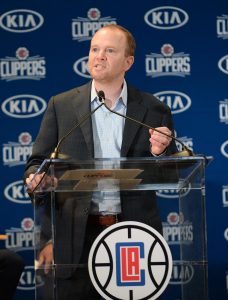
Frank received 10 of 29 first-place votes for the award, which is voted on by a panel of team front office executives from around the league. He beat out Sam Presti of the Thunder and Pat Riley of the Heat, who finished second and third, respectively.
The criteria for the Executive of the Year award aren’t clearly defined, so some top vote-getters are recognized for the splashy or savvy roster moves they made within the last year, while others receive votes for an accumulation of the moves made in recent years that helped build their current rosters.
In Frank’s case, it’s safe to say he earned Executive of the Year honors for the job he did landing Kawhi Leonard and Paul George on the same night last July, instantly turning the Clippers into title contenders. The team also re-signed Patrick Beverley, Ivica Zubac, JaMychal Green, and Rodney McGruder to new deals, and acquired Maurice Harkless and a first-round pick in a four-team deal during the free agent period last summer. Frank later flipped Harkless and a first-rounder to the Knicks for Marcus Morris.
Frank’s roster moves didn’t ultimately result in a deep playoff run for the Clippers, who were upset in the second round by the Nuggets. However, voting for the Executive of the Year award was completed prior to the NBA’s summer restart.
The full voting results for Executive of the Year can be found below. Teams’ heads of basketball operations were awarded five points for each first-place vote, three points for a second-place vote, and one point for a third-place vote.
- Lawrence Frank, Clippers (61 points)
- Sam Presti, Thunder (41)
- Pat Riley, Heat (39)
- Jon Horst, Bucks (27)
- Masai Ujiri, Raptors (20)
- Zach Kleiman, Grizzlies (16)
- Rob Pelinka, Lakers (14)
- Donn Nelson, Mavericks (8)
- Tim Connelly, Nuggets (7)
- Danny Ainge, Celtics (6)
- Bob Myers, Warriors (5)
- Jeff Weltman, Magic (5)
- David Griffin, Pelicans (5)
- James Jones, Suns (3)
- Ed Stefanski, Pistons (1)
- Dennis Lindsey, Jazz (1)
- Kevin Pritchard, Pacers (1)
- Sean Marks, Nets (1)
Photo courtesy of USA Today Sports Images.
2020 NBA Offseason Preview: Philadelphia 76ers
Hoops Rumors is previewing the 2020 offseason for all 30 NBA teams. We’re looking at the key questions facing each club, as well as the roster decisions they’ll have to make this fall. Today, we’re focusing on the Philadelphia 76ers.
Salary Cap Outlook
The Sixers will enter the 2020 offseason with one of the NBA’s most expensive rosters — the club has more than $142MM committed to just nine players so far in 2020/21, eliminating the possibility of cap room and making Philadelphia a near-lock to be a taxpayer.
Barring major cost-cutting moves, the 76ers would have the taxpayer mid-level exception ($5.72MM) at their disposal in free agency.
Our full salary cap preview for the Sixers can be found right here.
Roster Decisions To Watch
Options:
- None
Non-Guaranteed Contracts:
- Furkan Korkmaz ($1,762,796)
- Norvel Pelle ($1,517,981)
Two-Way Contracts:
- Marial Shayok (expires in 2021)
Free Agents:
- Alec Burks (Non-Bird)
- Glenn Robinson III (Non-Bird)
- Raul Neto (Non-Bird)
- Kyle O’Quinn (Non-Bird)
- Ryan Broekhoff (N/A)
- Note: Broekhoff won’t have any form of Bird rights because he was signed as a substitute player.
2020 Draft Assets
First Round:
- No. 21 overall pick
Second Round:
- No. 34 overall pick
- No. 36 overall pick
- No. 49 overall pick
- No. 58 overall pick
As has often been the case over the last few years, the Sixers have no shortage of draft picks available.
Philadelphia gave up its own 2020 first-rounder (No. 19) to acquire Tobias Harris from the Clippers in 2019, but the club has the Thunder’s first-round pick at No. 21 as a result of a Jerami Grant trade back in 2016. That selection, which had been top-20 protected, was sent to Orlando in 2017 for the rights to draft Anzejs Pasecniks before being traded back to Philadelphia in 2019 for Markelle Fultz.
In the second round, the Sixers have their own pick at No. 49, as well as the Hawks’, Knicks’, and Lakers’ selections.
Philadelphia got Atlanta’s pick (No. 34) when the Hawks moved up for Bruno Fernando in last year’s draft; the Knicks pick at No. 36 was acquired back in 2015 when New York traded for Willy Hernangomez‘s draft rights; and the Lakers’ pick (No. 58) was originally dealt to Orlando before being flipped to the Sixers at the 2020 deadline for James Ennis.
Three Key Offseason Questions
1. What will the decision-making structure look like going forward?
Following a disappointing season, the Sixers wasted no time in firing head coach Brett Brown once they were eliminated from the playoffs. Around that same time, reports suggested that the team also planned to make some changes to its front office personnel and structure.
Since the departure of former head of basketball operations Bryan Colangelo in 2018, the 76ers’ front office has taken a collaborative approach to decision-making, but general manager Elton Brand said at season’s end that he and the club felt as if “the collaboration days didn’t work.”
The stage seemed set for the Sixers to either hire a president of basketball operations a level above Brand or to empower Brand by giving him the final say on personnel decisions. Instead, there was little clarity on Philadelphia’s front office plan for several weeks while the team was searching for its new head coach.
Identifying and hiring Brown’s replacement was supposed to be Brand’s responsibility, but team ownership was said to be heavily involved in the process. When the Sixers ultimately hired Doc Rivers, Jason Dumas of KRON4 News reported that team ownership had initially wanted Mike D’Antoni while Brand preferred Tyronn Lue — when Rivers became available, he represented a candidate that both sides agreed upon.
The hiring of Rivers further muddies the waters of the Sixers’ front office hierarchy. Rivers was formerly the Clippers’ president of basketball operations, and when he was asked in his introductory presser with the Sixers about personnel decisions, he said that he and Brand will “work together.” That sounds a lot like the “collaborative” approach that Brand said in August wasn’t working for the franchise.
Having too many cooks in the kitchen on major roster decisions could complicate trade talks and create other problems for the Sixers in the future. It would be in the organization’s best interests to have co-owners Josh Harris and David Blitzer clearly define the front office hierarchy to avoid any confusion going forward, since significant roster decisions are on the horizon.
It sounds like the team is working toward that goal, having reportedly started interviewing candidates for at least one executive role below Brand.
2. How invested are the Sixers in the Ben Simmons/Joel Embiid duo?
Shortly after the 76ers’ 2019/20 season came to an end, Brand declared that the team had no intention of trading either Simmons or Embiid. The plan, according to Brand, is to put together a roster that will better complement those two stars.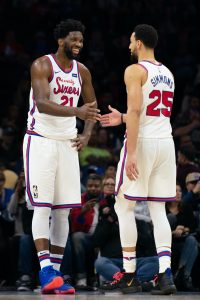
That approach comes as no surprise. When NBA teams bottom out like Philadelphia did during their infamous “Process,” the goal is to land a superstar-caliber player who can lead the franchise back to contention. Simmons and Embiid have their flaws, but they fit that criteria — they each have All-NBA berths under their belts and rank among the NBA’s best players at their respective positions. They’re also just 24 and 26 years old, respectively, so they have room to continue improving.
The problem, of course, is that their offensive styles don’t fit together as naturally as you’d like from your two stars. Simmons is a monster in transition, but still has little to no range on his jump shot, creating floor-spacing issues that clog the lane for Embiid, arguably the NBA’s best low-post scorer.
The duo’s mismatched nature has had some factions of NBA fans – in Philadelphia and elsewhere – clamoring for a trade involving one of the two players, since it’d be fascinating to see what they could do with their own teams built around their strengths.
For now though, the 76ers’ plan is to see if Rivers is capable of unlocking the potential of the Simmons/Embiid pairing. After all, it was just a puzzle that Brown was incapable of solving, then trading either player would be premature and short-sighted.
Still, while a Simmons or Embiid trade may not be in the cards this offseason, the Sixers need to start thinking about how long they’re committed to trying to make the marriage work. Even after the 2020/21 season, Embiid will have two more years on his contract and Simmons will be locked up for four seasons. Philadelphia could extract a substantial return for either player and could target packages headlined by players who would better suit their roster.
3. Can the Sixers find a favorable deal involving Tobias Harris or Al Horford?
If Simmons and Embiid are off the table, that means the Sixers’ best chance to shake up their roster this fall will involve moving one of their two other big-money contracts. Those deals belong to Harris, who still has four years and $147MM left, and to Horford, who has three years and $81MM remaining, though his final season is just partially guaranteed.
Neither of those players represents a positive asset right now. Harris remains a solid contributor, but with an annual salary of nearly $37MM over the next four years, he’s being paid as if he can be a top-two player on a title contender, which overstates his value.
As for Horford, he didn’t end up being a great fit alongside Embiid and it’s probably safe to say he’s past prime at age 34. His production won’t necessarily fall off a cliff, but his .450 FG% in his first season as a Sixer represented a career low, and his once-elite defensive skills will likely continue to fade as he enters his mid-30s and loses a step.
Although their trade value will be hurt by their exorbitant salaries, Harris and Horford could appeal to a team looking to get rid of an oversized contract of its own. That’s why Chris Paul has so frequently been cited as a potential trade target for Philadelphia.
Paul only has two years left on his contract, but his per-year salary during that time (approximately $42.8MM) is even higher than Harris’ or Horford’s. His play-making and shot-making abilities would also be a nice fit on a Sixers roster that could use a little help on both fronts.
Philadelphia native Kyle Lowry is also the sort of player the Sixers would presumably love to target. His game is similar to Paul’s and he’s even more affordable (one year at $30.5MM), though the Raptors presumably won’t be nearly as motivated to move him as the Thunder would be to find a taker for Paul.
Buddy Hield‘s is another name that has popped up frequently in 76ers-related trade speculation. He’s reportedly not thrilled with his situation in Sacramento and has liked social media posts linking him to Philadelphia. If the Sixers are targeting outside shooting, it’d be hard to do much better than Hield, who has made 41.1% of 6.7 three-point attempts per game since entering the league in 2016. His contract, worth $86MM over four years, plus incentives, isn’t necessarily a bargain, but it’s more team-friendly than Horford’s or Harris’.
Of those two Sixers contracts, Horford’s – which is shorter-term and less expensive than Harris’ – may be easier to move. Trading Horford rather than Harris probably also makes more sense for the Sixers from an on-court perspective, since it’s easier to find reliable backup centers on the cheap than it is to find productive wings.
Still, even if the 76ers’ top target is a mid-30s veteran with an oversized contract like Paul, it will take more than Horford to get a deal done. To acquire any sort of starting-caliber player, Philadelphia will have to be prepared to dip into its pool of future draft picks.
Information from Basketball Insiders and ESPN was used in the creation of this post. Photos courtesy of USA Today Sports Images.