
Five Key Offseason Questions: Milwaukee Bucks
With Giannis Antetokounmpo evolving into a legitimate MVP candidate, the Bucks evolved along with him, finishing strong and returning to the postseason despite playing without Khris Middleton and Jabari Parker for significant portions of the season. Milwaukee may not be a bona-fide contender quite yet, but the team looked dangerous in the first round of the playoffs, taking a 2-1 lead on the Raptors before Toronto came back to win the series.
Antetokounmpo, who is still just 22 years old, may yet have room to improve, which bodes well for the Bucks as they attempt to fortify their roster around him. Finding the best way to add and retain those complementary pieces will be the key challenge for the Bucks this summer.
Here are five important questions facing the Bucks as they enter the offseason…
1. Who will be making the final call on roster decisions?
John Hammond was my pick for Executive of the Year this past season, based on his impressive work in the draft and in trades. Milwaukee isn’t exactly a top destination for elite free agents, so the Bucks benefited from having their roster managed by someone like Hammond, who was capable of finding value in minor moves.
Hammond is now the general manager in Orlando, leaving assistant GM Justin Zanik as the executive calling the shots in Milwaukee right now. Zanik is a candidate – and a good one – to take over the top job in the Bucks’ front office, but the club is conducting a broad search for that position, and has already received permission to speak to execs from four other teams.
A timetable for a hiring hasn’t yet been announced, so it remains to be seen whether the Bucks will add someone to the front office in time for that newcomer to have substantial input on the team’s offseason moves, or whether Zanik will be allowed to run the show this offseason whether or not he formally receives a promotion.
2. How does Jabari Parker fit into the Bucks’ long-term plans?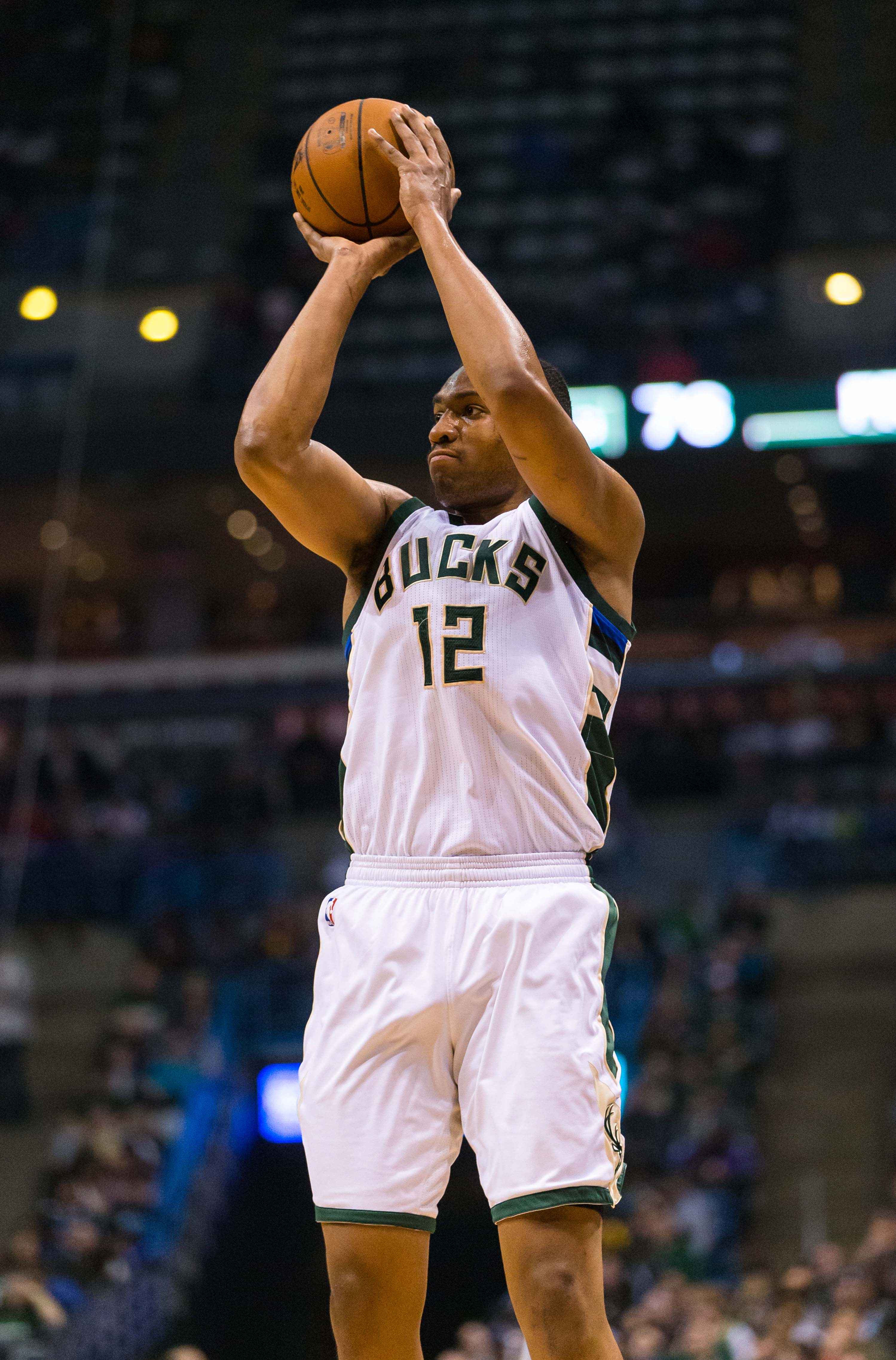
One of the decisions facing the Bucks’ new general manager this offseason will be whether or not to lock up Parker. The former No. 2 overall pick is eligible for a contract extension as of July 1, but he also remains in the process of rehabbing his second major ACL injury.
Complicating matters further is the fact that Milwaukee’s best stretch of the 2016/17 season came after Parker’s injury. When Parker went down, the Bucks had a 22-29 record, and seemed likely to tank down the stretch. Instead, the team went on a 20-11 tear to finish the season, thriving without Parker in the lineup.
That successful second-half run doesn’t mean that the Bucks are better without Parker for the long term, but – combined with his ACL injury – it’s probably enough to give the organization pause when it comes to working out a contract extension this offseason.
NBA Maximum Salary Projections For 2017/18
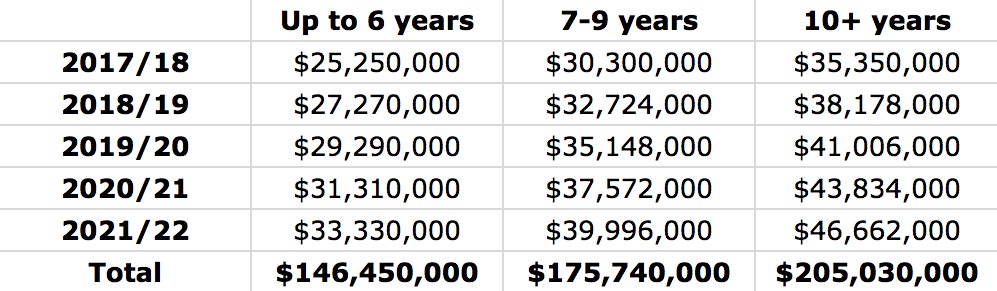
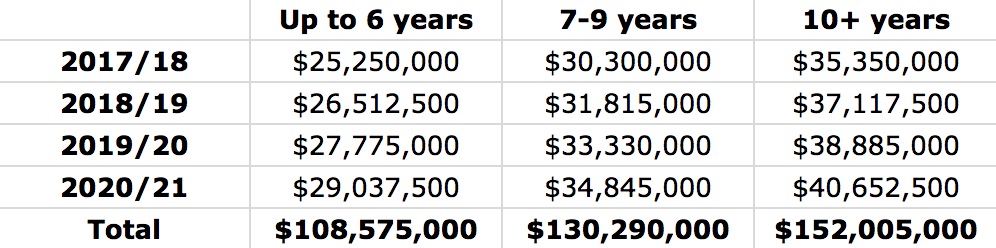
Back in March, we published maximum salary projections based on a $102MM salary cap. Since then, the NBA has reduced its projection for the 2017/18 league year to $101MM. The difference is small, but it’s enough to affect what maximum salary contracts would look like. For instance, a player like Chris Paul could earn more than $207MM on a five-year max with the Clippers with a $102MM cap. With a $101MM cap, his maximum earnings slip a little to about $205MM.
While maximum salary contracts start at the same amount no matter where a player signs, players re-signing with their own teams can get larger raises and more years than if they sign elsewhere.
Additionally, players with less than seven years of NBA experience can only get a maximum salary worth 25% of the cap, while veterans with more experience can sign deals that start at 30% or 35% of the cap. So, the figures below reflect the various salaries that players like Nerlens Noel (less than six years), Gordon Hayward (7-9 years), and Paul (10+ years) could get on max contracts.
You can check out our story from March for more details on maximum salary contracts. For now, here’s what new max deals will tentatively look like this summer based on a $101MM cap:
A player re-signing with his own team (8% annual raises, up to five years):
Trade Rumors app users, click here for chart.
A player signing with a new team (5% annual raises, up to four years):
Trade Rumors app users, click here for chart.
2017 Offseason Salary Cap Digest: Charlotte Hornets
After a solid 2015/16 season, the Hornets took a step back in ’16/17, with their win total dipping from 48 to 36. As Charlotte looks to bounce back, the fact that Kemba Walker is the sixth-highest-paid player on the roster is both good and bad news for the club — Walker is on a very team-friendly contract, but the Hornets have made some other questionable big-money investments that will limit their flexibility.
Here’s where things currently stand for the Hornets financially, as we continue our Offseason Salary Cap Digest series for 2017:
Guaranteed Salary
- Nicolas Batum ($22,434,783)
- Marvin Williams ($13,168,750)
- Michael Kidd-Gilchrist ($13,000,000)
- Cody Zeller ($12,584,270)
- Miles Plumlee ($12,500,000)
- Kemba Walker ($12,000,000)
- Jeremy Lamb ($7,000,000)
- Marco Belinelli ($6,606,060)
- Frank Kaminsky ($2,847,600)
- Total: $102,141,463
Player Options
- None
Team Options
- Ramon Sessions ($6,270,000)
- Total: $6,270,000
Non-Guaranteed Salary
- Johnny O’Bryant ($1,524,305)1
- Briante Weber ($1,471,382)2
- Treveon Graham ($1,312,611)
- Total: $4,308,298
Restricted Free Agents
- None
Cap Holds
- No. 11 overall pick ($2,904,480)
- Brian Roberts ($1,471,382)
- Christian Wood ($1,471,382)
- Total: $5,847,244
Trade Exceptions
- Troy Daniels TPE ($1,666,470) — Expires 7/12/17
Projected Salary Cap: $101,000,000
Maximum Cap Room: –$5,677,173
- The Hornets’ guaranteed salaries, plus cap holds for their first-round pick and two empty roster spots, total $106,677,173, putting the team over the cap. So, barring a significant change in direction, Charlotte is unlikely to dip below the cap this summer.
Footnotes:
- O’Bryant’s salary becomes fully guaranteed after August 1.
- Weber’s salary becomes fully guaranteed after August 1.
Salary information from Basketball Insiders and The Vertical was used in the creation of this post.
2017 Offseason Salary Cap Digest: New Orleans Pelicans
The Pelicans entered the 2016/17 season with playoff aspirations, but quickly fell out of the race and couldn’t climb back in, even after their deadline acquisition of DeMarcus Cousins. The frontcourt pairing of Cousins and Anthony Davis is a very intriguing one, particularly with a full offseason ahead for the two star bigs to get comfortable with one another. Still, the duo will need some help and New Orleans doesn’t have a ton of cap flexibility to continue adding complementary pieces.
Here’s where things currently stand for the Pelicans financially, as we continue our Offseason Salary Cap Digest series for 2017:
Guaranteed Salary
- Anthony Davis ($23,775,506)
- DeMarcus Cousins ($18,063,850)
- Solomon Hill ($12,236,535)
- Omer Asik ($10,595,505)
- E’Twaun Moore ($8,445,024)
- Alexis Ajinca ($4,961,798)
- Quincy Pondexter ($3,853,931)
- Tim Frazier ($2,000,000)
- Cheick Diallo ($1,312,611)
- Total: $85,244,760
Player Options
- None
Team Options
- None
Non-Guaranteed Salary
- Jordan Crawford ($1,709,538)1
- Axel Toupane ($1,471,382)
- Quinn Cook ($1,312,611)2
- Total: $4,493,531
Restricted Free Agents
- None
Cap Holds
- Jrue Holiday ($16,929,777)
- Dante Cunningham ($5,658,675) — Player option declined
- Donatas Motiejunas ($1,471,382)
- Total: $24,059,834
Trade Exceptions
- Buddy Hield TPE ($3,517,200) — Expires 2/20/18
Projected Salary Cap: $101,000,000
Maximum Cap Room: $13,308,395
- Adding three cap charges for empty roster spots to New Orleans’ nine guaranteed contracts results in a total team salary of $87,691,605. The cap space created in that scenario is minimal, so the Pelicans are more likely to retain one or two of their players on non-guaranteed contracts and to keep Holiday’s cap hold on the books as they attempt to re-sign him. That would mean staying over the cap.
Footnotes:
- Crawford’s salary becomes fully guaranteed after August 1.
- Cook’s salary becomes partially guaranteed ($25,000) after July 5. Guarantee increases to $100,000 after July 25.
Salary information from Basketball Insiders and The Vertical was used in the creation of this post.
2017 NBA Offseason Salary Cap Digest Series
As we approach the 2017 NBA draft and free agent period, Hoops Rumors has been examining each team’s cap situation, breaking down the guaranteed salaries, non-guaranteed salaries, options, free agents, and cap holds on the books for each of the league’s teams.
We’re also previewing each club’s offseason in more depth, but these salary cap digests provide a bare-bones look at where teams are at with their spending, how much cap room they figure to have this summer, and which players may not be safe, given their contract situations.
You can find the link to your favorite team’s offseason salary cap digest below. If we haven’t covered your team yet, we’ll be doing so soon. You can find this post anytime on our right-hand sidebar under “Hoops Rumors Features.”
EASTERN CONFERENCE
Atlantic Division
Central Division
Southeast Division
WESTERN CONFERENCE
Northwest Division
Pacific Division
Southwest Division
Five Key Offseason Questions: Los Angeles Lakers
It’s rare for a team that finished 41 games out of the top spot in its conference to have an air of optimism surrounding the organization. One of the league’s storied franchises has hit hard times lately but the Los Angeles Lakers headed into the offseason with some real hope for a turnaround.
They got lucky in the lottery, securing the No. 2 pick and putting off the first-round debt they owe to the Sixers for another season. They have a new front office direction, thanks to the in-season shakeup which saw Lakers legend Magic Johnson and former agent Rob Pelinka become the franchise’s top two executives. They already hired a coveted young coach prior to last season in Luke Walton.
There’s also a reasonable chance they can attract a top-level free agent or use some of their assets to trade for an All-Star level player.
Here’s a look at the major questions confronting the club this offseason:
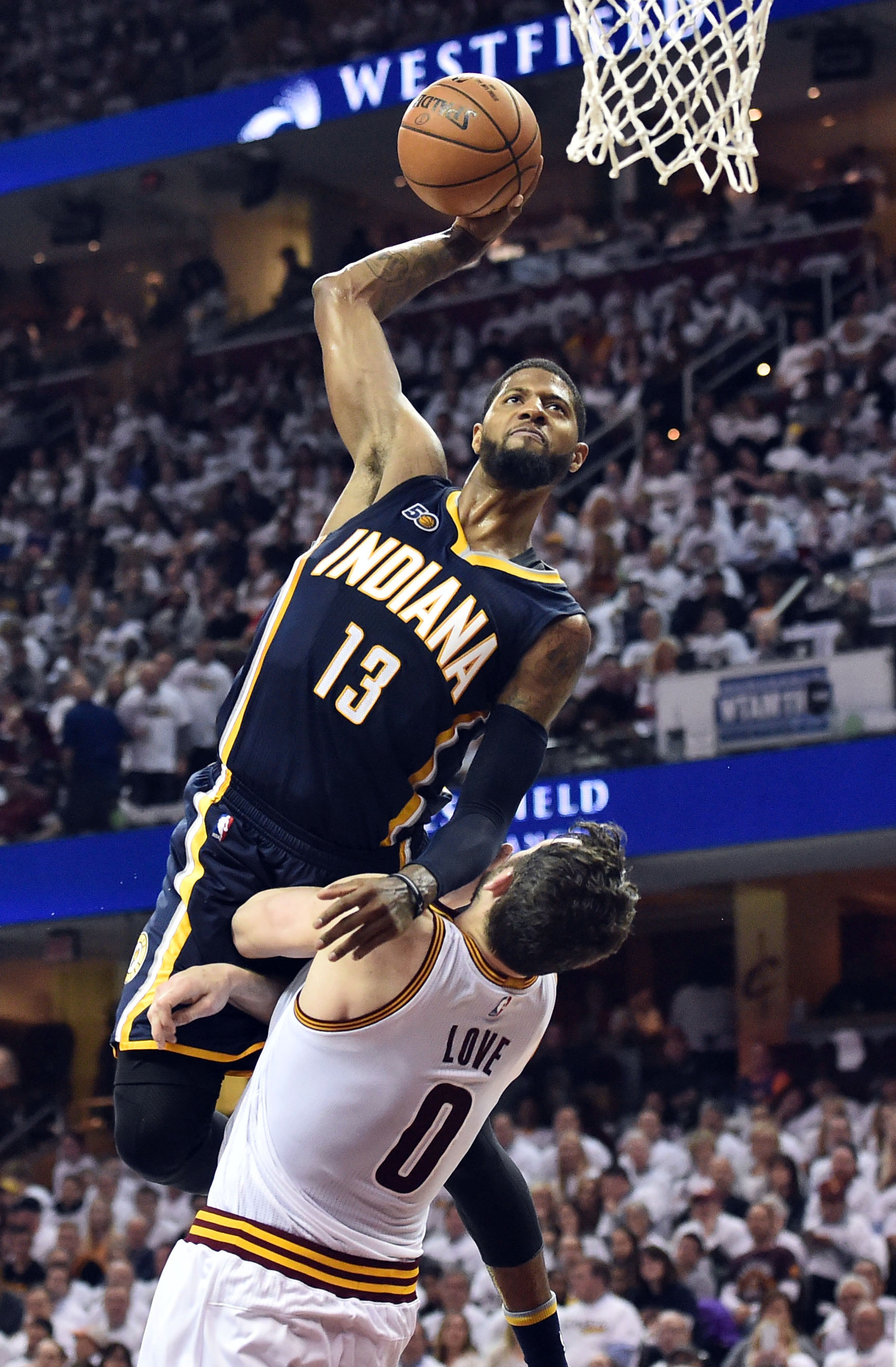 1. Should the Lakers pursue a trade for Pacers star Paul George or wait until he becomes a unrestricted free agent?
George’s desire to play for the Lakers is an open secret. He would give Johnson the star he covets, and Magic has no bones that he’ll be shopping for a superstar.
Whether George fits that category is debatable but he’s undeniably one of the top forwards in the league. In a perfect world, the Lakers could sit back and wait for George to sign the dotted line next summer.
If the Lakers really want him, a preemptive strike might be necessary. They would probably have to move the No. 2 overall pick and a couple of young players to entice the Pacers to trade George prior to his walk year. Magic apparently views last June’s lottery pick, Brandon Ingram, as his only untouchable.
2. Assuming the Lakers don’t trade their lottery pick, is Lonzo Ball the right choice?
Community Shootaround: Blake Griffin
Blake Griffin enters unrestricted free agency with some question marks but undoubtedly the Los Angeles Clippers star will wind up with a max contract. The big mystery is whether he’ll re-sign with the Clippers or seek a fresh start elsewhere.
The Clippers have the advantage of being able to offer him a five-year deal worth approximately $175MM. He would have to accept a maximum of four years and $130MM elsewhere but opt out clauses are often used by agents to circumvent those restrictions.
Griffin’s last two seasons have been sidetracked by injuries. He appeared in just 35 games in 2015/16 because of a quad injury. This past season, a knee injury limited him to 61 regular-season games. He missed the last four games of the opening-round playoff series against the Jazz with a toe injury that required surgery.
Griffin’s defense, and occasionally his character, has also been criticized. But there’s no denying his offensive talent. A power forward who can average 21.6 PPG, 8.1 RPG and 4.9 APG, as he did in his walk year, will have plenty of suitors on the market.
The Celtics, Wizards, Thunder and Heat are some of the teams expected to pursue him. Boston needs a big-time power forward to get over the hump in the Eastern Conference and Washington needs more balance to its backcourt-oriented attack. Griffin could return to his home state of Oklahoma and take some of the scoring and playmaking burden off Russell Westbrook. He could be “the man” for a club like Miami and even the Lakers could be an option, considering that he’d be surrounded with young talent and their No. 1 scoring option.
Of course, the Clippers will do everything they can to keep their core of Griffin, Chris Paul and DeAndre Jordan intact, despite the playoff flops in recent years.
That brings us to our question of the day: Which team do you think unrestricted free agent Blake Griffin will sign with and why?
Please take to the comments section and share your opinion on this topic. We look forward to what you have to say.
2017 Offseason Salary Cap Digest: Dallas Mavericks
The Mavericks have been a perennial playoff team for most of the last two decades, but after posting their worst record (33-49) since 1998/99, they finally seem ready to retool — even as Dirk Nowitzki‘s career nears its end. While the Mavs don’t have any players eligible for unrestricted free agency this summer, they have nine players on team options, on non-guaranteed contracts, or eligible for restricted free agency. That should create plenty of opportunity for roster turnover in Dallas in the coming weeks and months.
Here’s where things currently stand for the Mavericks financially, as we continue our Offseason Salary Cap Digest series for 2017:
Guaranteed Salary
- Harrison Barnes ($23,112,004)
- Wesley Matthews ($17,884,176)
- Dwight Powell ($9,003,125)
- J.J. Barea ($3,903,900)
- Seth Curry ($3,028,410)
- Devin Harris ($1,339,662) — Partial guarantee. Non-guaranteed portion noted below.
- A.J. Hammons ($1,312,611)
- Gal Mekel ($315,758) — Waived via stretch provision.
- Total: $59,899,646
Player Options
- None
Team Options
- Dirk Nowitzki ($25,000,000)
- DeAndre Liggins ($1,577,230)1
- Yogi Ferrell ($1,312,611)
- Total: $27,889,841
Non-Guaranteed Salary
- Devin Harris ($3,062,884) — Partial guarantee. Guaranteed portion noted above.
- Salah Mejri ($1,471,382)2
- Nicolas Brussino ($1,312,611)3
- Dorian Finney-Smith ($1,312,611)4
- Jarrod Uthoff ($1,312,611)5
- Total: $8,472,099
Restricted Free Agents
- Nerlens Noel ($4,187,598 qualifying offer / $10,961,225 cap hold)
- Total: $10,961,225
Cap Holds
- No. 9 overall pick ($2,681,900)
- Total: $2,681,900
Trade Exceptions
- Andrew Bogut TPE ($6,642,537) — Expires 2/23/18
- Justin Anderson TPE ($1,514,160) — Expires 2/23/18
Projected Salary Cap: $101,000,000
Maximum Cap Room: $34,340,379
- The Mavericks have six fully guaranteed contracts on their books. Adding cap charges for their first-round pick and five empty roster spots brings their total team salary to $66,659,621. That would create enough flexibility to pursue a maximum salary player, but it also doesn’t account for players like Noel or Nowitzki, who will almost certainly be back. So, barring cost-cutting trades, Dallas figures to have less cap room than that when July begins.
Footnotes:
- Merji’s salary becomes fully guaranteed after July 12.
- Liggins’ salary becomes partially guaranteed ($26,773) after June 24 if team option is exercised.
- Brussino’s salary becomes fully guaranteed after July 6.
- Finney-Smith’s salary becomes partially guaranteed ($100,000) after July 6.
- Uthoff’s salary becomes partially guaranteed ($200,000) after July 30.
Salary information from Basketball Insiders and The Vertical was used in the creation of this post.
Trade Rumors App For iOS/Android
If you enjoy Hoops Rumors on your smartphone or tablet, be sure to check out our free Trade Rumors app!
Trade Rumors, available for iOS and Android, is the best way to consume our content on a mobile device. Here’s what it delivers, all for free:
- All the articles from Hoops Rumors, MLB Trade Rumors, Pro Football Rumors, and Pro Hockey Rumors in an easy-to-navigate, eye-catching format. Swipe through stories to quickly consume all the news and rumors from our four sites. Not into all four sports? No problem – any sport can be easily removed.
- Customize what you see. You can create feeds for any team or player across any of our sites.
- Notifications. For any team or player, you can set up push notifications to ensure you always get breaking news instantly. Notifications can also be set up at the sport level.
- Commenting. You can read and contribute comments on the app seamlessly.
- Customer service. If you find a bug, we’ll fix it. If you have a feature request, we’ll consider it. The app is continually evolving and improving.
- Did we mention Trade Rumors is a free app? What do you have to lose? Download it now!
Community Shootaround: Chris Paul And The Spurs
After another early playoff exit with the Clippers, Chris Paul is expected to exercise his early-termination option, give up almost $24.27MM for next season and hit the free agent market. If and when he does, the Spurs have quickly come to the forefront as a possible destination for the nine-time All-Star.
There has been rumored “mutual interest” between both sides and while San Antonio has limited cap space, the Clippers view the Spurs as a serious threat for Paul’s services, per ESPN’s Marc Stein (link via Twitter). As previously noted, to make room for Paul’s hefty salary, the Spurs would likely have to renounce the rights to Patty Mills and not match an offer sheet to restricted free agent Jonathan Simmons. Additionally, Dewayne Dedmon and David Lee have player options the Spurs would likely have to renounce to swing an agreement with Paul — trading Tony Parker, LaMarcus Aldridge, or Danny Green could make space, too.
At 32 years old, Paul is still one of the best players at his position and in the NBA. Adding him to a Gregg Popovich-led Spurs could help the team — which was swept by the Warriors in the Western Conference Finals — possibly supersede Golden State in the Western Conference.
Last October, Paul said to reporters, including ESPN’s Andrew Ham, that he does not look ahead, instead prioritizing his current situation.
“And I always say this — I don’t think about things long term,” Paul said. “I think about right now. I don’t know who said it — somebody said it: The funny thing about the NBA is, everybody comes into the season pretty optimistic. You know what I mean? Everybody is like, ‘Oh, this could be our year.’ I guess it’s one of those things only time can tell.”
Six years in Los Angeles has not yielded a championship and Paul is not getting any younger. However, the Clippers, led by Doc Rivers, have always been on the verge of greatness but have fallen short each year. It will be up to Paul to decide what he wants to do.
That brings up a series of important questions: Does it make sense for the Spurs to devote a significant chunk of their cap space to Paul? Would acquiring Paul be the move that puts the Spurs over the top? Is staying with the Clippers Paul’s best best at a championship?
Share your thoughts on Paul down below!