
Fantasy Hoops: Ferrell, Cousins, Embiid
We’ve hit the third quarter of the NBA season and Hoops Rumors is examining the fantasy basketball landscape in order to help you dominate the competition. Check back weekly for more fantasy basketball analysis.
Breaking Down Dallas’ Backcourt
Something very interesting is happening in Dallas. A rookie has taken control of the team and elevated them just as everyone thought the franchise was done for the season. No, we’re not talking what Dak Prescott just did for the Cowboys and we’re not talking about their running back Ezekiel Elliot either (although, you could find out the latest on those two at our sister-site Pro Football Rumors). We’re talking about what undrafted point guard Yogi Ferrell has done for the Mavericks.
If Pierre Jackson doesn’t injure his hamstring nearly two weeks ago, Ferrell isn’t on this team. If J.J. Barea doesn’t remain sidelined with a calf strain and Deron Williams‘ toe injury doesn’t linger, Ferrell never gets to start. Yet, all of those things happened and it’s led to an incredible opportunity for the former Indiana Hoosier.
Ferrell has seen the most court time on the team since arriving in Dallas. His 36.7 minutes per game ranks 15th in the league since his first start on January 29th. He’s scoring 16.3 points per game and he’s shooting 47.1% from behind the arc. The team has gone 4-2 in Ferrell’s six starts, but they were a missed C.J. McCollum floater away from being 5-1.
The 23-year-old has become a nice asset in fantasy and he’ll remain one as long as injuries keep the team’s regulars on the sideline. Barea is a few weeks away from returning and Williams’ toe injury may keep him out until the All-Star break. The Mavs have four more games before the break, so if Ferrell is available (owned in roughly 45% of ESPN leagues), he’s worth adding.
Once Williams is healthy, there’s a chance that he’ll be dealt. The Cavs were considering him as a trade acquisition, though for the time being, Dallas appears reluctant to deal the veteran point guard. If the team were to move him, Ferrell becomes a must-own in all leagues.
Ferrell isn’t the only Mavs guard worth rostering while the team gets healthy. Seth Curry, who signed a two-year, $6MM deal with Dallas over the summer, is having a nice season. Over his last 12 games, he’s shooting 51.0% from the field, a figure that ranks fifth in the league among players seeing at least 32 minutes per game. However, he now finds himself on the injury report after hurting his shoulder in Tuesday’s game against the Blazers. As of this writing, it doesn’t appear to be serious, but if he’s not back up and running for Thursday’s game against the Jazz, Devin Harris should see more opportunity. Harris could be a nice low-cost option in daily fantasy if Curry is out.
My end-of-season rankings for the backcourt are as follows: Williams, Ferrell, Curry, Barea, Harris. Keep an eye on this situation for the rest of this season, as Dallas guards have ever-changing fantasy values due to a number of injuries on the team.
Here’s more fantasy analysis and notes from around the league:
- Rudy Gay ruptured his Achilles in mid-January and since he was sidelined, DeMarcus Cousins has become even more involved in the offense. The big man is averaging nearly six assists per contest since the small forward’s injury compared to 4.4 per game before it. That’s the good news. The bad news is that Cousins is suspended for tonight’s game against the Celtics as a result of picking up his 16th technical of the season and if he picks up two more technicals, he’ll be suspended for another game.
- Since MLK day, only Stephen Curry and Isaiah Thomas have made more three-pointers than Otto Porter. The small forward has made 54.9% of his shots from behind the arc over that stretch. Porter can become a restricted free agent after the season and he’s playing like he wants to get paid. He’s a top-40 fantasy option for the rest of the season.
- Joel Embiid has missed nine of the Sixers’ last 10 games, including tonight’s tilt with the Spurs, because of a knee injury. Coach Brett Brown said that the team is simply being cautious with Embiid and the big man is expected back on the court soon. I implored fantasy owners to trade Embiid in a recent edition of Fantasy Hoops since his fantasy value was at an all-time high. I would still consider trading him in the right deal due to his injuries woes and the Sixers propensity to be “cautious” with injuries.
Fantasy questions? Take to the comment section below or tweet me at @CW_Crouse.
Statistics are current through Wednesday afternoon.
Trade Candidate: Jahlil Okafor
As the February 23 trade deadline nears, Hoops Rumors will be taking a closer look at several players we consider trade candidates, discussing their value, speculating on potential destinations, and explaining why they are – or should be – available. These players won’t necessarily be dealt in advance of the deadline, but it won’t be surprising if they are.
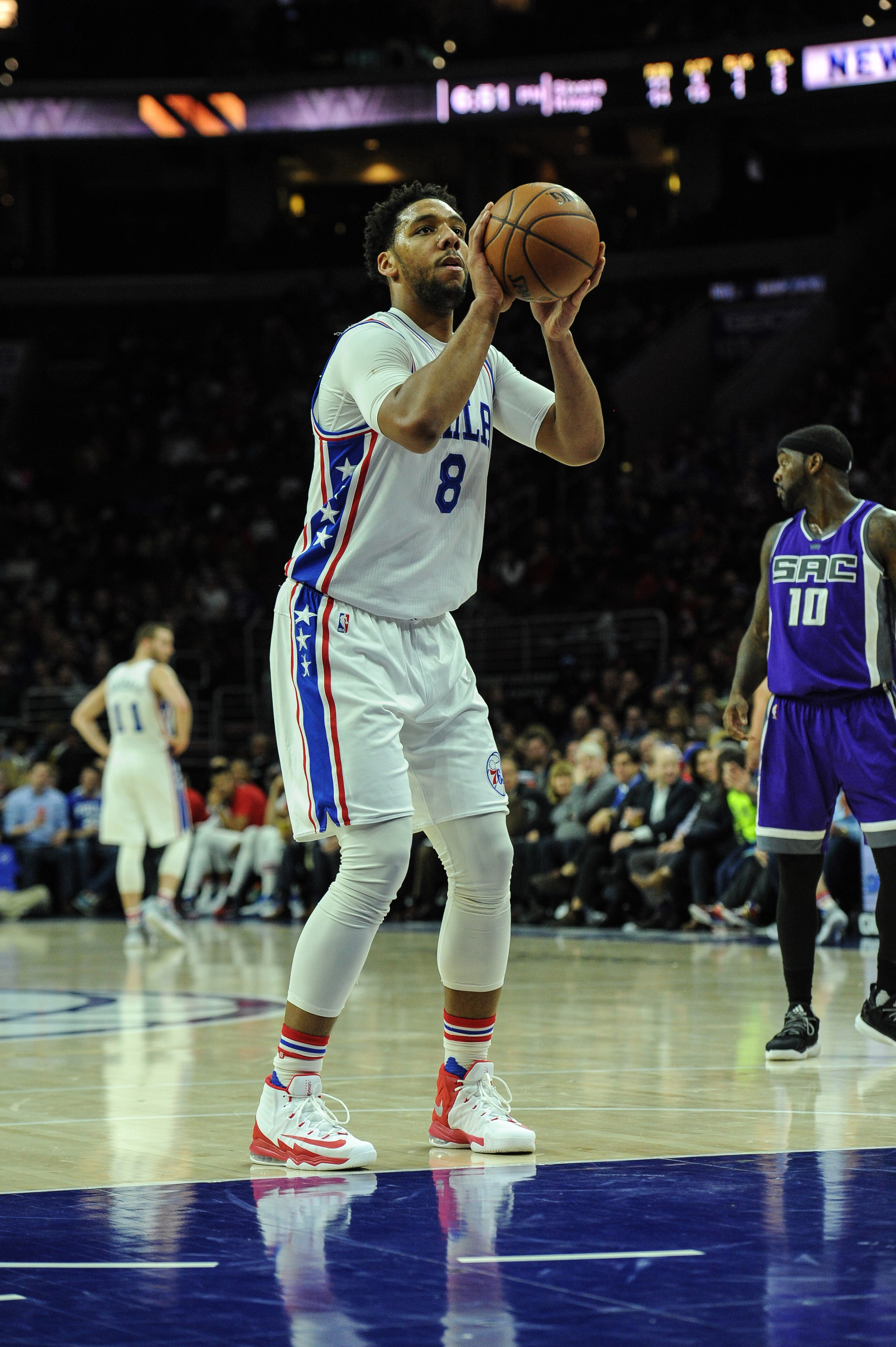
Jahlil Okafor, C
Philadelphia 76ers
2016/17 salary: $4,788,840
Team holds an option for the 2018/19 season; eligible for restricted free agency in 2020
Trade restrictions: None
Jahlil Okafor knows he’s in a unique situation. He’s heard his name in trade rumors since he was drafted by the Sixers with the No. 3 overall pick. He’s seen his role on the team fluctuate and he’s handled it all like a professional should.
“I know I’m not the type of player that’s DNP,” Okafor said earlier in the month about a game in which he was a healthy but didn’t see the court. “But that’s what it is right now. Coach Brown has been phenomenal with communicating with me. I know in the long run, I’ll be fine.”
In the long-run, Okafor will likely be playing for another team. GM Bryan Colangelo has reportedly been in contact with eight other franchises regarding an Okafor trade and the strong play of both Joel Embiid and Dario Saric have increased the likelihood that the team deals either Okafor or Nerlens Noel, according to Marc Stein of ESPN.com.
It appears that Okafor is more likely to be dealt than Nerlens Noel, as John Smallwood of the Philadelphia Inquirer wrote last month. Two months ago, the opposite was true. Noel wasn’t seeing regular minutes and Philadelphia was investing time in the Okafor-Embiid pairing. The team didn’t like what it saw and it stopped using the combo together. Okafor has seen his role diminished since the team split up the centers, while Embiid has thrived, which led one anonymous league executive to claim that the Cameroon native could eventually become a top-3 player in the league.
Okafor will likely never reach that pinnacle, though that doesn’t mean he can’t have a great career. Over his first season and a half, he’s shown promise on the offensive end, aggressively taking the ball to the basket either by backing defenders down or driving at them from the elbow. It’s been inconsistent, but that’s expected; he’s a 21-year-old kid who has only appeared in 88 career games. Teams looking for a young big man certainly see what’s there. He isn’t a blank canvas on the offensive end.
Okafor’s defense remains a work-in-progress. He’s the league’s second-worst center on defense, per ESPN’s Defensive Real Plus/Minus. Karl-Anthony Towns is the league’s worst, according to that metric, so we should remember that it takes time and experience in this league to become a good defender in the post. Rim protectors need to learn how to properly position themselves during the offensive attack. Once a player learns that, simply being a massive near 7-footer is enough to be an adequate defender; just ask Nikola Vucevic. Magic coach Frank Vogel vowed to install his defensive principles and coach up Vucevic so that he can improve on his defense. This year, the Swiss behemoth has been defending opposing bigs at a top level. He’s the 15th most impactful defender this season, according to NBAMath, and there’s hope that Okafor can take similar strides with the right amount of experience and coaching.
That’s not to say coach Brett Brown isn’t doing a great job with Okafor and with this team. The issue is that there are only so many coaching hours available and Brown has so many young guys on the roster. Gregg Popovich was always able to get the best out of non-star players because his top players were experienced and didn’t need as much attention. Popovich could devote the time to the role players and coach them up to help them improve. Brett Brown has no such luxury. Examine the Sixers’ roster; How many players are self-sufficient and don’t need a considerable amount of coaching?
Okafor will get to an acceptable level on defense, but he’s not going to substantially improve without seeing more court time. He’s barely cracked 800 minutes so far this season (232 players have seen more minutes than Okafor this year, including Anthony Tolliver and Corey Brewer among others). He’s firmly behind Embiid on the depth chart and both Noel and Richaun Holmes have seen action ahead of him at times when everyone is healthy.
Philadelphia is being cautious with Embiid’s knee injury, which opened up an opportunity for Okafor to start (and audition for other teams) tonight against the Pistons. The game could end up being one of Okafor’s final contests with the Sixers, as the team was reportedly heavily engaged in talks with the Pelicans to send the Duke product to New Orleans. Philadelphia was set to receive a 2018 first-rounder in addition to center Alexis Ajinca and there was a 5:00 pm EST deadline today to complete a deal, presumably because Philadelphia played tonight and needed to know whether or not to have Okafor suit up. The teams didn’t consummate a deal before that cutoff, but the two sides remain engaged in talks, as Keith Smith of RealGM reports (Twitter link).
Anthony Davis would be an excellent frontcourt partner for any player in the league, but his skillset particularly suits Okafor. At this point in his career, Okafor doesn’t have much range. He can’t play outside the paint and that, coupled with his defensive issues, makes pairing him in the frontcourt a tough task. He needs to be aligned with someone who has an outside shot and is able to help cover up his defensive imperfections. The potential Davis-Okafor pairing is arguably the best-case scenario for any franchise looking to build around the 2015 ACC Player of the Year.
The Pelicans are shopping their 2018 first-round pick around the league with an eye on acquiring a center, according to Adrian Wojnarowski of The Vertical (Twitter link), so they could ostensibly make another deal and miss out on acquiring Okafor.
“Obviously at this time of the year all the GMs are talking,” Pelicans coach Alvin Gentry said earlier tonight. “In that situation right there it’s best that you guys ask [GM Dell Demps]. I don’t want to get misquoted or anything. Like I said, all the GMs are talking back and forth.”
I speculate that a deal will get done with New Orleans and the franchise is just looking to gain leverage during trade talks. However, if Demps decides to trade the team’s pick elsewhere, the Bulls could get back in the mix for Okafor, as they reached out to the Sixers late last week regarding the big man.
Philadelphia is reportedly looking for at least one future first-round pick in exchange for Okafor. He’s under team control for at least two more seasons after this one, so Philadelphia doesn’t necessarily have to deal him before the deadline. Still, regardless of whether it happens this season, this offseason or a year from now, an Okafor trade remains likely. Sam Hinkie’s final first-round selection has the potential to be a solid NBA player and he could even develop into an All-Star-caliber player down the road; it’s just not going to happen while he’s a member of the Sixers.
Photo courtesy of USA Today Sports Images
Reaction Roundup: Jahlil Okafor Trade Rumors
Tonight’s flurry of Jahlil Okafor trade rumors appears to have reached a (temporary) conclusion; according to a report from Keith Smith of RealGM, the Pelicans and Sixers missed a 5 PM EST cutoff to complete a trade. Nevertheless, Okafor’s trade availability is no longer in doubt- Sixers GM Bryan Colangelo has reportedly approached eight teams with trade proposals involving Okafor. While details are still emerging, we gathered some takes from around the league on a potential Pelicans/Sixers swap.
- Okafor would be a good fit on the Pelicans, Jessica Camerato writes for CSN Philly. Okafor has exhibited flaws on defense, Camerato notes, but the former #3 overall pick would not be tasked with those responsibilities in New Orleans, as Anthony Davis remains the team’s premier rebounder. “Okafor would start at the five, his true position. When he’s paired with Joel Embiid, he’s forced to play the four. A pairing of Davis and Okafor would help spread the floor for Davis and relieve pressure from defenders, who would have to focus on Okafor on the block,” Camerato argues.
- Adding Okafor may not prevent the Pelicans from declining, Dan Feldman of NBC Sports warns. “Trading a 2018 first-rounder becomes even more logical for New Orleans when you consider general manager Dell Demps’ seemingly shaky job security. Okafor could help the Pelicans become more respectable in the short term — and if the center doesn’t, Demps might be gone for the 2018 draft,” Feldman writes.
- John Reid of NOLA.com implored the Pelicans to “pull the trigger” is they can acquire Okafor for Alexis Ajinca and a 2018 first round pick. The Pelicans sit at 19-32 and have no reinforcements coming back from injury, Reid added.
- Pels coach Alvin Gentry had little to say of the trade rumors prior to Monday’s match-up against the Suns. ”Obviously I think at this time of the year all the GM’s are talking back and forth,” Gentry told reporters, including Justin Verrier of ESPN. ”I think with that situation right there, it’s best that you ask Dell. You ask Dell, I don’t want to be misquoted or anything. Probably take it up with him.”
- Ajinca found out he was mentioned in trade rumors from Twitter. Ajinca told Justin Verrier of ESPN “I need to play…if my time is up here then we’ll see.”
Hoops Rumors’ 2017 10-Day Contract Tracker
For the last month, NBA teams have been eligible to sign free agents to 10-day contracts, and the bulk of the signings that have taken place during that span have been of the 10-day variety. Hoops Rumors has created a database that allows you to keep on top of those deals, tracking every 10-day signing all season long. So far, 16 different players have signed 10-day contracts in 2017.
Our 10-Day Contract Tracker includes information on all 10-day contracts signed from the 2006/07 season on, giving you a chance to identify trends regarding your favorite teams and players. The search filters in the database make it easy to sort by team, player and year. Just be sure to write a player’s last name first if searching in that field. You can even see whether a player and team signed a second 10-day contract, and if the short-term deals led to an agreement that covered the rest of the season.
For instance, if you want to see how many 10-day deals current Nets guard Sean Kilpatrick has signed over the course of his career, you can find that information here. Similarly, if you want to see all the 10-day contracts that the Cavaliers have signed in recent years, you can do so here.
A link to our 10-Day Contract Tracker can be found at any time in the Tools menu at the top of the page, or in the right sidebar under “Hoops Rumors Features.” We’ll be keeping it up to date for the rest of the season, so be sure to check back to keep tabs on the latest signings as they become official.
Community Shootaround: Denver’s Trade Chips
Despite a 22-28 record, the Nuggets find themselves within striking distance of a playoff spot in the Western Conference. Staked to a half-game lead in the eighth seed, Denver has outperformed expectations behind a breakout season from Nikola Jokic.
As Mark Kiszla pointed out in a Denver Post column, the Nuggets have a decision to make: pursue a No. 7 or 8 seed, or sell off their assets by the trade deadline? Wilson Chandler has been critical of his role (or occasional lack thereof) under coach Michael Malone, making him a logical trade candidate.
Malone firmly denied Emmanuel Mudiay‘s availability via trade, but several Nuggets remain viable trade chips; particularly Danilo Gallinari and Jusuf Nurkic. As of late January, Nurkic was rumored to be available in a package deal with veteran forward Kenneth Faried.
We know Nuggets GM Tim Connelly has a history of trade deadline activity; here’s what we want to know as February 23rd approaches…
Who would you like to see the Nuggets shop at the deadline? Would it be worthwhile for Connelly to keep his team intact while pursuing a playoff spot? Which team would be the most logical destination for Chandler?
Let us know in the comments section!
Heat Notes: Weber, Spoelstra, Waiters, Ellington
Briante Weber said he chose to sign with the Warriors instead of the Heat because he wanted a new challenge, relays Manny Navarro of The Miami Herald. Weber played one game for Miami after signing in April. He was waived in October and has spent this season with the Heat’s D-League affiliate in Sioux Falls. The 24-year-old point guard turned down offers of 10-day contracts from Miami and Charlotte to choose Golden State. “So I just felt like I’ve been with Miami and they haven’t picked me up by now,” Weber said, “then why continue to go down the same road? I figured I should pick something new and actually a team with a spot. They actually let somebody go to fill me in. That says a lot about the organization and about how they feel about me being potentially being here for longer than just 10 days. So I kind of picked a spot that was going to give me the best opportunity to expose myself and put myself on the radar where everybody else can see.”
There’s more news out of Miami:
- Weber received good luck wishes from Heat coach Erik Spoelstra, according to the Associated Press. Spoelstra said he appreciates how Weber, who averaged 16.5 points, 7.5 rebounds, 7.4 assists and 3.3 steals at Sioux Falls, proved he deserves a shot at the NBA. “He’s put in the time,” Spoelstra said. “He hasn’t skipped a step. He approached every part of this as an opportunity to get better and everybody’s journey is different to get into this league. He’s a bona fide NBA player.”
- Dion Waiters, who has enjoyed a career renaissance in Miami, attributed his success to Spoelstra’s ‘tough love.’ “It’s good bumping heads. It’s not anything bad. It’s like, `I’m challenging you. You can do more. Don’t settle for that,’” Waiters told Tom D’Angelo of the Palm Beach Post. “I had coach [Jim] Boeheim. It was tough love at the end of the day. They see so much in me that he’s challenging me. I look at it as a challenge. He’s been doing a tremendous job keeping me motivated.” Now in his fifth NBA season, Waiters has been sublime of late; averaging 23.3 points on 52.2% shooting over his last eight games.
- Now riding a 10-game winning streak, the Heat have adopted a “don’t believe the hype” mantra. As Anthony Chiang of the Palm Beach Post points out, Miami’s improbable streak includes wins over quality opposition- particularly the Warriors, Rockets, and Hawks. “We know where we’ve been at and where we want to be at, so we’re not satisfied,” Heat guard Wayne Ellington said. “Coach keeps telling us. But at the same time, he doesn’t really need to. We’re hungry, man. We know where we were at. Obviously it feels good to get some wins. But at the same time, we understand that we’ve got a ways to go to be where we want to be at.”
Hoops Rumors Originals: 1/29/17-2/4/17
In addition to our news coverage, the Hoops Rumors team has been active publishing original content as well. Here are some of the best posts from this week.
- Should the Bucks stand pat after trading away Miles Plumlee or should they continue to tinker with their roster? Milo Taibi posed that question to our readers.
- Luke Adams took a poll to find out which Eastern Conference team poses the biggest threat to the Cavaliers. Check out the results here.
- Luke also took a closer look at the Timberwolves’ options regarding injured center Nikola Pekovic.
- There are still six teams below the salary-cap floor this season, including a club comfortably in the playoff mix. Want to know which teams still need to add to their payroll? Find out all the details here.
- Want to know how to follow specific players? We provide a detailed explanation here.
- Blazers center Mason Plumlee is a stat-sheet stuffer and an underrated fantasy basketball asset. Rockets center Clint Capela and Sixers guard T.J. McConnell are also trending upward. Read more about it in Chris Crouse’s Fantasy Hoops breakdown and send him your questions on Twitter at @HoopsRumors or @CW_Crouse.
- Don’t forget to check out our 2016/17 Reverse Standings to see how next year’s draft order is shaping up. The daily updated list tracks each team’s position in the standings and the associated lottery odds.
- We love hearing what readers have to say about pertinent topics in the NBA world. Here is a list of our Community Shootaround Topics this week.
- Chris Crouse handed out his midseason awards, including his MVP selection of James Harden. You can check out his selections and weigh in with your choices here.
- Here are last week’s Hoops Rumors Originals so you don’t have to go searching for them.
Mavs Notes: Ferrell, Sanders, Bogut
After signing a 10-day contract with Dallas on January 27th, Yogi Ferrell has hit the ground running. The former Hoosier has averaged 37.8 MPG in four appearances and turned in a masterpiece last night, torching Portland for 32 points on nine 3-pointers in a 108-104 victory. Ferrell was cut loose by the Nets after playing in 10 games this season, but now looks to have found carved a role through the rest of 2016/17 in Dallas.
- Ferrell deserves to be the first player ever to win NBA player of the week honors while on a 10-day contract, Eddie Sefko of Dallas News writes. Ferrell’s nine 3-pointers is the highest total from a Mavericks rookie since Roddy Beaubois scored 40 points against the Warriors in 2010/11.
- Mavericks owner Mark Cuban indicated he will sign Ferrell for the rest of the season, according to Dwain Price of the Fort Worth Star-Telegram. GM Donnie Nelson praised Ferrell’s performance following Friday’s showing. “That’s exactly how we scripted it, step in and start against two of the top three teams in the league,” Nelson told Price. “It’s just really kind of a special moment in time and he put himself in a great position. It’s really very unique and he obviously was kind of the straw that stirred the drink for those two games against pretty formidable opponents. So let’s just hope the trend continues.”
- The Mavericks are among five teams interested in free agent Larry Sanders, according to Gery Woelfel of Woelfel’s Press Box. Sanders’ agent, Joel Bell, indicated a deal with one of the teams could come together soon. “By the end of next week, we should have a reasonably good handle on where this is going,’’ Bell said.
- Matt Mosley of Dallas News was hesitant to list Deron Williams or Andrew Bogut as a viable trade chip, noting each player’s extensive injury history. Bogut, who has been recently sidelined with a hamstring injury, hasn’t carved out a role in Rick Carlisle‘s rotation, averaging a career-worst three points through 25 games in Dallas. Tim MacMahon of ESPN noted the possibility of Bogut’s contract being bought out after the trade deadline.
What’s The Next Move For The Bucks?
The Bucks dealt Miles Plumlee to Charlotte this week, getting out from under Plumlee’s $50MM contract while acquiring inexpensive big men Spencer Hawes and Roy Hibbert. Milwaukee GM John Hammond was widely lauded for the move, creating additional payroll while finding a willing trade partner for Plumlee, who had been relegated to 9.7 MPG through 32 games this season.
With the newfound future cap space, Adrian Wojnarowski of The Vertical suggests Milwaukee may pursue a new deal for Tony Snell, who has averaged 8.1 points on 45.8% shooting in Khris Middleton‘s absence. A restricted free agent after 2016/17, Snell would command a significantly higher salary than the $2,368,327 he earned this season.
In the meantime, however, the Bucks have some roster configuring to do following this week’s trade. As Kevin Pelton pointed out for ESPN, Milwaukee’s depth chart at the five is suddenly loaded, with Hawes, Hibbert, John Henson, Greg Monroe, and Thon Maker all vying for court time.
At first glance, Hibbert appears the most likely to be traded or bought out by the trade deadline. The 30-year-old isn’t on the books for next season, and – if it’s any indication of his role on the team – has already been ruled a healthy inactive for Milwaukee’s game against Phoenix on Saturday. The Bucks have been linked to Hawes in the past, and the 28-year-old has a $6,021,175 player option for next season; a reasonable salary for a competent backup center, though there’s a good chance he’ll opt out.
If Monroe or Henson yield a more significant return on the trade market than the team’s newly-acquired veterans, it may not be a bad idea to trade one of them for a combo guard. As of right now, the Bucks are relying on a combination of Matthew Dellavedova, Malcolm Brogdon, and Jason Terry behind Giannis Antetokounmpo. Monroe has been subject to trade rumors throughout his two-year run in Milwaukee; last month, Monroe claimed to be undecided regarding his $17.8MM player option following the 2016/17 season.
The Bucks have already waived Steve Novak to accommodate Thursday’s trade, creating a center-heavy roster during a vital stretch of their playoff pursuit. In a league over-saturated with centers, Hammond’s challenge may involve finding a new home for one his five big men.
What do you think? Are the Bucks done dealing for now, or will they continue to be active before the trade deadline?
Submit Your Questions For This Weekend’s Mailbag
We at Hoops Rumors love interacting with our readers. This is why we provide an opportunity for you to hit us up with your questions in our weekly mailbag feature.
Have a question regarding player movement, free agent rumors, the salary cap, the NBA draft, or the top storylines of the week? You can e-mail them here: hoopsrumorsmailbag@gmail.com. Feel free to send emails throughout the week, but please be mindful that we may receive a sizable number of questions and might not get to all of them.
If you missed out on any past mailbags and would like to catch up, you can view the full archives here.