
2021 NBA Offseason Preview: Denver Nuggets
Any discussion about how injuries affected the 2021 NBA postseason probably has to start with the Nets and the Lakers, but the Nuggets shouldn’t be overlooked. After acquiring Aaron Gordon at the trade deadline in March, Denver was firing on all cylinders and looked capable of seriously competing for a spot in the NBA Finals.
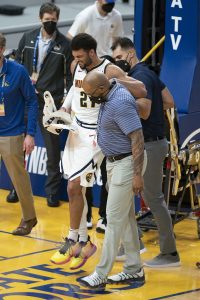 Those good vibes didn’t last long though. After the Nuggets won eight of their first nine games with Gordon in the lineup, disaster struck in the 10th game, as Jamal Murray suffered a torn ACL that ended his season and will keep him sidelined for the start of the 2021/22 campaign.
The resilient Nuggets still finished the season strong and won a playoff series against Portland. But without Murray, who averaged 26.5 PPG on a scorching .505/.453/.897 shooting line in 19 playoffs games (39.6 MPG) in 2020, the odds of the team making a deep postseason run took a nosedive.
As tempting as it to imagine “what if?” scenarios about how the second-round series against Phoenix might have played out with a healthy Murray, the Nuggets have to turn their attention to figuring out how to make up for his absence to start next season — and how to put themselves in title contention again in 2022.
The Nuggets’ Offseason Plan:
With Nikola Jokic, Michael Porter Jr., Murray, Gordon, and Monte Morris all under contract for next season, the Nuggets have an enviable core to build upon. Still, there are a number of rotation questions for the team to address this summer.
Will Barton ($14.7MM) and JaMychal Green ($7.6MM) face player option decisions after playing key roles for Denver in 2020/21. Barton, in particular, was an important part of the Nuggets’ success, starting 52 games for the club and serving as a reliable secondary scorer and play-maker. Green’s role was more modest, but he provided reliable depth at the power forward spot and could play the five if needed. The Nuggets, who would probably be just fine with both players opting in, will have to figure out how to replace or re-sign them if they opt out.
Meanwhile, Paul Millsap, JaVale McGee, and Austin Rivers will be unrestricted free agents. The club can withstand losing all three players if necessary, but their contributions shouldn’t be overlooked. Millsap has helped stabilize the frontcourt defense during his time in Denver, while Rivers ended up playing big minutes for the team following injuries to Murray and Barton. I imagine the Nuggets will at least explore bringing all three players back, but if the cost is much higher than the minimum, they may let them walk.
Having already cashed in some of their trade chips for Gordon, the Nuggets seem unlikely to make another major splash in the trade market this offseason, preferring instead to add reinforcements using their draft pick (No. 26 overall) and the mid-level exception.
Whether or not Barton is back, I expect the club will be focused in free agency on finding a guard with some size who can play alongside Morris or Facundo Campazzo in the backcourt. If Green or Millsap returns to join Jokic, Gordon, and Porter, the frontcourt shouldn’t be as high a priority — especially if the team believes Nnaji or Bol is ready to contribute.
Finally, it’s worth noting that Porter will be extension-eligible this offseason and will likely be in line for a max deal or something close to it. While the idea of paying Porter the max with Jokic and Murray already on the books for big money may give the Nuggets pause, extending MPJ is probably the right thing to do — he’s improving at such a rate that he’d still be a positive asset on a more lucrative contract, barring health issues.
Salary Cap Situation
Note: Our salary cap projections are based on a presumed 3% increase, which would result in a $112.4MM cap for 2021/22.
Guaranteed Salary
- Nikola Jokic ($31,579,390)
- Jamal Murray ($29,467,800)
- Aaron Gordon ($16,409,091)
- Monte Morris ($8,449,074)
- Michael Porter Jr. ($5,258,735)
- Facundo Campazzo ($3,200,000)
- Zeke Nnaji ($2,498,760)
- Bol Bol ($2,161,152)
- Total: $99,024,002
Player Options
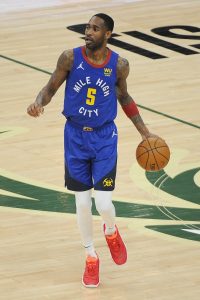 Will Barton ($14,669,642): Bird rights 1
- JaMychal Green ($7,559,748): Non-Bird rights 2
- Total: $22,229,390
Team Options
- None
Non-Guaranteed Salary
- PJ Dozier ($1,910,860) 3
- Vlatko Cancar ($1,782,621) 4
- Total: $3,693,481
Restricted Free Agents
- None
Two-Way Free Agents
Draft Picks
- No. 26 overall pick ($2,096,880)
- Total: $2,096,880
Extension-Eligible Players
- Michael Porter Jr. (rookie scale)
- Will Barton (veteran)
- Vlatko Cancar (veteran)
- Aaron Gordon (veteran)
Unrestricted Free Agents / Other Cap Holds
- Paul Millsap ($15,000,000): Bird rights
- JaVale McGee ($7,980,000): Bird rights
- Austin Rivers ($1,669,178): Non-Bird rights
- Troy Daniels ($1,669,178): Non-Bird rights 6
- Richard Jefferson ($1,669,178): Non-Bird rights 6
- Total: $27,987,534
Offseason Cap Outlook
The Nuggets will almost definitely operate over the cap this offseason, and should be able to stay out of tax territory.
Even if we assume Barton and Green pick up their player options, Dozier’s salary is guaranteed, and the team keeps its first-round pick, that would result in about $125MM for 12 players. That would leave Denver with enough flexibility to use its full mid-level exception without crossing the projected tax line (which is in the $136-137MM range).
Cap Exceptions Available
- Mid-level exception: $9,536,000 7
- Trade exception: $5,325,000
- Trade exception: $2,193,480
- Trade exception: $1,620,564
Footnotes
- Barton’s decision is reportedly due by July 17.
- Green’s decision is reportedly due by July 26.
- Dozier’s salary becomes partially guaranteed ($200K) after August 16.
- Cancar’s salary becomes fully guaranteed after August 3.
- Because he’ll have four years of NBA service, Harrison is ineligible to sign another two-way contract.
- The cap holds for Daniels and Jefferson remain on the Nuggets’ books from prior seasons because they haven’t been renounced. They can’t be used in a sign-and-trade deal.
- This is a projected value.
Salary and cap information from Basketball Insiders, RealGM, and ESPN was used in the creation of this post.
Southeast Notes: Dragic, Heat, Unseld, Hornets
Goran Dragic has been with the Heat for over six seasons, and has played some of the best basketball of his career in Miami. He was arguably the third-best player during the Heat’s run to the Finals last season before a foot injury limited him to two games against the Lakers. But the 35-year-old point guard is coming off an injury-plagued season and owed over $19MM next season.
According to Ira Winderman of the South Florida Sun-Sentinel, the Heat don’t want to trade Dragic this offseason. But if a deal for a star presents itself, the team would be willing to do so.
We have more news from around the Southeast Division:
- The Heat have traded away both their picks in this year’s draft, but that hasn’t stopped team president Pat Riley for setting the edict to the scouting department to find and secure useful players from the draft, writes Winderman. “We don’t have any picks, but I can guarantee you we’ll probably get a couple of good players out of this year’s draft, somehow,” Riley said at the end of the season. The Heat have a track record of landing productive players like Kendrick Nunn and Duncan Robinson despite scant draft resources. They’ll try to repeat history this year.
- Anthony Chiang of the Miami Herald looks at how the Olympics experience could help the Heat‘s Nigerian trio of Gabe Vincent, KZ Okpala and Precious Achiuwa. Team Nigeria has been dominant during exhibition games, but if they don’t make the medal round, it’s possible the three young players will be back in Las Vegas for Summer League, looking to build off the momentum and confidence they’ve gained from this experience.
- Wes Unseld Jr. is not just a familiar name, he’s also an experienced coach who has paid his dues, writes Fred Katz in a piece for The Athletic on the Wizards’ newest head coach. Katz writes that Unseld sold the Wizards based not only on his track record, but also on ideas for how to better utilize star Bradley Beal and last season’s lottery pick Deni Avdija.
- The Hornets are working out six prospects today, per a tweet from the team: Derrick Alston Jr., Ian Dubose, Romeao Ferguson, Ariel Hukporti, Carlik Jones, and Ruot Monyyong. The Hornets have the 56th and 57th picks in the draft, the range in which most of said prospects may be available.
Hoops Rumors Glossary: Qualifying Offers
Players eligible for restricted free agency don’t become restricted free agents by default. In order to make a player a restricted free agent, a team must extend a qualifying offer to him — a player who doesn’t receive one becomes an unrestricted free agent instead.
The qualifying offer, which is essentially just a one-year contract offer, varies in amount depending on a player’s service time and previous contract status.
If a player reaches free agency with three or fewer years of NBA service time under his belt, his qualifying offer is worth 125% of his prior salary, or his minimum salary plus $200K, whichever is greater.
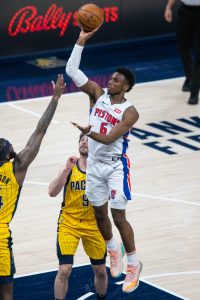 For instance, after earning $1,663,861 this season, Pistons guard Hamidou Diallo projects to have a minimum salary worth $1,729,217 in 2021/22. Adding $200K to that figure works out to $1,929,217, whereas 125% of his prior salary is $2,079,826. His qualifying offer will be worth the higher amount ($2,079,826).
On the other hand, a player like Magic forward Ignas Brazdeikis signed a minimum-salary contract late in the season and had a cap hit of just $49,510. Calculating 125% of that amount works out to just $61,888, so his qualifying offer projects to be $1,869,178 — his minimum salary ($1,669,178) plus $200K. The exact value of Brazdeikis’ qualifying offer will depend on where exactly the ’20/21 salary cap ends up, since minimum salary increase or decrease at the same rate as the cap.
The qualifying offer for a former first-round pick coming off his rookie scale contract is determined by his draft position. The qualifying offer for a first overall pick is 130% of his fourth-year salary, while for a 30th overall pick it’s 150% of his previous salary — QOs for the rest of the first-rounders fall somewhere in between. The full first-round scale for the draft class of 2017, whose first-rounders will be hitting free agency this summer, can be found here, courtesy of RealGM.
Here are a pair of examples for this offseason: 2017’s second overall pick, Pelicans guard Lonzo Ball, is coming off a fourth-year salary of $11,003,782, so he must be extended a qualifying offer of $14,359,936 (a 30.5% increase) to become a restricted free agent. Meanwhile, the 28th overall pick, Thunder center Tony Bradley, will be eligible for a qualifying offer of $5,277,669, a 49.0% increase on this season’s $3,542,060 salary.
A wrinkle in the Collective Bargaining Agreement complicates matters for some RFAs-to-be, since a player’s previous usage can impact the amount of his qualifying offer. Certain players who meet – or fail to meet – the “starter criteria,” which we break down in a separate glossary entry, become eligible for higher or lower qualifying offers. Here’s how the starter criteria affects QOs:
- A top-14 pick who does not meet the starter criteria will receive a same qualifying offer equal to 120% of the amount applicable to the 15th overall pick.
- Note: In 2021, the value of this QO will be $7,031,451.
- A player picked between 10th and 30th who meets the starter criteria will receive a qualifying offer equal to 120% of the amount applicable to the ninth overall pick.
- Note: In 2021, the value of this QO will be $7,705,447.
- A second-round pick or undrafted player who meets the starter criteria will receive a qualifying offer equal to 100% of the amount applicable to the 21st overall pick.
- Note: In 2021, the value of this QO will be $4,736,102.
Knicks guard Frank Ntilikina is one example of a player who falls into the first group, since he didn’t meet the starter criteria this year. The No. 8 overall pick in 2017, Poeltl will be eligible this offseason for a QO worth $7,031,451 instead of $8,326,027. Conversely, Cavaliers center Jarrett Allen (a former No. 22 overall pick) met the starter criteria and will be eligible for a QO worth $7,705,447 instead of $5,661,538.
[RELATED: Potential 2021 RFAs Whose Qualifying Offers Will Be Impacted By Starter Criteria]
A qualifying offer is designed to give a player’s team the right of first refusal. Because the qualifying offer acts as the first formal contract offer a free agent receives, his team then receives the option to match any offer sheet the player signs with another club.
A player can also accept his qualifying offer, if he so chooses. He then plays the following season on a one-year contract worth the amount of the QO, and becomes an unrestricted free agent at season’s end if he has at least four years of NBA experience. A player can go this route if he wants to hit unrestricted free agency as early as possible, or if he feels like the QO is the best offer he’ll receive. Accepting the qualifying offer also gives a player the right to veto trades for the season.
Only one restricted free agent, Bulls wing Denzel Valentine, accepted his qualifying offer during the 2020 offseason.
Finally, while the details outlined above apply to players on standard NBA contracts who are eligible for restricted free agency, a different set of rules applies to players coming off two-way contracts. For most of those players, the qualifying offer would be equivalent to a one-year, two-way salary, with $50K guaranteed.
A player who is coming off a two-year, two-way deal, has already been on two-way deals with his current team for at least two seasons, or has four years of NBA service would be eligible for a qualifying offer equivalent to a standard, minimum-salary NBA contract. The guarantee on that QO would have to match or exceed a two-way salary.
Note: This is a Hoops Rumors Glossary entry. Our glossary posts will explain specific rules relating to trades, free agency, or other aspects of the NBA’s Collective Bargaining Agreement. Larry Coon’s Salary Cap FAQ and salary information from Basketball Insiders was used in the creation of this post. Earlier versions of this post were published in previous years.
2021 NBA Offseason Preview: Los Angeles Lakers
Coming off their championship in the Walt Disney World bubble in 2020, the Lakers enjoyed a very brief offseason, reporting to training camp just over a month-and-a-half after the NBA Finals ended.
Whether that abridged offseason was a major factor in the team’s up-and-down 2020/21 season is debatable. The Lakers showed no ill effects of the quick turnaround in the early going, getting off to a 21-6 start, but things went south from there.
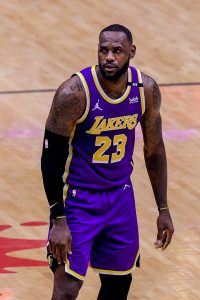 Anthony Davis and LeBron James both missed time due to injuries and didn’t look 100% healthy when they returned. Los Angeles finished the regular season on a 21-24 run and needed a play-in victory to secure a playoff spot.
The Lakers were still viewed as a legitimate championship threat as the No. 7 seed in the West, but fell to the Suns in six games in round one, ensuring that Davis, James, and the rest of the club will get a much longer summer break in 2021.
The Lakers’ Offseason Plan:
The Lakers won’t have to worry about losing either of their two superstars this offseason, as both Davis and James remain under contract for multiple seasons. But those two are the only players who are locks to return to the team in 2021/22.
Kentavious Caldwell-Pope, Kyle Kuzma, and Marc Gasol are all under contract for at least one more year, but they could be trade candidates if an opportunity arises for Los Angeles to upgrade its roster. Montrezl Harrell has a player option, but could also end up on the trade block if he opts in. And virtually every other player on the roster is a free agent, either unrestricted (Dennis Schröder, Alex Caruso, Markieff Morris, and Andre Drummond, among others) or restricted (Talen Horton-Tucker).
First and foremost, the Lakers will have to determine which of their free agents are the highest priorities.
Schröder is perhaps the most important, given his role (he led the team in minutes played in 2020/21) and the financial considerations at play. The Lakers find themselves in what John Hollinger calls the “Bird rights trap” with Schröder — if he signs elsewhere, the Lakers would still be over the cap without the means to pay another player the sort of salary that Schröder will be seeking (likely $20-25MM per year), which means he has some leverage to squeeze them for a higher salary than they’d like to pay.
The one alternative to either investing heavily in Schröder or losing him for nothing would be to work out a sign-and-trade arrangement sending him to a new team. But I suspect it will be a challenge for Los Angeles to find a club willing to both give the point guard a massive payday and surrender a desirable asset for him.
Besides Schröder, the Lakers’ most important free agents will be Morris, Caruso, and Horton-Tucker. Morris showed a willingness last offseason to accept a discount to be a Laker, and it won’t be surprising if he does so again. But the team will face stiff competition for Caruso and Horton-Tucker and can’t reasonably expect either player – whose career NBA earnings pale in comparison to Morris’ – to take a team-friendly deal.
Caruso will likely get offers worth at least the full mid-level, and it’s not out of the question that Horton-Tucker will too — he’ll be one of the youngest free agents on the market and rival suitors may like the idea of putting pressure on the Lakers to match an aggressive offer sheet.
Determining how to handle the center position will also be a crucial part of the Lakers’ offseason. Gasol, Harrell, and Drummond didn’t have the same kind of success at the five that JaVale McGee and Dwight Howard did the year before, which suggests the team may be better off with players who are happy focusing on rebounding and defense rather than bigs who need to play a major role on offense.
Theoretically, Drummond could play that role, but if offensive touches remain a priority for him, it makes sense to let him seek a new team. Gasol would be content to focus on rebounding and defense, but he has clearly lost a step since his prime, limiting his effectiveness on the defensive end and rendering him almost a non-factor on the offensive end — relying on him to play big minutes would be risky.
I expect the Lakers to spend plenty of time perusing the trade market for upgrades using Caldwell-Pope, Kuzma, and Harrell (if he opts in) as potential chips. But a package that starts with two or three of those guys likely won’t be enough to make the team a favorite to land a true impact player, especially since L.A. has traded away so many of its future first-round picks. Caldwell-Pope, Kuzma, and Harrell can be solid rotation players in the right situation, but none of the three are clear bargains at their current salaries.
Salary Cap Situation
Note: Our salary cap projections are based on a presumed 3% increase, which would result in a $112.4MM cap for 2021/22.
Guaranteed Salary
- LeBron James ($41,180,544)
- Anthony Davis ($35,361,360)
- Kentavious Caldwell-Pope ($13,038,862)
- Kyle Kuzma ($13,000,000)
- Luol Deng ($5,000,000) — Waived via stretch provision.
- Marc Gasol ($2,692,991)
- Total: $110,273,757
Player Options
- Montrezl Harrell ($9,720,900): Non-Bird rights 1
- Total: $9,720,900
Team Options
- None
Non-Guaranteed Salary
- Alfonzo McKinnie ($1,910,860)
- Total: $1,910,860
Restricted Free Agents
- Talen Horton-Tucker ($1,897,476 qualifying offer / $1,897,476 cap hold): Early Bird rights
- Total (cap holds): $1,897,476
Two-Way Free Agents
Draft Picks
- No. 22 overall pick ($2,451,120)
- Total: $2,451,120
Extension-Eligible Players
- Alfonzo McKinnie (veteran)
Unrestricted Free Agents / Other Cap Holds
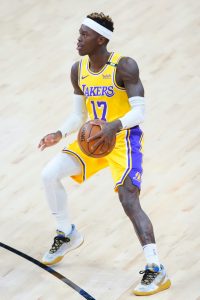 Dennis Schröder ($24,000,000): Bird rights
- Alex Caruso ($5,225,000): Bird rights
- Wesley Matthews ($4,347,600): Non-Bird rights
- Jared Dudley ($1,669,178): Early Bird rights
- Markieff Morris ($1,669,178): Early Bird rights
- Andre Drummond ($1,669,178): Non-Bird rights
- Ben McLemore ($1,669,178): Non-Bird rights
- Dion Waiters ($1,669,178): Non-Bird rights 4
- Total: $41,918,490
Offseason Cap Outlook
With $110MM+ committed to five roster spots, the Lakers project to be over the cap before addressing a single one of their free agents. If the team re-signs Schröder, it’s a safe bet Los Angeles will find itself in luxury tax territory in 2021/22.
Even without a new deal for Schröder, the club could end up a taxpayer based on Harrell’s option and potential new contracts for guys like Caruso, Morris, and Horton-Tucker. If they let a bunch of free agents walk or make a cost-cutting trade, the Lakers could theoretically stay below the tax apron and use the full mid-level exception, but I’m not counting on that outcome.
Cap Exceptions Available
- Taxpayer mid-level exception: $5,890,000 5
- Trade exception: $674,408
Footnotes
- Harrell’s decision is reportedly due by July 31.
- Antetokounmpo has reached a contract agreement with French team ASVEL. The Lakers could still make the procedural move of tendering him a qualifying offer if they want to retain matching rights in the event of his return to the NBA. Because he has been on a two-way contract with the Lakers for two seasons, Antetokounmpo is eligible for a standard minimum-salary qualifying offer.
- Because he has been on a two-way contract with the Lakers for two seasons, Cacok is eligible for a standard minimum-salary qualifying offer.
- The cap hold for Waiters remains on the Lakers books from a prior season because he hasn’t been renounced. He can’t be used in a sign-and-trade deal.
- This is a projected value. If the Lakers stay below the tax apron, they could have access to the full mid-level exception ($9.5MM).
Salary and cap information from Basketball Insiders, RealGM, and ESPN was used in the creation of this post.
Community Shootaround: Rockets’ No. 2 Pick
While Cade Cunningham is widely expected to be the first player drafted on July 29, there’s no established consensus about which prospect should be the second player off the board, making the Rockets‘ pick at No. 2 overall one of the most fascinating selections of the draft.
Essentially, there are three directions the Rockets could go. They could keep the pick, trade up to No. 1, or trade down.
Let’s start with the most straightforward – and probably the most likely – outcome: keeping the pick. Even in that scenario, the Rockets will face a difficult decision. You could make a legitimate case for Jalen Green, Evan Mobley, Jalen Suggs, and even Jonathan Kuminga to be the second player selected after Cunningham.
With a pick as high as No. 2, a rebuilding team should always take the best player available rather than focusing on fit. But if the Rockets like Mobley and one of the other top prospects about equally, perhaps concerns about Mobley’s potential fit alongside Christian Wood in the frontcourt push the needle toward the other player.
That “other player” seems most likely to be Green, who is currently projected as the Rockets’ pick in mock drafts by ESPN, Bleacher Report, The Ringer, and others. Of all the players in this year’s draft class, Green is the best bet to rank among the NBA’s leading scorers year-in and year-out, making him a logical choice to be a centerpiece of the rebuild in Houston, where the team traded longtime leading scorer James Harden earlier in the year.
While the Rockets may be happy to stand pat and nab Green or another promising young prospect, one recent report suggested the team has been “fixated” on Cunningham. Another story said Houston has been aggressive in its efforts to trade up to No. 1.
Obviously, the question of whether the Rockets “should” trade up to No. 1 depends in large part on the price. If it’s just a matter of adding the 23rd pick to the No. 2, then sure, that’s a no-brainer. But the cost figures to be much higher than that — in order to move up for a consensus top prospect like Cunningham, Houston would likely have to include an unprotected or lightly-protected future first-rounder in its offer in order to get Detroit’s attention.
If the Rockets really believe in Cunningham’s star potential, that price may be worth it — after all, following the Harden trade, the club has no shortage of future first-round selections to dangle in trade talks.
On the other hand, if the price to trade up to No. 1 is deemed too high and the Rockets’ have no clear preference at No. 2, perhaps trading down is worth exploring. Although Houston did add a number of draft picks and swaps in the Harden blockbuster, the team has also traded away a couple of its own first-rounders and isn’t as loaded with future draft assets as rebuilding rivals like the Thunder or Pelicans.
The opportunity to move down a handful of spots and pick up a few more assets to use during the rebuild may appeal to the Rockets — especially if they’re high on a specific prospect who would still be available in the 4-6 range.
Again, the terms of a potential trade here are crucial in determining whether it’s a viable path for the Rockets, particularly since this year’s draft class has a distinct top tier. If they’re moving out of the top five and not acquiring a ton of assets for their trouble, the Rockets likely won’t be interested. On the other hand, if they’re just trading down a spot or two and receiving a couple valuable future draft picks, that would be much more intriguing.
We want to know what you think. Will the Rockets trade up or down, or will they stay put? If they keep the No. 2 pick, will Green be the pick? Should he be the pick, or would you like to see Houston go in a different direction?
Head to the comment section below to weigh in!
And-Ones: Rose, Roberts, Thunder’s Arena, Free Agents, Silver
NBA VP of basketball operations Malik Rose is a candidate to succeed Michele Roberts as executive director of the National Basketball Players Association, Marc Stein of Substack tweets. Roberts recently told Yahoo Sports’ Vincent Goodwill she planned to stay at her post for “another six or so months.” Rose was an assistant GM with the Pistons for two seasons prior to accepting his current post last June.
We have more from around the basketball world:
- A new name for the Thunder‘s arena will be revealed as soon as next week, Steve Lackmeyer of The Oklahoman writes. Signage for the Chesapeake Energy Arena was removed on Thursday. The team has a naming rights deal in place, pending approval of its application from the Downtown Design Review Committee.
- Kawhi Leonard, Chris Paul and John Collins are the top three potential free agents, according to a ranking system used by The Athletic’s John Hollinger. The top 20 free agents are ranked, with Hollinger projecting potential contracts offers for those players.
- The challenges over the past two seasons created by the virus have been immense but NBA commissioner Adam Silver hopes it has brought a better understanding between management and players, according to ESPN’s Ramona Shelburne. “That sense of unity, I hope we can keep up,” Silver said. “I think the players have a better understanding of what we’re up against in trying to run this business, and we have a better understanding of the players — what it’s like to travel the amount they do, the stresses they’re under, the emotional and physical burdens they’re under by competing at this level.”
Draft Notes: Warriors, Hornets, Green Room Invites, Preston
The Warriors brought in some first-round prospects for workouts on Friday, Anthony Slater of The Athletic tweets. Chris Duarte, Keon Johnson, Corey Kispert, Trey Murphy III, Ziaire Williams and Ayo Dosunmu visited the Warriors’ training facility. Johnson is the highest-rated prospect on the list, as the Tennessee guard is currently ranked No. 9 overall by ESPN.
Gonzaga’s Kispert (No. 13), Virginia’s Murphy (18), Oregon’s Duarte (23), Stanford’s Williams (24) and Illinois’ Dosunmu (34) could all be off the board by the second round. Golden State holds the seventh and 14th overall picks.
We have more draft-related news and tidbits:
- The Hornets looked at a handful of prospects on Thursday, the team’s PR department tweets. That group included Jahvon Blair (Georgetown), Tahj Eaddy (USC), Balsa Koprivica (Florida State), Sterling Manley (North Carolina) and M.J. Walker (Florida State).
- Cade Cunningham, Jalen Green, Evan Mobley and Jalen Suggs — the highest-rated prospects — are among the 15 players already invited to Green Room for the draft, which will be held at Brooklyn’s Barclays Center, Jonathan Givony of ESPN tweets. Davion Mitchell, James Bouknight, Keon Johnson, Scottie Barnes, Franz Wagner, Jalen Johnson, Kispert and Moses Moody will also be there. As previously noted, Jonathan Kuminga, Josh Giddey and Kai Jones have received invites. The remaining invites will be determined next week, Givony adds in a separate tweet.
- Ohio University guard Jason Preston blogged about the Pistons as a teenager, James Edwards III of The Athletic writes in a feature piece. Edwards details Preston’s journey from a journalism student who wasn’t recruited out of high school to a likely second-round pick. He’s currently slotted at No. 42 on ESPN’s list.
Pelicans Plan To Hire Willie Green As Head Coach
JULY 16: Green is expected to be officially hired after the Finals, Andrew Lopez of ESPN tweets.
JULY 13: The Pelicans plan to hire Green as their next head coach, reports Shams Charania of The Athletic. The two sides are working through the final stages of the process, Charania adds.
JULY 12: Current Suns assistant coach Willie Green appears to have become the strong favorite to nab the position of Pelicans head coach, writes Andrew Lopez of ESPN.
Lopez is the latest to name Green as the frontrunner for the job. Christian Clark of NOLA.com said the same thing over the weekend, as did Fletcher Mackel of WDSU (Twitter link).
Green, 39, has served as an assistant with Phoenix during the past two seasons under head coach Monty Williams. He is currently facing off in the NBA Finals against the Bucks. Bucks assistant coach Charles Lee had been floated along with Green last week as one of New Orleans’ preferred candidates.
Green was also a Warriors assistant coach under Steve Kerr from 2016-19, winning two titles with the club in 2017 and 2018. Green has appeared in four NBA Finals as an assistant coach.
Lopez writes that Green’s skill in building relationships with players has made him an especially appealing contender for a head coaching position. Green was a 12-year NBA pro, and actually suited up alongside current starting Pelicans guard Eric Bledsoe on the Clippers during the 2012/13 season. Green played for New Orleans during the lockout-abbreviated 2010/11 NBA season, prior to the club’s re-brand as the Pelicans.
Central Notes: Love, Pistons, Pacers’ Staff, Sexton
Kevin Love‘s decision to withdraw from the Olympics raises more questions for the Cavaliers about his future, Chris Fedor of the Cleveland Plain Dealer writes. Love is still bothered by the right calf strain that limited him to just 25 games this season, an alarming development for Cleveland, considering Love still has two years left on his contract. Rather than using his experience with Team USA as a springboard to a career revival, Love may be facing the prospect of seeing his career come to an abrupt end. The Cavs will soon have conversations with Love about his health issues, Fedor adds, though retirement has not been discussed or considered.
We have more from the Central Division:
- While there has been plenty of speculation about whether the Pistons are sold on Cade Cunningham as the No. 1 pick, it’s in their best interests to keep their intentions secret, Keith Langlois of Pistons.com writes. If GM Troy Weaver has any desire to trade the pick, it’s best the others come calling with increasingly better offers, rather than Weaver openly shopping it.
- The Pacers officially announced in a press release that former Hawks head coach Lloyd Pierce, Ronald Nored, Mike Weinar and Jenny Boucek will be assistant coaches under Rick Carlisle. Pierce is currently an assistant with Team USA. Nored spent the past three seasons as an assistant with the Hornets, while Weinar spent 13 seasons with the Mavericks, four as an assistant coach. Boucek was also on Carlisle’s staff in Dallas the past three seasons.
- Although the Cavaliers have made Collin Sexton “very available” according to a recent report, they’ve put a hefty price tag on him, Fedor writes in a separate story. The Knicks have had discussions with the Cavs about Sexton but they’re just one of many teams monitoring the situation, according to Fedor. Cleveland may ultimately be better off holding onto Sexton next season and not signing him to an extension, then allow him to become a restricted free agent next summer. In that scenario, another team can set the price tag for Sexton and Cleveland can choose whether or not to match it.
JaVale McGee, Keldon Johnson Added To Team USA Roster
6:05pm: Those additions are now official, USA Basketball tweets.
11:58am: Nuggets center JaVale McGee has been added to the U.S. Olympic team, tweets Shams Charania of The Athletic. Spurs forward Keldon Johnson will fill the other open roster spot, according to ESPN’s Adrian Wojnarowski (Twitter link).
They will take the place of Bradley Beal, who isn’t able to play after being placed in health and safety protocols, and Kevin Love, who withdrew from the team earlier today over concerns about the calf injury that forced him to miss most of the season.
McGee, 33, is a 13-year veteran and a three-time NBA champion. He will provide frontcourt depth for an American team that is loaded with guards and wing players, but is short on rebounders and rim protectors.
Johnson, 21, is coming off a breakthrough season after appearing just 17 games as a rookie. He averaged 12.8 points, 6.0 rebounds and 1.8 assists for San Antonio this year while starting 67 of the 69 games he played.
A member of the U.S. Select team that has scrimmaged against the Olympians, Johnson has the advantage of being very familiar with the system run by head coach Gregg Popovich. He had become a favorite of USA Basketball decision makers and staff, according to Wojnarowski (Twitter link).
Team USA was down to just six active players before today’s additions as Devin Booker, Jrue Holiday and Khris Middleton won’t join the team until after the NBA Finals. The Americans will open Olympic play July 25 against France.