
Southwest Notes: Irving, Mavs, Kennard, Bassey
Mavericks guard Kyrie Irving was a late addition to Wednesday’s injury report due to low back tightness. He was first listed as questionable, but was downgraded to out a couple hours later (Twitter links).
Wednesday is Dallas’ final game before the All-Star break, as the team won’t play again until February 23. However, Irving was voted to the All-Star team for the eighth time last month — it’s unclear if the back issue will prevent him from suiting up for the exhibition event.
Christian Wood also saw his name pop up on the injury report due to an illness. He was originally considered a game-time decision, but he’ll be active tonight in Denver, the Mavs announced (via Twitter).
Here’s more from the Southwest:
- In an appearance on Get Up, ESPN’s Adrian Wojnarowski (YouTube link) said he believes “it’s more likely than not” that Irving will re-sign with the Mavericks as a free agent this summer. Wojnarowski points out that Dallas gave up a pretty significant haul to acquire Irving from Brooklyn and the Mavs have a history of paying players that want to play for them.
- The Grizzlies traded for Luke Kennard in order to bolster their three-point shooting, but it might be difficult for him to get a significant amount of playing time, writes Damichael Cole of The Memphis Commercial Appeal. As Cole notes, replacing Dillon Brooks with Kennard in late-game scenarios would help offensively, but hurt the team’s defense. Kennard played 21 minutes in each of his first two games with Memphis.
- Spurs center Charles Bassey recently received a promotion to a standard contract, signing a four-year, $10.2MM deal, including $5.2MM guaranteed. Jeff McDonald of The San Antonio Express-News (subscriber link) reports that Bassey’s contract features non-guaranteed salaries in years three and four and he was paid $3MM up front for the 2022/23 season. The 22-year-old called it a “surreal” experience. “I’m not going to lie, it felt good,” Bassey said. “I feel like the Spurs believe in me and believe in what I bring to the team. They trust me, and I just appreciate that.”
Russell Westbrook Interested In Returning To Wizards?
After being traded from the Lakers last week, former league MVP Russell Westbrook is currently away from the Jazz as he explores his options on the buyout market. Utah has granted Westbrook permission to speak with teams that might be interested in his services, Adrian Wojnarowski of ESPN said on NBA Countdown (YouTube link).
While the Bulls, Clippers and Heat have previously been mentioned as possibilities, Wojnarowski reports that Westbrook has also spoken to the Wizards.
Westbrook helped lead the Wizards to the playoffs a couple years ago prior to getting traded to Los Angeles. In 65 games (36.4 MPG) with the Wizards in 2020/21, he averaged a triple-double, posting 22.2 PPG, 11.5 RPG, 11.7 APG and 1.4 SPG on .439/.315/.656 shooting splits.
He only spent one season in Washington D.C., but Westbrook is familiar with several players on the Wizards’ roster and shares an agent (Jeff Schwartz) with Kristaps Porzingis.
As Woj explains, Westbrook and his potential suitors have been trying to figure out “what a potential fit might look like, what a role might look.” There’s also a chance that Westbrook could opt to sit out the rest of the season and enter unrestricted free agency this summer, according to Wojnarowski.
In 52 games (28.7 MPG) with the Lakers in ’22/23, all but three as a reserve, Westbrook averaged 15.9 PPG, 6.2 RPG, 7.5 APG and 1.0 SPG on .417/.296/.655 shooting.
Poll: Which Team Will Win The Western Conference?
Every team in the Western Conference was involved in at least one trade prior to last week’s deadline. With so much activity and the standings so jumbled together (except at the top and bottom), now is a good time to take stock of where things currently stand out West for the teams that have a chance at making the postseason.
- Nuggets, 40-18 (28-11 vs. West)
- In: Thomas Bryant, Reggie Jackson (free agent addition after buyout)
- Out: Bones Hyland, Davon Reed
- Grizzlies, 34-22 (16-16)
- In: Luke Kennard
- Out: Danny Green
- Kings, 32-25 (20-13)
- In: Kessler Edwards (had an open roster spot)
- Suns, 32-27 (21-14)
- In: Kevin Durant, T.J. Warren, Darius Bazley, Terrence Ross (free agent addition after buyout)
- Out: Mikal Bridges, Cameron Johnson, Jae Crowder (wasn’t playing), Dario Saric
- Clippers, 32-28 (18-16)
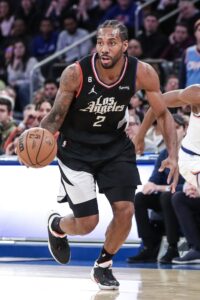 In: Eric Gordon, Mason Plumlee, Bones Hyland
- Out: Luke Kennard, Reggie Jackson, John Wall
- Mavericks, 31-28 (23-15)
- In: Kyrie Irving, Markieff Morris, Justin Holiday (free agent addition after buyout)
- Out: Spencer Dinwiddie, Dorian Finney-Smith
- Pelicans, 30-28 (19-14)
- In: Josh Richardson
- Out: Devonte’ Graham
- Timberwolves, 31-29 (22-19)
- In: Mike Conley, Nickeil Alexander-Walker
- Out: D’Angelo Russell, Bryn Forbes (waived)
- Warriors, 29-29 (17-14)
- In: Gary Payton II (injured)
- Out: James Wiseman
- Jazz, 29-30 (19-17)
- In: Russell Westbrook (away from team), Damian Jones, Juan Toscano-Anderson
- Out: Mike Conley, Nickeil Alexander-Walker, Malik Beasley, Jarred Vanderbilt
- Trail Blazers, 28-30 (20-16)
- In: Cam Reddish, Matisse Thybulle, Ryan Arcidiacono, Kevin Knox
- Out: Josh Hart, Gary Payton II
- Thunder, 27-29 (14-17)
- In: Dario Saric, Eugene Omoruyi (promoted from two-way deal)
- Out: Darius Bazley, Mike Muscala
- Lakers, 26-32 (13-20)
- In: Rui Hachimura, Davon Reed, D’Angelo Russell, Malik Beasley, Jarred Vanderbilt, Mohamed Bamba
- Out: Kendrick Nunn, Russell Westbrook, Damian Jones, Juan Toscano-Anderson, Thomas Bryant, Patrick Beverley
Phoenix made the biggest splash, trading for superstar forward Durant (MCL sprain), who won’t make his Suns debut until after the All-Star break. The Mavericks got a second star to pair with Luka Doncic in Irving, though he can be mercurial. The Clippers bolstered their guard depth and added a traditional backup center in Plumlee.
 Golden State dealt away its former second overall pick and brought back a familiar face to try and defend its title, but discovered that Payton was injured and will miss a significant amount of time. The Wolves swapped out point guards, preferring Conley’s veteran leadership and additional year of team control to Russell’s expiring deal.
The Lakers completely reshaped their roster, but with only 24 games remaining, they’re running out of time to make up ground in the standings. The Jazz were a seller, but they have exceeded expectations all season and hold a half-game lead on the Blazers and Thunder for the final spot in the play-in tournament.
The top three seeds were all relatively quiet at the deadline, particularly the Kings, who only made one very minor trade. It’s understandable why the Nuggets and Grizzlies were confident in their teams, given their respective places in the standings.
After starting the season 14-10, the Nuggets have gone 26-8 over their past 34 games. They hold a five-game lead over Memphis for the top seed in the West and currently have a 26-4 home record in 2022/23 — home court advantage could be a big deal for Denver in the playoffs.
We want to know what you think. Which team will represent the Western Conference in the NBA Finals?
Vote in our poll, then head to the comment section to weigh in with your predictions.
Which Team Will Win The Western Conference?
-
Nuggets 48% (785)
-
Suns 22% (359)
-
Warriors 7% (114)
-
Lakers 5% (86)
-
Clippers 4% (67)
-
Mavericks 4% (59)
-
Grizzlies 3% (50)
-
Kings 3% (46)
-
Timberwolves 2% (27)
-
Thunder 1% (17)
-
Pelicans 1% (9)
-
Trail Blazers 0% (6)
-
Jazz 0% (5)
Total votes: 1,630
Justin Holiday Signs With Mavs After Buyout With Rockets
FEBRUARY 15: Holiday’s new contract with the Mavericks is official, the team announced (via Twitter).
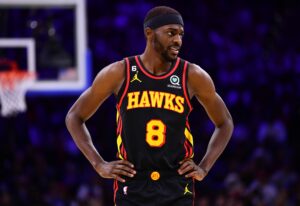 FEBRUARY 13, 9:05pm: Holiday has officially been waived by the Rockets, according to the NBA transactions log.
FEBRUARY 13, 12:17pm: Veteran swingman Justin Holiday has reached a buyout agreement with the Rockets and intends to sign with the Mavericks after he clears waivers, sources tell Brian Windhorst of ESPN.
Marc Stein reported Sunday evening (via Twitter) that the Mavs would be interested in Holiday if he was bought out by Houston. Dallas was also reportedly interested in Terrence Ross, who plans to sign with the Suns after being bought out by Orlando. However, according to Tim MacMahon of ESPN, Holiday was the Mavs’ top potential buyout target (Twitter link).
Holiday, 34, was sent to Houston from Atlanta as part of a cost-cutting trade by the Hawks. Now in his 10th season, Holiday didn’t get much playing time with Atlanta in 2022/23, making 28 appearances while averaging 4.5 points in 14.7 minutes per game.
A report after the trade indicated that the Rockets were interested in keeping Holiday around, perhaps even beyond this season. Obviously that didn’t work out, with Holiday spotted having an extended conversation with coach Stephen Silas during Monday’s shootaround (Twitter link via Kelly Iko of The Athletic).
The Mavs dealt away Dorian Finney-Smith as part of the Kyrie Irving trade, so Holiday will provide some additional depth on the wing. Dallas technically has a full 15-man roster, but big man Chris Silva is only on a 10-day deal — if Dallas wants to sign Holiday before the All-Star break, Silva’s contract would likely be ended early to make room for the newcomer.
Blazers Notes: Grant, Deadline, Offseason, Lillard, Reddish
Trail Blazers forward Jerami Grant sustained a right eye contusion during Friday’s loss to Oklahoma City. Although he was cleared to return at the time, he started experiencing “concussive symptoms” on Saturday morning and was placed in the league’s concussion protocol, Portland announced in a press release.
The impending free agent was initially questionable for Monday’s game against the Lakers, but he has been downgraded to out, per the Blazers (Twitter links). Forward Kevin Knox, who was acquired in a four-team trade that also involved Golden State, Detroit and Atlanta, will be active for his first game with Portland.
Here’s more on the Blazers:
- Grant has switched agents ahead of free agency. He is now represented by Klutch Sports Group, he confirmed to Danny Marang of 1080 The FAN (Twitter link).
- GM Joe Cronin says he was disappointed to not add a major impact player at the trade deadline, so he instead pivoted to “asset acquisition mode,” as Jason Quick of The Athletic relays. “We want to be championship level as soon as possible. So for us, it was disappointing. We want to get out there, and we would love to have a team out here tonight that is ready to rock. We are borderline anxious to push all of our chips in. We can’t wait for that moment to happen. It just hasn’t come up yet,” he said.
- Cronin went on to say the Blazers will aggressively build around Damian Lillard in the offseason, according to Quick. “We are going to be ridiculously aggressive, to the point where once we push our chips all the way in, like, deal-to-deal you might say ‘Wow, they lost that deal. They gave a lot for that guy.’ But no, that’s just us pushing our chips in. We feel extremely obligated to put a great roster around Damian Lillard. And when I say we, that’s from the top. Jody (Allen) and I have had a lot of conversations about how important it is for us to do right by Damian. And we plan to do that,” Cronin said.
- Lillard believes Cam Reddish has untapped upside and hopes the Blazers can bring out the best in the fourth-year wing. “You know he has all the tools…He hasn’t found a home yet…If we can change his life and get that potential out of him, create opportunity for him to blossom, then it could be a great thing…that’s our job, to try to get it out of him,” Lillard said (Twitter video link via New York Basketball).
Pacers Re-Sign James Johnson
The Pacers have re-signed James Johnson, the team announced in a press release. Johnson’s contract covers the rest of the 2022/23 season, per Michael Scotto of HoopsHype (Twitter link), so he will be an unrestricted free agent in the offseason.
Indiana waived the veteran forward as part of the four-team blockbuster trade that sent Kevin Durant to Phoenix. The fact that the Pacers decided to bring him back isn’t a surprise, as Dustin Dopirak of The Indianapolis Star reported a few days ago that Johnson was expected to re-sign with Indiana after clearing waivers.
Johnson, 35, is a well-traveled veteran — the Pacers are his 10th NBA team in 14 seasons. He hasn’t seen much on-court action this season, appearing in just 12 games for a total of 98 minutes, but the Pacers value his leadership in the locker room.
Shai Gilgeous-Alexander, Derrick White Named Players Of The Week
Thunder guard Shai Gilgeous-Alexander and Celtics guard Derrick White have been named the NBA’s players of the week, the league announced (via Twitter).
Gilgeous-Alexander, a first-time All-Star in 2022/23, averaged 31.3 points, 6.3 assists, 1.7 rebounds and 1.3 steals in leading Oklahoma City to a 2-1 record last week. He posted a .571/.333/.949 shooting line in the three games (35.4 minutes per contest). Gilgeous-Alexander won the Western Conference award for the second time this season.
White, the East’s winner, led Boston to a 4-0 week by averaging 24.5 points, 7.5 assists, 4.8 rebounds and 1.3 blocks on .522/.515/.900 shooting in 38 minutes per contest. He started all four games in place of Marcus Smart, who is currently sidelined with an ankle injury.
According to the NBA (Twitter link), the other nominees in the West were Deandre Ayton, De’Aaron Fox, Nikola Jokic and Ja Morant, while Jarrett Allen, Giannis Antetokounmpo, Jimmy Butler, Tyler Herro, Joel Embiid, James Harden and Trae Young were nominated in the East.
Warriors’ Myers On Payton, Wiseman, Trade, Buyout Market
Warriors president of basketball operations Bob Myers held a press conference on Monday following the four-team trade that saw Gary Payton II sent back to Golden State from Portland. The deal was held up for a few days as the Warriors considered their options, but it ultimately went through even though they failed Payton’s physical due to a core muscle injury.
The veteran guard will be reevaluated in one month and the team hopes he’ll be back before a potential playoff push, Myers told reporters, including Anthony Slater of The Athletic (Twitter link). Regarding Payton’s injury, Myers added that “there are things I can’t say for legal reasons and HIPAA reasons,” tweets Mark Medina of NBA.com.
A formal league inquiry into the Trail Blazers‘ alleged failure to provide sufficient medical information is expected to be opened. Myers didn’t want to comment on the potential investigation.
“Good question, but I don’t want to answer that. I can’t go down that road of accusations,” Myers said (Twitter link via Medina).
As far as why the process took a few days, Myers said the team was evaluating its options and wanted clarity on whether the trade could potentially be amended, which wasn’t possible after the deadline passed. He hopes to get a “fair” result from the investigation.
“What do I want? Whatever the NBA says is fair,” Myers said, per Slater (Twitter video link).
Here’s more from Myers’ press conference:
- Slater pointed out to Myers that Payton missed the first 35 games of the season after a long recovery following surgery, and when he returned he wasn’t always playing every day. Was that a red flag? “We looked at the fact that he started the night before against our team…I didn’t factor in the thought that he’d be out as long as he will be,” Myers replied (Twitter video link).
- Myers said it was a difficult decision to deal way former No. 2 overall pick James Wiseman, who was sent to Detroit as part of the trade. He said it was a “tough, tough move to make,” adding that “he’s a great kid and did everything we asked him to do” (Twitter link via Medina).
- The Warriors were still high on Wiseman’s long-term potential, but Myers believes he needs playing time to develop his skills, and that wasn’t happening on Golden State. He said the trade was “not an indictment of James” and “it’s a hard rotation to crack,” tweets Medina. Part of the reason the Warriors decided to go through with the trade was because they “didn’t see a path” for Wiseman to be successful if they rescinded the trade and brought him back, per ESPN’s Kendra Andrews (Twitter link).
- Myers was asked if the Warriors would look to the buyout market to address frontcourt depth. “It doesn’t matter if he’s seven feet tall or eight feet tall. Any buyout conversation has to be done in collaboration with the coaching staff. Because why bring a player in if they’re not going to use him? But if there’s a player that the coaching staff and front office thinks can be helpful, then absolutely we’ll go target that guy,” Myers replied (Twitter video link courtesy of Slater).
- When Slater asked Myers about the possibility of converting Anthony Lamb or Ty Jerome, both of whom are on two-way contracts, to a standard deal, Myers said a decision hasn’t been made yet. “I think we’ve gotta look and see whether it’s that or another player or whatever it might be and compare them. And say to Steve, ‘Hey, these are your options. Which player do you think helps us the most?’ And make that determination,” Myers said, adding that system fit would factor in as well.
Eric Gordon To Clippers, Luke Kennard To Grizzlies In Three-Team Trade
10:22pm: The trade is now official, according to press releases from the Rockets, Grizzlies, and Clippers.
As first reported by Kelly Iko of The Athletic and confirmed by the Rockets, the swap rights Houston got in the deal are top-six protected. So in the unlikely event that the Thunder’s and Clippers’ picks both land in the top six, the Rockets won’t be able to swap the Bucks’ first-rounder for the least favorable of those two picks.
The Rockets also confirmed that they’ve waived Boban Marjanovic to accommodate the extra incoming player in the deal. They’re expected to re-sign him once he clears waivers and Wall is released.
Andrew Greif of The Los Angeles Times (Twitter link) has the details on the three second-round picks the Clippers acquired from the Grizzlies. They are as follows:
- The Raptors’ 2024 second-round pick.
- Either the Pacers’ 2024 second-round pick or the least favorable of the Cavaliers’ and Jazz’s 2024 second-round picks (whichever is most favorable).
- The Grizzlies’ 2027 second-round pick.
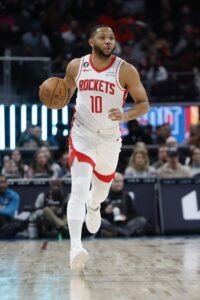 1:20pm: The Clippers have reached an agreement to acquire veteran wing Eric Gordon from the Rockets, sources tell Shams Charania of The Athletic (Twitter link).
According to Charania, the move will be part of a three-team deal that sends Luke Kennard to the Grizzlies, with Clippers guard John Wall headed back to Houston (Twitter links). The Rockets plan to waive Wall, tweets Chris Haynes of Bleacher Report.
Danny Green will be sent from Memphis to Houston in the trade, according to Wojnarowski, who reports (via Twitter) that the Clippers are getting three second-round picks from the Grizzlies. The Rockets will also acquire the right to swap this year’s Bucks first-round pick with the Clippers’ first-rounder (or the Thunder’s first-rounder, if the Clippers pick is earlier in the draft), tweets Tim MacMahon of ESPN.
It’s an interesting trade from all sides. The Clippers have needed a guard who could drive and shoot from outside while playing decent defense, and Gordon fits that bill when he’s playing well. Gordon has been in trade rumors for years, and now he’s headed back to the Clippers, who drafted him seventh overall back in 2008.
While the Clippers took a risk by potentially losing their own first-round pick, they’ll still be guaranteed to receive the Bucks’ first-rounder and will also get three second-rounders from Memphis, which isn’t bad at all considering they arguably got the best player in the trade. Gordon, 34, makes $19.57MM this season, but his $20.92MM salary for 2023/24 is non-guaranteed.
The Rockets had long been looking for a first-round pick for Gordon, and they’re essentially swapping Milwaukee’s potential late first-round pick (it would be 28th right now) for one with higher upside — the Clippers’ would be 18th right now. The Bucks (37-17) are currently six games ahead of the Clippers (31-27), but there’s still 20-plus games remaining for both teams.
Green has been one of the NBA’s best 3-and-D wings for the better part of a decade, winning three championships with the Spurs, Raptors and Lakers. He holds a 39.9% career mark from behind the arc, but he’s 35 years old and just made his season debut this month after recovering from a torn ACL suffered in last year’s playoffs. Green will be a free agent this summer.
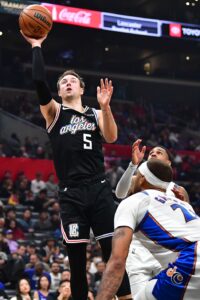 Wall temporarily heading back to Houston after his troubled tenure with the Rockets is an ironic twist, as he’ll be waived by the same team that bought him out in the offseason — that’s how he signed with L.A. in the first place. He didn’t find much success with the Clippers, posting a poor shooting slash line of .408/.303/.681 for a team hoping to contend.
The Grizzlies rank just 24th in the league in 3-point percentage and get one of the league’s best shooters in the 26-year-old Kennard, who holds a career mark of 42.7% on 3s, including 44.7% this season. He is not a strong defensive player, but he’s a decent complementary play-maker.
Dealing away three second-rounders for a player who is nine years younger and on a reasonable long-term contract that will pay him about $45.2MM through 2025 (the final year is a team option) makes sense. Green is a very good, albeit streaker shooter, but Kennard is elite in that regard.
Luke Adams contributed to this post.
Suns Trade Saric, Second-Rounder To Thunder For Bazley
7:53pm: The trade is now official, according to a press release from the Thunder. Phoenix sent its own 2029 second-round pick and cash to Oklahoma City in the deal.
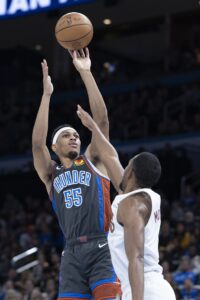 1:00pm: The Suns are trading forward/center Dario Saric and a second-round pick to the Thunder in exchange for forward/center Darius Bazley, reports Shams Charania of The Athletic (via Twitter).
As John Hollinger of The Athletic tweets, the deal was possible because of a large traded player exception the Thunder created when they dealt Derrick Favors to Houston before the 2022/23 season started (Favors was subsequently waived).
Both players are impending free agents — Saric will be unrestricted and makes $9.24MM in the final year of his contract, while Bazley is earning $4.26MM and will be a restricted free agent if Phoenix gives him a qualifying offer.
Considering the Suns went all-in in their blockbuster trade to acquire superstar forward Kevin Durant, I’m a little surprised that they’re moving a second-round pick — and perhaps the better player — to save money in this deal. Saric missed all of last season while recovering from a torn ACL and he had a very slow start to ’22/23, but he has played his best basketball as of late, averaging 8.8 PPG, 5.4 RPG and 2.3 APG on .485/.438/.800 shooting over the past 15 games (seven starts, 18.5 MPG).
It’s definitely not certain that Saric is a better player than Bazley right now. Both players have been in-and-out of their teams’ rotations, but Bazley (22) is six years younger than Saric (28) and is a superior athlete and defender, while the Crotian veteran has been a better all-around offensive player to this point in their careers.
Perhaps the Suns didn’t want to bring back Saric in free agency, or they were worried about his fit with the new roster. Either way, they will save a significant amount of money toward the luxury tax and get a look at a versatile defensive player who might have some untapped upside in Bazley — his next contract should be relatively affordable, if they choose to re-sign him.
For the Thunder, they add a veteran in the frontcourt after agreeing to trade Mike Muscala to Boston, and add another second-round pick to their ever-growing draft cache. Stylistically, Saric fits well with what the Thunder like to do offensively, as he’s a good screener, passer and play-maker, while Bazley is more limited in that regard.