
Wolves Rumors: Butler, Wiggins, Jones, Dieng
Jimmy Butler will have the opportunity to opt out and sign a new contract with the Timberwolves a year from now, but Sean Deveney of The Sporting News hears from sources familiar with the situation that Butler is uncertain about playing alongside Andrew Wiggins in the long term. According to Deveney, Butler had issues last season related to Wiggins’ work ethic and defensive approach.
As Deveney details, head coach Tom Thibodeau has had similar gripes with Wiggins in the past, and had hoped that bringing in a “tough-minded” veteran like Butler would motivate the former No. 1 pick to improve. However, it didn’t seem to help much.
While the Wolves figure to explore the trade market for Wiggins this summer, it will be hard to find a viable deal with his five-year, maximum-salary contract set to take effect, Deveney notes.
Here’s more from Deveney on the Wolves:
- Thibodeau’s use of his bench continues to be a source of friction in Minnesota, with Tyus Jones among the backups adversely affected. A source tells Deveney that Jeff Teague suggested to Thibodeau last season that Jones should play more.
- According to Deveney, Jones considered requesting a trade out of Minnesota, but Thibodeau “reasserted his support” of the young guard following the season, assuring Jones that his role will increase next season even if Derrick Rose is re-signed, due to the presumed departure of Jamal Crawford.
- While the Wolves don’t appear likely to move Jones, they’ll look to deal highly-priced backup Gorgui Dieng, per Deveney.
- I touched on several of these topics earlier this week in my preview of the Timberwolves’ offseason.
Kawhi Leonard Wants Out Of San Antonio
Star forward Kawhi Leonard wants the Spurs to trade him, league sources tell Jabari Young of The San Antonio Express-News. Multiple outlets have confirmed the news, with Shams Charania of Yahoo Sports writing that Leonard has “grown uncomfortable” in San Antonio and would like a change.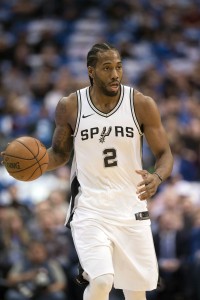
Sources tell ESPN’s Adrian Wojnarowski (Twitter link) that while it seems clear Leonard wants a change of scenery, he has yet to express anything directly to the Spurs about his future, and the team won’t rush the process.
According to Wojnarowski (via Twitter), Leonard – a Los Angeles native – has L.A. “at the center” of his preferred landing spots. While the Clippers could offer a compelling trade package and plan to pursue Leonard aggressively, per Marc Stein of The New York Times (Twitter link), the Lakers are atop his wish list, Wojnarowski adds.
Meanwhile, ESPN’s Ian Begley reports (via Twitter) that people close to Leonard have expressed a desire for the 26-year-old to play in New York, though the Knicks might have trouble putting together a viable trade package without including Kristaps Porzingis. Chris Mannix of Yahoo Sports adds the Kings to the list of teams who could kick the tires, tweeting that Sacramento has talked to teams about the No. 2 overall pick and “desperately” wants an established star.
The Sixers have also been cited as an asset-rich team with interest in acquiring Leonard, and the Celtics would fit that bill too. Boston reportedly made an offer for Leonard at the 2018 trade deadline, and Wojnarowski reports (via Twitter) that the C’s still have interest.
Leonard is just a year away from being able to reach unrestricted free agency, so he should be able to assert some leverage in the process depending on how willing – or unwilling – he is to commit long-term to certain teams. However, as we saw last summer with Paul George, who also wanted to join the Lakers, there will likely be clubs willing to roll the dice on a player of Leonard’s caliber without any assurances that he’ll stick around for longer than one year.
Of course, in George’s case, he was coming off a healthy, productive season, which can’t be said for Leonard. As we’ve written throughout the 2017/18 league year, Leonard and the Spurs were at odds this season over the diagnosis and treatment of a troublesome quad issue, with Leonard’s own doctors disagreeing with team doctors about the nature of the injury. That disagreement has been a source of tension between the Spurs and Leonard’s camp. The veteran was also reportedly put off by having his status questioned during a players-only meeting.
There was a belief that the Spurs and Leonard would look to mend fences this offseason, especially since the former first-round pick is eligible for a “super-max” extension that would start at 35% of the cap and would pay him well over $200MM for five seasons. San Antonio is the only team eligible to sign Leonard to such a deal, though there was no guarantee that the club would put that offer on the table. If Leonard is traded, he’d be eligible next summer to sign a five-year contract worth up to 30% – rather than 35% – of the cap.
According to Chris Haynes of ESPN.com (Twitter link), Leonard isn’t worried about the possibility of missing out on the super-max. Haynes adds that there’s a “feeling of betrayal” on Leonard’s side that at this point appears irreparable, as the two-time Defensive Player of the Year feels like the franchise turned on him after he sought a second opinion on his quad.
Per Haynes, Leonard and Spurs head coach Gregg Popovich have been in touch in recent days, but have yet to speak in person.
Although a number of teams figure to be in the mix for the former NBA Finals MVP if and when San Antonio begins taking calls, it’s hard not to see the Lakers as an ideal fit, assuming the Spurs aren’t committed to sending him to the Eastern Conference.
Besides being Leonard’s preferred destination, L.A. also has several young players that could intrigue the Spurs in a trade, and has indicated that none are untouchable. The Lakers would still have more than enough cap room to add another star in free agency after taking on Leonard’s $20MM salary for 2018/19. They’re also projected to be so far below the cap that they wouldn’t necessarily need to match salaries in a deal after July 1.
When the Lakers weighed a George trade a year ago, one key question they had to answer was how much they were willing to surrender for a player who might simply head to L.A. as a free agent 12 months later. The franchise figures to face a similar dilemma this offseason as it considers trading for Leonard. If the Lakers are confident they can land another star or two, it may make more sense to go all-in for Leonard than it did with George in 2017.
Photo courtesy of USA Today Sports Images.
Notable Trade Exceptions Available This Offseason
For NBA teams lacking the cap room to make impact additions to their roster this offseason, traded player exceptions represent one tool available to accommodate that sort of acquisition.
As we explain in our glossary entry, traded player exceptions are created when a team trades away a single player without immediately taking salary back in return. The club then has up to one year in which it can acquire one or more players whose combined salaries amount to no more than the traded player’s salary (plus $100K).
That means sizable traded player exceptions created during the 2017 offseason are on track to expire in the coming weeks or months, so teams will have to use them or lose them during the 2018 offseason. Trade exceptions generated during the 2017/18 regular season prior to the February deadline will be available through the offseason and into the 2018/19 season.
The full list of available traded player exceptions can be found right here, but here are a few notable TPEs worth keeping an eye on during the coming offseason:
Portland Trail Blazers
Value of traded player exception: $12,969,502
Expiry date: 7/25/18
Created when they traded Allen Crabbe to the Nets.
The Trail Blazers already have more than $110MM in guaranteed salaries on their books for 2018/19, and that figure doesn’t include a potential new contract for Jusuf Nurkic. So unless they’re able to significantly cut costs elsewhere, it may not be realistic for the Blazers to use their $13MM trade exception to take on another sizable contract.
Still, president of basketball operations Neil Olshey talked earlier this offseason about feeling as if Portland has been too “protective” of some of its assets, including its trade exception. So it sounds like he’ll explore possible uses for it, even if the club ends up not finding a viable deal.
Chicago Bulls
Value of traded player exception: $12,500,000
Expiry date: 2/1/19
Created when they traded Nikola Mirotic to the Pelicans.
The Bulls have been in an odd spot from a cap perspective for the last year, having carried a variety of exceptions that technically made them an over-the-cap team even though their players salaries have never exceeded $99MM. Chicago will have another opportunity to dip below the cap this offseason, and it seems likely that the club will do so, which would mean forfeiting this exception.
Toronto Raptors
Value of traded player exception: $11,800,000
Expiry date: 7/13/18
Created when they traded DeMarre Carroll to the Nets.
The Raptors, who also have a $6,125,440 exception left over from last July’s Cory Joseph deal, are in a similar spot to the Blazers. While their TPEs are good tools to improve the roster in theory, the Raptors have a potential luxury-tax bill to worry about. As such, adding salary without sending out any in return probably isn’t practical for Toronto, and I wouldn’t be surprised to see these exceptions expire.
It’s worth noting that are ways for the Raptors – and other teams on this list – to roll over at least one significant TPE for another year. For instance, let’s say Toronto dealt a player like Norman Powell for someone making about $10-11MM in 2018/19. In that scenario, the Raps could acquire the incoming player with the Carroll TPE and create a new exception worth Powell’s salary.
Los Angeles Clippers
Value of traded player exception: $7,273,631
Expiry date: 6/28/18
Created when they traded Chris Paul to the Rockets.
The Clippers have less than two weeks to use this exception, created in last June’s CP3 blockbuster. This limits their options, since many deals won’t be made until the new league year begins in July. I think this exception is a good bet to go unused.
Detroit Pistons
Value of traded player exception: $7,000,000
Expiry date: 1/29/19
Created when they traded Boban Marjanovic to the Clippers.
With nearly $112MM in guaranteed money on their 2018/19 cap, the Pistons have a little more flexibility than teams like the Blazers and Raptors, but not by much. For instance, Detroit likely wouldn’t be able to use its full mid-level exception and acquire a $7MM player using this TPE. However, if the Pistons can’t find a player they like on the free agent market worth a mid-level investment, this exception could provide an alternate path to adding a bench piece.
Cleveland Cavaliers
Value of traded player exception: $5,811,114
Expiry date: 8/22/18
Created when they traded Kyrie Irving to the Celtics.
There are a ton of moving pieces in play for the Cavaliers‘ offseason, so this modest exception will get overlooked. Still, it could be a useful tool to try to acquire help for LeBron James if he stays — or to help accommodate some roster reshuffling if he departs.
Nuggets’ Darrell Arthur Exercises Player Option
Nuggets power forward Darrell Arthur has opted into his contract for the 2018/19 season, reports Shams Charania of Yahoo Sports (via Twitter). Arthur will earn a salary of $7,464,912 next year after exercising his player option.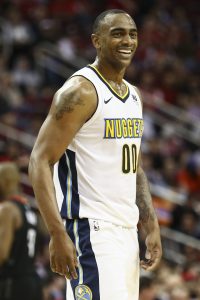
Arthur, 30, enjoyed perhaps the best year of his career in 2015/16, his first season in Denver, when he averaged 7.5 PPG and 4.2 RPG with a .452/.385/.755 shooting line in a rotation role for the team. However, he has seen his playing time cut back significantly over the last two years.
In 2017/18, Arthur appeared in just 19 games for Denver, averaging 2.8 PPG and 0.8 RPG in 7.4 minutes per contest. With Paul Millsap, Trey Lyles, Kenneth Faried, Juan Hernangomez, and Wilson Chandler all seeing time at the four while Nikola Jokic and Mason Plumlee handled the five, there simply wasn’t a role for Arthur.
Since Arthur was unlikely to command more than the minimum salary on the open market, his decision to pick up his player option comes as no surprise. It doesn’t assure of him spending the 2018/19 season in Denver though.
With the Nuggets potentially looking to lock up Jokic and Will Barton to lucrative new deals this summer, the team will probably need to cut costs elsewhere, making Arthur a candidate to be traded or released. The Nuggets could reduce Arthur’s 2018/19 cap charge by nearly $5MM by waiving and stretching him. The club is also said to be exploring trades involving Faried.
Arthur’s player-option decision continues an offseason trend that reflects the lack of league-wide cap room available this summer. After only eight total veterans picked up their player options in 2016 and 2017, Arthur becomes the 10th veteran to do so in 2018, and he won’t be the last. The full list of player option decisions can be found right here.
Photo courtesy of USA Today Sports Images.
Five Key Offseason Questions: Oklahoma City Thunder
After losing Kevin Durant during the summer of 2016, the Thunder made an effort to reintroduce some star power to their roster during the 2017 offseason, finalizing trades for Paul George and Carmelo Anthony to create a new “Big Three” along with Russell Westbrook.
However, Oklahoma City sacrificed important depth in those deals, and it came back to haunt the team, particularly after Andre Roberson went down with a season-ending injury — the bench ranked 29th in the NBA in scoring during the regular season, and was dead last in PPG during the playoffs. Whether or not George and Anthony are still on the roster next season, OKC will have to find a way to replenish its rotation with reliable contributors.
Here are five key questions facing the franchise this summer:
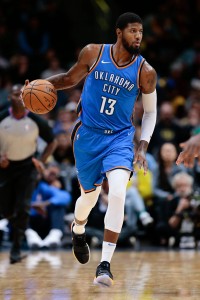 1. Will George re-sign with the Thunder?
A year ago, it seemed like a foregone conclusion that George would be traded to a team like the Lakers – his preferred landing spot – or the Celtics, who had more than enough assets to put together any number of competitive trade offers. The Thunder ended up shocking the world by snatching George out of Indiana in a blockbuster deal that virtually no one saw coming.
Twelve months later, it’s tempting to once again write the Thunder off as a long-term home for George, particularly after the team’s unceremonious first-round exit from the postseason. There’s a clear path for George to return home to Los Angeles and join the Lakers, who can create enough cap room to sign two stars this offseason.
Still, we keep hearing that the Thunder remain confident about their chances of re-signing George, and Marc Stein of The New York Times wrote this week in his newsletter that there’s a “growing belief” around the league that the club’s confidence is well-founded. I’m still not entirely convinced that George sticks in Oklahoma City. After all, the last time the Thunder were conveying this sort of confidence heading into a star player’s free agency, he bolted for the Bay Area.
It would be fascinating to see what happens if the Thunder do re-sign George. A maximum-salary contract for the two-way forward would start at $30MM+. With about $89MM in guaranteed money already on the club’s 2018/19 cap, and Anthony’s expensive player option likely to add another $28MM or so to that figure, OKC probably can’t really afford George unless costs are cut elsewhere.
2. Will Anthony be on the Thunder’s roster in 2018/19?
Whether or not George is back, Anthony’s player option is a problem. He hasn’t technically opted in yet, but there’s no chance he’ll turn down a $27.9MM+ salary. He’d be lucky to receive a third of that on the open market.
Anthony’s situation is somewhat reminiscent of Dwyane Wade opting into his $23MM+ contract with the Bulls last June. Wade was unlikely to ever get that sort of payday again, so he couldn’t pass up the money, but it quickly became clear that he had no interest in playing for the rebuilding Bulls, and the two sides reached a buyout agreement that saw Wade give up about $8MM in order to sign with a team of his choice.
While the Thunder and Anthony could reach a similar agreement, Carmelo may not quite as eager as Wade was to leave his current situation. Chicago was entering a full-fledged rebuild, whereas OKC hopes to contend again next season, particularly if George returns. Paradoxically though, it looks like there’s no way the Thunder could reasonably keep Anthony on board at his current cap figure if they re-sign George. The tax penalties would be too high.
If George re-signs, I’d expect Anthony to be waived and stretched, even if he’s not willing to give up any money in a buyout. Stretching the final year of his contract over three seasons would reduce his cap charge by about $18.6MM, creating some badly-needed relief for the Thunder. Even if George isn’t back, it wouldn’t be a total surprise to see OKC take that route, since doing so would move team salary well below the tax line and would generate some flexibility for other roster moves.
Draft Notes: Evans, Jazz, J. Robinson, Simons, Lakers
Potential first-round pick Jacob Evans will work out on Sunday for the Jazz, league sources tell Tony Jones of The Salt Lake Tribune (Twitter link). A swingman out of Cincinnati, Evans could be an option for Utah when the club is on the clock at No. 21.
Meanwhile, the Jazz are bringing in several more prospects for a Friday audition, according to the team (Twitter link). Josh Okogie (Georgia Tech) and Jerome Robinson (Boston College), two more possible targets at No. 21, are the headliners. They’ll be joined by Trevon Duval (Duke), Landry Shamet (Wichita State), Kelan Martin (Butler), and George King (Colorado).
Here are several more draft-related notes:
- Anfernee Simons is generating some first-round buzz, according to Kevin O’Connor of The Ringer, who tweets that the Trail Blazers and Lakers are among the teams with interest in the IMG Academy guard.
- The Lakers will host another group workout on Friday, with De’Anthony Melton (USC), Yante Maten (Georgia), Gabe DeVoe (Clemson), Peyton Aldridge (Davidson), Justin Tillman (VCU), and Kyle Washington (Cincinnati) taking part, per a team release.
- The Timberwolves are among the teams that have worked out Boston College guard Jerome Robinson, according to Darren Wolfson of 5 Eyewitness News, who suggests (via Twitter) that Robinson has made a good impression on the workout circuit. Robinson currently ranks as the No. 17 prospect on Jonathan Givony’s ESPN big board, so he’s a potential target for Minnesota at No. 20.
- In addition to Kevin Knox and Wenyen Gabriel, whose workouts were previously reported, the Sixers will be taking a closer look today at Jacob Evans (Cincinnati), Tra Holder (Arizona State), E.C. Matthews (Rhode Island), and Jordan Barnett (Missouri), as Keith Pompey of The Philadelphia Inquirer relays (via Twitter).
- Despite the declining importance of centers in the modern NBA, many of this year’s very best prospects play the five, creating some risk at the top of the draft, Kevin Pelton writes in an interesting piece for ESPN.com.
Hoops Rumors Glossary: Over-38 Rule
The Over-38 rule, formerly known as the Over-36 rule under the NBA’s previous Collective Bargaining Agreement, closes a loophole in the CBA, preventing teams from paying older free agents more than their cap room or cap exceptions allow. It also limits the ability of players in their mid- to late-30s to sign long-term contracts.
The original purpose of the Over-38 rule was to block teams from circumventing the salary cap by offering a contract that extends beyond when the club expects a player to end his career. For instance, if a team wanted to offer a 37-year-old free agent a two-year contract worth $35MM but only had the mid-level exception available, the team could have made it a four-year offer in order to fit the average annual salary within the MLE, knowing that the player could collect his third- and fourth-year salaries after retiring. The Over-38 rule prevents that.
The Over-38 rule generally takes effect when a free agent signs a long-term contract that extends beyond his 38th birthday. In these cases, the salary in the year(s) after the player turns 38 is considered deferred compensation, and is applied to the years earlier in the contract, when that salary is actually being earned. In most cases, this prevents the team from completing the contract using the necessary cap room or exception.
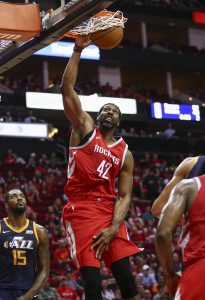 The Over-38 rule is a little complicated, so let’s use a real-life example to illustrate it. In the summer of 2017, the Rockets and Nene fell victim to the Over-38 rule when they tried to complete a four-year deal using Nene’s Non-Bird rights. The contract would’ve looked like this:
| Year | Salary |
|---|---|
| 2017/18 | $3,477,600 |
| 2018/19 | $3,651,480 |
| 2019/20 | $3,825,360 |
| 2020/21 | $3,999,240 |
| Total | $14,953,680 |
Unfortunately for Nene and the Rockets, the final year of this deal would have violated the Over-38 rule because the veteran center will turn 38 on September 13, 2020, prior to the start of the fourth season of his contract.
The start of a season is considered to be October 1 for Over-38 purposes, so if Nene’s birthday was on October 13 rather than September 13, he would have been okay. But because a four-year deal for him had to be considered an Over-38 contract, the fourth-year salary needed to be viewed as deferred compensation, which would be spread out in a prorated fashion over the first three years of the deal. It would have looked like this:
| Year | Salary | Deferred Compensation | Cap Charge |
|---|---|---|---|
| 2017/18 | $3,477,600 | $1,269,600 | $4,747,200 |
| 2018/19 | $3,651,480 | $1,333,080 | $4,984,560 |
| 2019/20 | $3,825,360 | $1,396,560 | $5,221,920 |
| 2020/21 | $3,999,240 | $0 | $0 |
| Total | $14,953,680 | $3,999,240 | $14,953,680 |
Due to the increased cap hits on the new-look deal, the contract would have violated the rules of the Non-Bird exception, which limited Nene’s first-year salary to 120% of his previous salary ($2,898,000). As such, the Rockets couldn’t complete the four-year contract using those Non-Bird rights.
It’s important to note that the Over-38 rule didn’t prevent the Rockets from signing Nene to a four-year, $15MM deal. If the team had wanted to use part of its mid-level exception, it could have given him that same contract the two sides originally negotiated. But Houston had earmarked its MLE for P.J. Tucker, leaving the Non-Bird exception as the team’s only viable means of bringing back Nene. So while Nene technically could have signed a contract that extended beyond his 38th birthday, the Over-38 rule significantly limited the Rockets’ ability to complete such a deal.
In Nene’s case, that fourth year was referred to as a “zero year,” reflecting the adjusted cap charge. Determining what seasons are considered “zero years” is tricky, since a variety of factors relating to the length of the contract, the player’s age, and the player’s Bird rights are taken into account. Here are some of those factors:
- The Over-38 rule only applies to four- or five-year contracts, or extensions that keep a player under contract for a total of four or five years.
- The first “zero year” is either the fourth season of the contract or the first season after the player’s 38th birthday, whichever comes later.
- Players who re-sign with their previous teams prior to October 1 using full Bird rights get some extra leeway. If a player who is 35 or 36 years old signs a four-year contract with his previous team using Bird rights, the Over-38 rule wouldn’t apply. If that player signs a five-year contract, only the fifth season would be considered a zero year. In other words, if Nene had full Bird rights last summer, his four-year deal wouldn’t have been subject to the Over-38 rule.
- These special exceptions for players with Bird rights don’t apply to players who change teams via a sign-and-trade.
If the Over-38 rule doesn’t already sound complicated enough, there’s an additional aspect of the rule that affects what happens when a veteran on an Over-38 contract plays out most or all of his deal. In that scenario, his deferred compensation gradually stops being considered deferred, and his cap hits are adjusted accordingly over the course of his contract. You can check out Larry Coon’s CBA FAQ for more details on that component of the rule if you’re interested.
Finally, it’s worth noting that LeBron James and Chris Paul reportedly played major roles during the last CBA negotiations in having this rule changed from the Over-36 rule to the Over-38 rule. It’s probably no coincidence that both James and Paul head into the 2018 offseason at age 33 with the opportunity to sign five-year deals that would have been considered Over-36 contracts — the new Over-38 rule won’t interfere with those deals.
Note: This is a Hoops Rumors Glossary entry. Our glossary posts will explain specific rules relating to trades, free agency, or other aspects of the NBA’s Collective Bargaining Agreement. Larry Coon’s Salary Cap FAQ was used in the creation of this post.
Photo courtesy of USA Today Sports Images.
Southeast Notes: Gordon, Simmons, Muscala, James
Newly-hired Magic head coach Steve Clifford recently visited Aaron Gordon in San Jose, California as part of an effort to get to know his players, tweets Josh Robbins of The Orlando Sentinel. Gordon is a restricted free agent this summer, but reports have indicated that the Magic are likely to retain his services, even if they have to go up to the maximum salary to do so.
In April, Gordon addressed what his “ideal’ contract would be this summer. “Ideal is max,” Gordon said, per Josh Robbins of The Orlando Sentinel (Twitter link). “That would be ideal. Three letters. … Definitely here (in Orlando).”
While injuries limited him to 58 games this past season, Gordon posted the best totals of his career. Gordon, 22, averaged 17.6 PPG and 7.9 RPG for the Magic.
Check out more Southeast Division notes below:
- Magic swingman Jonathon Simmons underwent surgery on his right wrist in late April, a team spokesman confirmed to Josh Robbins of The Orlando Sentinel. Simmons missed the final 12 games of the season due to a wrist injury. It’s unclear when Simmons will resume basketball activities. In 69 games, Simmons averaged 13.9 PPG while shooting 46.5% from the field.
- Hawks big man Mike Muscala remains undecided about what he will do with his $5MM player option for 2018/19, tweets Chris Vivlamore of the Atlanta Journal-Constitution. Muscala has until June 29 to make a decision on that option.
- While the possibility may be slim, LeBron James leaving the Cavaliers to join the Wizards is not that far-fetched, Chase Hughes of NBC Sports Washington opines. Hughes writes that the opportunity to stay in the Eastern Conference, a chance to win now, and a fondness for D.C. are just a few reasons why James could consider the nation’s capital.
Michael Porter Jr. Cleared For Evaluation By Lottery Teams
After canceling a workout for lottery teams due to a hip injury, Michael Porter Jr. has been cleared for second pro day evaluation by lottery clubs in Chicago on Friday, tweets Shams Charania of Yahoo Sports. Teams traveling to Chicago understand the purpose of Porter’s showcase tomorrow is a medical/physical evaluation, Charania adds.
It has been an odd 24 hours for Porter, who is widely expected to be a top-10 – or even top-five – pick in next week’s draft. The Missouri product originally canceled Friday’s scheduled workout due to a strained hip and spasms that prevented him from getting out of bed. Porter underwent an MRI shortly thereafter which showed a “positive review.”
“After being shut down to do strengthening/core stabilization work for his first 4 weeks in Chicago, and then being ramped up as hard as he was the last 3 weeks, Michael developed some inflammation that wrapped around his nerve and caused massive spasms,” a statement from his camp read. A later statement noted that if he passed another evaluation today, tomorrow’s medical evaluation would carry on as scheduled.
The Kings, Grizzlies and Mavericks appear to be the most interested teams in Porter with the Bulls lurking at No. 7 if he falls that far.
Haslem May Play Overseas To Continue Career
Udonis Haslem has only suited up for one team in his 15-year NBA career, but if he wants to continue his career, he may need to do it outside of South Beach. The longtime Heat big man said he may play in China or Europe as he seeks more playing time, Manny Navarro of the Miami Herald writes.
“I know they want me to come back, but there’s also the selfless part of me that gives, gives, gives and a part of me that says I’ve got to start thinking about myself sometimes,” Haslem said. “That’s where I’m at. That’s the dilemma for me. I’ve got to start thinking about myself. I love being around the guys. I enjoy giving life to the guys. I enjoy working out with the guys, and I enjoy seeing the things we do off the court manifest on the court and having success. But you know at the end of the day I still go home a little bit frustrated because I can still play. Part of that is deciding whether I want to deal with that.”
The 38-year-old has taken on more of a mentor and leader role with the Heat in recent seasons. Haslem has played in just 67 games the past three seasons and averaged just 0.6 PPG and 0.7 RPG in 2017/18. While Haslem admits he’s no longer capable of playnig 30-plus minutes each game, he believes he can contribute something of value.
Haslem also noted that if his former teammate, LeBron James, entertained the idea of returning to Miami, he would be part of the recruitment to lure him back. Haslem and his longtime teammate and friend Dwyane Wade reunited this past season when the Cavaliers traded the veteran guard back to Miami. Like Haslem, Wade has yet to make a decision on his future. At the end of the day, Haslem supports his friends, but also wants to make the best decision for himself.
“As a friend I support LeBron in any decision he makes. So we’ll see,” he said. “Am I going to be a part of the recruiting process? Hell yeah. If we talk I’m going to throw it out there. But you just never know.”