
Suns’ Jalen Green Fined $25K For Profane Comment
Suns guard Jalen Green has been fined $25K by the NBA for using profanity when interrupting a teammate’s live television interview, the league announced on Tuesday (via Twitter).
Green made his comments while Collin Gillespie was being interviewed at the conclusion of the Suns’ 115-101 victory over the Wizards on Monday. Gillespie posted 25 points and six assists against Washington. A video clip of the interview can be found here.
Green, who was traded by Houston to Phoenix during the summer, made the trip to D.C. even though he’s currently sidelined by a right hamstring strain. The hamstring injury has been an ongoing problem in 2025/26 for Green, who initially suffered a strain early in training camp, then aggravated it during his ramp-up process in mid-October.
The 23-year-old sat out the first eight games of the regular season, played 23 minutes in his debut in early November, then aggravated the injury again a couple days later about seven minutes into his second game.
The fine will eat up just a small portion of Green’s salary. He’s earning approximately $33.6MM in the first season of a three-year, $105MM rookie scale extension.
Jordan Ott Discusses Fight That Led To Mark Williams' Suspension
- Suns coach Jordan Ott said after Saturday’s game that a more physical atmosphere led to the fight that resulted in suspensions for Mark Williams and Jose Alvarado, per Dana Scott of The Arizona Republic (subscription required). Williams and Alvarado exchanged punches in the third quarter on Saturday as the Suns and Pelicans faced one another for the second time in two nights. “Last night (Dec. 26), there was a lot of free throws,” Ott said. “Tonight, there wasn’t as much. They let us play tonight, which is something that we enjoyed to do, and they got tangled up.”
NBA Suspends Jose Alvarado, Mark Williams
The NBA announced today that Jose Alvarado has been suspended for two games without pay for his role in Saturday night’s fight during the Pelicans‘ game against the Suns (Twitter link). Suns center Mark Williams has been suspended for one game.
Both players were ejected during the third quarter of the game after a hard foul from the Pelicans guard led to Williams shoving Alvarado, leading to an altercation between the two players.
ESPN Bobby Marks notes (via Twitter) that the suspensions will cost Alvarado approximately $62K and Williams approximately $36K. Alvarado will lose 2/145ths of his $4.5MM salary as a result of his multi-game suspension, while Williams forfeits just 1/174th of his $6.3MM salary for the one-game ban.
The Suns ultimately won Saturday’s game by a score of 123-114 behind 20 points from Devin Booker.
Alvarado will miss games on Monday against the Knicks and Wednesday against the Bulls, while Williams will miss the Suns’ Monday night contest against the Wizards.
Pelicans’ Alvarado, Suns’ Williams Ejected After Fight
Pelicans guard Jose Alvarado and Suns center Mark Williams were both ejected from Saturday’s game in New Orleans after a brief fight late in the third quarter, writes Rashad Milligan of NOLA.com.
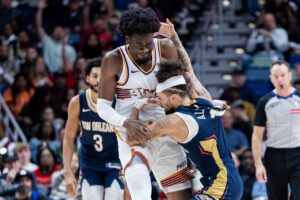 Alvarado was whistled for a foul after pushing Williams, who was attempting to set a screen, with two hands (YouTube link). As Alvarado looked to the official to plead his case, Williams returned the favor with his own two-handed shove.
The 6’0″ Alvarado confronted the 7’1″ Williams, who dismissively tried to forearm Alvarado out of the way. Undeterred, Alvarado grabbed Williams’ left arm and jersey and a brief scuffle ensued, with Williams and then Alvarado both throwing right-handed punches that connected.
Williams also punched down at Alvarado with his left hand as the players were being separated, but it’s unclear from the video if it connected. Both players were ejected for the incident.
After the game, which Phoenix won, Suns head coach Jordan Ott said he had not yet reviewed a video of the altercation, per The Associated Press.
“I saw it start, and then all of a sudden everyone jumped in,” Ott said. “Obviously, it happens. It just feels like the lack of sleep the second night of a back-to-back, something always tends to happen. Last night, there were a lot of free throws; tonight there wasn’t as much. They let us play tonight, which is something we enjoy. They got tangled up, and obviously they both got thrown out.”
The NBA tends to be pretty strict when it comes to fights, especially when punches are thrown, so fines and suspensions could be coming for Alvarado and Williams.
Fischer’s Latest: CP3, Harden, Gillespie, Cavs, Knicks
There had been some speculation that Chris Paul could be moved by the Clippers on December 15, the day he became trade-eligible, but that did not occur. While Paul is no longer around the team after Los Angeles announced that it was “parting ways” with the franchise icon, the Clippers are working with his representatives to find Paul a new club that he finds desirable, writes Jake Fischer of The Stein Line (Substack link).
Paul’s minimum-salary contract would theoretically be simple to trade from a mechanics standpoint, but a deal doesn’t appear imminent. Sources tell Fischer that it’s possible Paul might be included as part of a larger trade around the February 5 deadline. In that scenario, Paul could be waived by the team that acquires him, Fischer continues, which would allow the 40-year-old to pick a new destination as a free agent.
While the Lakers have been linked to Paul for years, Fischer has been “strongly advised” they aren’t expected to pursue the 11-time All-NBA point guard, who is in his 21st and final season. Houston could theoretically use backcourt depth, but Fischer hears the Rockets are content with their roster right now and likely won’t consider changes until late January due their proximity to the first apron, at which they’re hard-capped.
Here’s more from Fischer’s latest rumor round-up, which is centered on point guards:
- The Clippers continue to signal to rival teams that they aren’t willing to discuss trading James Harden, according to Fischer. As he points out, Harden has an implicit no-trade clause for 2025/26 and a $42.3MM player option for 2026/27 that’s partially guaranteed for $13.3MM. In order to approve a potential trade, Harden would likely want to know if the team interested in acquiring him planned to keep him past his July 11 salary guarantee date or if it would be open to re-signing him to a new deal, Fischer writes.
- Collin Gillespie, who is having a breakout season for the Suns, will be an unrestricted free agent in 2026. Rival teams are projecting the 26-year-old to receive a contract similar to the three-year, $27MM deal Ty Jerome signed with Memphis this past summer, per Fischer.
- While rival clubs are reportedly monitoring both players, the Cavaliers have shown no interest to this point in making an in-season deal involving Darius Garland or Jarrett Allen, Fischer confirms, echoing reporting from Brett Siegel.
- As Fischer writes, Tyler Kolek‘s impressive recent play with the Knicks has opposing teams wondering if New York will target frontcourt help ahead of the deadline instead of a veteran point guard. It’s unclear which position the Knicks will ultimately look to fortify.
Suns’ Jalen Green To Miss At Least 2-3 More Weeks
While Jalen Green “continues to make good progress” in his recovery from strained right hamstring, he will be out at least two or three more weeks, according to Suns, who announced that the fifth-year guard will be checked out again at that point (Twitter link via Duane Rankin of The Arizona Republic).
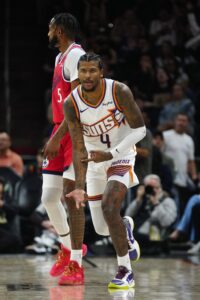 The hamstring has been an ongoing problem in 2025/26 for Green, who initially suffered a strain early in training camp, then aggravated it during his ramp-up process in mid-October. The 23-year-old sat out the first eight games of the regular season, played 23 minutes in his debut in early November, then aggravated the injury again a couple days later about seven minutes into his second game.
This is the first concrete update from Phoenix on Green since the team said he would be reevaluated in four-to-six weeks on November 11. Head coach Jordan Ott admitted last week that the Suns were playing it “pretty safe” with Green after he multiple setbacks.
Green, who was doing some on-court work last week, had been quite durable over the first four years of his career. He played 67 games as a rookie and 76 in his second year, then appeared in 82 games each of the past two seasons.
Green was traded from Houston to Phoenix over the summer as part of the Kevin Durant mega-deal. He’s earning about $33.6MM in ’25/26 in the first season of a three-year, $105MM rookie scale extension that includes a $36MM player option for the ’27/28 campaign.
Warriors Notes: Green, Kerr, Curry, Richard, Hield
Draymond Green’s ejection early in the second quarter of Saturday’s game wound up being a turning point for the Warriors, who rallied for a win over Phoenix, writes Monte Poole of NBC Sports Bay Area. Golden State trailed by 11 points when its volatile leader was tossed for picking up a pair of quick technical fouls, but the sequence sparked a rally that led to the end of a three-game losing streak.
“Sometimes we take advantage of Draymond, what he does for us, and we count on him to clean up everything,” Gary Payton II said. “But once he’s out of there, we know we all got to come together and do it collectively. I think everybody felt that. And when we’re doing that as a unit, we can be pretty damn good.”
Green got his first technical for pushing Suns guard Collin Gillespie in transition (YouTube link). The next one came seconds later when Green taunted lead official Pat Fraher, resulting in an automatic ejection.
Phoenix scored 44 points and registered five dunks in the first quarter, according to Poole. The Warriors’ defensive effort picked up after the incident as they held the Suns to a combined 31.8% from the field in the second and third quarters.
“I think it woke us up,” Stephen Curry said. “Because we knew without him, we’re going to have to play even tougher, dig deeper down the rotation. I think everybody was kind of on alert and trying to have his back.”
There’s more on the Warriors:
- Coach Steve Kerr called Green’s ejection “weak” on the part of the officials and compared it to an incident from the teams’ prior matchup on Thursday, per Nick Friedell of The Athletic. Kerr is still fuming about a play late in that game where he claims Dillon Brooks hit Curry with a “premeditated” punch to the stomach. Brooks was assessed a flagrant 1 foul after a video review, but wasn’t ejected. “How can you not be upset? This is a guy who broke Gary’s elbow in the playoffs, clotheslining him with one of the dirtiest plays I’ve ever seen,” Kerr said. “So it’s not like there’s not a track record there, and it’s right there, they look at it. I don’t know what the point of replay is if you’re not gonna kick a guy out for literally punching somebody. It’s bizarre to me that he was not, first of all, ejected from that game, and then suspended or fined. Nothing. Nothing.”
- In an interview with Zena Keita of “The Athletic Show,” Kerr expresses gratitude for being able to coach Curry and Green for so long, relays Jordy Fee-Platt of The Athletic. Kerr reveals that he nearly worked out a draft-day deal to bring Curry to Phoenix in 2009 when he was serving as general manager of the Suns. Kerr also states that even though he’s in the final year of his contract, he has no plans to retire while Curry is still active. “I will never leave Steph Curry,” he said.
- Rookie guard Will Richard contributed 20 points in the victory, but he only played because Kerr chose to end Buddy Hield‘s long streak of consecutive games, Poole notes in a separate story. Hield was a healthy scratch for the first time since joining the Warriors last season. “I told him beforehand, I feel terrible, he had a streak of 199 games in a row, it was one of the longest streaks in the league and one of the things I love about Buddy is he’s there for you every single night,” Kerr said. “He’s the greatest teammate ever and just an amazing spirit and a key part of our team, and it felt terrible not to play him, but I sat Will the last five or six games and we needed to get him back out there and you can see why. Buddy’s time will come back around, it always does. He has got the right attitude, he’s going to keep working and getting shots up and I know things will work out for him.”
"No setbacks" For Grayson Allen As He Battles Knee Soreness
- Suns guard Grayson Allen missed his second straight game tonight with soreness in his right knee, but he’s expected back soon, per Duane Rankin of The Arizona Republic (Twitter link). “No setbacks. He’s doing more and more every day,” coach Jordan Ott said. “It’s going on the right direction. Then we’re hopeful that it continues and he’ll be out there soon.”
Western Notes: Monk, Ellis, Brooks, Nuggets, Jokic, Mitchell
Kings guard Malik Monk was a DNP-CD for the first time since the 2022/23 season on Thursday, not getting off the bench at all during the team’s 134-133 overtime loss in Portland. Explaining the decision after the game, head coach Doug Christie described Monk as the “odd man out” in the backcourt rotation as he sought to give Keon Ellis a larger role for defensive purposes.
“We were going with defense, but it’s a logjam,” Christie said, per Jason Anderson of The Sacramento Bee. “We’ve got a lot of guards, so whenever it was Keon being the odd man out, then it was Keon being out. Tonight, we were playing Keon, so Malik was out.”
With the Kings off to a 6-21 start this season, Christie acknowledged that he’s still searching for answers and is willing to experiment with the rotation in the hopes of turning things around. He also made it clear that “nothing is permanent,” though he added that he liked what he saw from Ellis, who played a season-high 32 minutes vs. Portland.
“We’ll give Keon a run and allow him to continue to develop with those guys,” Christie said. “He came in off the bench, I thought, and played fantastic with that bench unit. They did a really good job in the third quarter. It just kind of got away from us. We got stalled out a little bit, but they came back with the starters and Keon was a part of that group. … I thought those guys did a great job.”
We have more from around the Western Conference:
- The NBA has rescinded the technical foul assessed to Suns forward Dillon Brooks in the second quarter of Thursday’s game vs. Golden State, the league announced (Twitter link). Brooks appeared to get the technical for something he said after making a layup and stumbling to the floor (video link via NBA.com). He’s still the league leader with eight technicals this season.
- The Nuggets aren’t especially well positioned to be aggressive at this season’s trade deadline, writes Bennett Durando of The Denver Post (subscription required). Denver is hovering right around the luxury tax line, has few tradable draft picks, and lacks an obvious salary-matching candidate making mid-level money or more. Zeke Nnaji ($8.2MM) is the most expendable of the Nuggets’ players earning more than $5MM, but his contract – which has two more years left on it after this season – would have negative value.
- Nuggets star Nikola Jokic passed Kareem Abdul-Jabbar on Thursday for the most career assists by an NBA center, Durando writes in another Denver Post story. Abdul-Jabbar compiled 5,660 assists across 20 NBA seasons; Jokic surpassed him in his 11th season, at age 30. “This is a time that I can be able to look back and appreciate all the years I’ve had to play this game with him,” teammate Jamal Murray said of Jokic. “It’s special. Passing Kareem in anything is pretty cool. So I think it just speaks to his greatness and how unselfish he is.”
- Thunder wing Ajay Mitchell spoke to Brett Siegel of ClutchPoints about the experience of winning a championship as an NBA rookie, whether he has thought about vying for the Most Improved Player award, and why he views the toe injury that cost him three months last season as a positive. “I know it sounds crazy, but this was my first major injury ever, and looking back on everything we went through, it made me realize how special being a part of this organization truly is,” Mitchell said, explaining that general manager Sam Presti was with him “every step of the way before and after surgery.”
Trade Rumors: Castle, Suns, Raptors, Davis, Kings
There’s reportedly a sense that the Spurs won’t seriously pursue a Giannis Antetokounmpo trade even if the Bucks make the two-time MVP available this season. While San Antonio seemingly has the assets necessary to make a compelling offer for a star-level trade candidate like Antetokounmpo, the team is very high on its young core and isn’t eager to break it up to go all-in on an older player, writes Kurt Helin of NBC Sports.
Victor Wembanyama is obviously untouchable and reports have indicated that the Spurs have never shown any interest in moving rookie Dylan Harper, dating back to lottery night when they won the No. 2 overall pick and the right to draft him. The team’s unwillingness to discuss trades involving its rising young stars also extends to reigning Rookie of the Year Stephon Castle, ESPN’s Brian Windhorst said this week during an appearance on The Ryen Russillo Show (YouTube link).
“I cannot tell you how much the Spurs loved Castle when they got him,” Windhorst said (hat tip to HoopsHype). “Like, right out of the gate they were like, ‘Oh my god, do we love this guy.’ They are convinced that he is the perfect guy to have with Victor. … They love everything about his make-up. They love everything about the way he competes. They love everything about his willingness to improve. They love Stephon Castle.”
While Windhorst acknowledged that very few players in the NBA are absolutely untouchable, he stressed that the Spurs are extremely unlikely to move Castle anytime soon.
“I would be stunned if they gave Castle away for almost anything,” he said.
Here are a few more trade-related notes and rumors from around the NBA:
- Gerald Bourguet of Suns After Dark confirms that the Suns and Raptors spoke about a possible trade that would send Nick Richards to Toronto in exchange for Ochai Agbaji and a second-round pick, but says Phoenix isn’t looking to make a deal quite yet, doesn’t have a ton of interest in Agbaji, and didn’t love the quality of the second-rounder the Raptors were willing to offer. While it’s unclear which pick Toronto put on the table, neither of the 2026 second-rounders the team controls would be very valuable if the season ended today — the Raptors’ own pick would be No. 52, while the Lakers’ second-rounder Toronto owns would be in the 56-58 range.
- Mavericks big man Anthony Davis sits atop the trade deadline “big board” published today by Sam Vecenie of The Athletic, who ranks potential trade candidates based on a combination of their potential impact and their likelihood of being moved. If Antetokounmpo doesn’t get traded this season, Davis is considered the one player on the market who could “swing the title race the most if he were dealt to the right situation,” Vecenie writes.
- Earlier this week, Yossi Gozlan of The Third Apron (Substack link) published the first installment of his comprehensive guide to the 2026 NBA trade deadline, identifying possible trade candidates and potential goals for all 30 teams. For instance, in examining the Kings, Gozlan classifies Keon Ellis and Dennis Schröder as likely to be traded, Russell Westbrook, Malik Monk, and DeMar DeRozan as “very possible” to be moved, and Zach LaVine and Domantas Sabonis as more likely to stay put due to their sizable contracts.