
Nets Likely To Turn Down Garrett Temple’s Option?
Several teams monitoring the free agent market believe the Nets will decline their team option on Garrett Temple for the 2020/21 season, reports Ian Begley of SNY.tv. Begley cautions that things could change between now and the decision deadline, but says he’d be surprised if Temple’s option is exercised.
Temple, 34, played regular minutes for Brooklyn in 2019/20, averaging a career-best 10.3 PPG to go along with 3.5 RPG and 2.5 APG in 62 games (27.9 MPG). However, his shooting percentages (.378 FG%, .329 3PT%) weren’t great and he would likely see his role significantly reduced next season on a fully healthy Nets team that will have Kevin Durant and Kyrie Irving in the lineup.
Temple’s option is worth just over $5MM, which isn’t a bad price for the veteran swingman, but the Nets are already on the hook for about $133MM in guaranteed money for next year’s roster and still want to re-sign Joe Harris. Replacing Temple on the cheap might make sense, especially since minimum-salary wing Timothe Luwawu-Cabarrot should be back next season.
No decision deadline has been set yet, since the NBA and NBPA have yet to agree on a start date for free agency. The Nets’ decision figures to be due a day or two before the start of the new league year, so they’ll likely have until after the draft to make that call.
If the Nets do decline Temple’s option, he’ll receive interest from multiple suitors in free agency, per Begley. Since making his NBA debut 10 years ago, Temple has played for nine teams — he could join his 10th this offseason.
Draft Rumors: Ball, Bulls, Avdija, Hornets, Okongwu, Nnaji
Earlier this morning, we passed along a report from Kevin O’Connor of The Ringer about the Celtics, Magic, and Wizards showing interest in trading up from their current spots in the first round of the 2020 NBA draft. O’Connor’s latest mock draft at The Ringer includes several more intriguing tidbits about the draft — we’ll round up a few of the highlights here:
- Echoing a report from Rick Bonnell of The Charlotte Observer, O’Connor says LaMelo Ball has struggled in meetings with teams and could conceivably fall out of the top three. If Ball is still available at No. 4, the Bulls‘ phone will likely be “buzzing,” O’Connor adds.
- Speaking of the Bulls, multiple sources have told O’Connor recently that they’ve heard Deni Avdija may be the play-maker Chicago wants at No. 4. Avdija would be a nice fit alongside the Bulls’ current pieces, and new head of basketball operations Arturas Karnisovas has a history of identifying international talent.
- Although James Wiseman has been most frequently been linked to the Hornets, the team is also heavily considering Onyeka Okongwu, multiple league sources tell The Ringer. According to O’Connor, there are “many” front offices around the NBA that have Okongwu ranked ahead of Wiseman, so if both players are on the board at No. 3, it’s not necessarily a lock that Charlotte will opt for Wiseman.
- Former Arizona forward Zeke Nnaji is receiving interest from teams in the late teens and the 20s, O’Connor reports. Nnaji comes off the board at No. 22 to Denver in The Ringer’s mock.
Celtics, Magic, Wizards Exploring Trading Up In Draft?
The Celtics, Magic, and Wizards are among the teams exploring the possibility of moving up from their current spots in the first round of the draft, league sources tell Kevin O’Connor of The Ringer.
Boston, which currently holds the 14th, 26th, and 30th overall selections, have offered all three of those picks in an effort to move up into the middle of the lottery, but no one is biting so far, according to O’Connor.
Orlando has the 15th overall pick and is also trying to move into the middle of the lottery, per O’Connor, though it’s not clear what the club is offering to sweeten the pot for potential trade partners. The Magic do hold all of their future first-rounders and could make one of those available if they want to move up badly enough.
As for the Wizards, they’re currently set to pick at No. 9, but O’Connor hears they’re angling to move up from there. General manager Tommy Sheppard acknowledged immediately after August’s draft lottery that trading up would be a possibility for his club, though it’s unclear whether Washington is targeting a specific player or spot. O’Connor wonders if a high-upside prospect like LaMelo Ball might pique the Wizards’ interest, especially if he slips beyond the top few picks.
Plenty of teams picking in the top half of the lottery, including the Timberwolves (No. 1), Warriors (No. 2), and Bulls (No. 4) have reportedly looked into trading down or would have interest in doing so. In other words, there should be options for the Celtics, Magic, Wizards, and any other teams that would like to move up.
However, given this year’s unusual pre-draft process and the perception that the 2020 class lacks star power, it may be a challenge for teams to agree on fair value for swapping picks separated by a few spots. The draft is still more than two weeks away and the league’s transaction moratorium has yet to be lifted, so we’ll have to wait a little longer to see how much movement there is in the first round.
Sixers, Alex Rucker Part Ways
The Sixers have parted ways with executive vice president of basketball operations Alex Rucker, writes Keith Pompey of The Philadelphia Inquirer. Adam Aaronson of The Rights To Ricky Sanchez podcast first reported on Sunday that Rucker was “out,” though the move has been anticipated for months.
Just last week, Pompey reported that Rucker was expected to remain with the team through a “transition period” as Daryl Morey came aboard before eventually departing the organization. It seems that transition period only lasted a few days.
Rucker’s departure from the 76ers is part of the team’s front office overhaul, which includes not just the hiring of Morey as the new president of basketball operations, but also the addition of Peter Dinwiddie as the new executive VP of basketball ops, the position held by Rucker for the last two years. According to Pompey, Rucker was initially reassigned when Dinwiddie was hired.
Prior to Morey’s arrival, general manager Elton Brand held the top title in Philadelphia’s basketball operations department and faced much of the criticism for any missteps by the front office. However, Rucker had been “heavily involved” in those decisions as well, sources tell Pompey.
Before he joined the 76ers in 2016, Rucker was part of the Raptors’ analytics department.
NBA, NBPA Face Increasingly Short Window To Negotiate December 22 Start
In a call today with the league’s general managers, the NBA said there’s still no agreement in place with the National Basketball Players Association on a timeline for the 2020/21 regular season, reports Adrian Wojnarowski of ESPN (Twitter link).
As Wojnarowski details, talks are ongoing between the league and the players’ union, but the two sides face an increasingly short window to negotiate all the necessary details ahead of a potential December 22 start (with a possible December 1 start date for training camps). Besides agreeing on a schedule for the season, the two sides continue to work through a series of financial amendments to the Collective Bargaining Agreement (Twitter link).
[RELATED: NBA Targeting December 22 Start, 72-Game Season]
According to Wojnarowski (Twitter link), commissioner Adam Silver told teams on today’s conference call, “We’re running out of time.”
Despite that ominous comment from Silver, and despite the fact that many players reportedly prefer a January 18 start, I certainly wouldn’t rule out a December 22 opening night. The NBA has estimated that postponing the start of the 2020/21 season to mid-January could cost the league upwards of $500MM to $1 billion in revenue next season and beyond. Lost revenue is bad news for the players as well as the league, so the NBPA has plenty of incentive to figure out how to make the earlier start date work.
The NBA and NBPA pushed back the CBA termination deadline for a fourth time last week, setting a deadline of this Friday, November 6. If the two sides can agree to most of the major CBA details by that date, a pre-Christmas start still seems realistic. If that deadline has to be postponed yet again, that may not bode well for the December 22 target date.
2020 NBA Offseason Preview: Denver Nuggets
Hoops Rumors is previewing the 2020 offseason for all 30 NBA teams. We’re looking at the key questions facing each club, as well as the roster decisions they’ll have to make this fall. Today, we’re focusing on the Denver Nuggets.
Salary Cap Outlook
Taking into account eight players and their first-round draft pick, the Nuggets are currently on the hook for just over $100MM in commitments for 2020/21. That’s won’t put them in position to create any cap room, but it should allow them to re-sign some combination of Jerami Grant, Paul Millsap, Torrey Craig, and Mason Plumlee without going into tax territory.
The full mid-level exception ($9.26MM) and bi-annual exception ($3.26MM) should be in play for Denver, though there’s a chance the team will be limited to the taxpayer MLE ($5.72MM) if re-signing its own free agents gets expensive.
Our full salary cap preview for the Nuggets can be found right here.
Roster Decisions To Watch
Options:
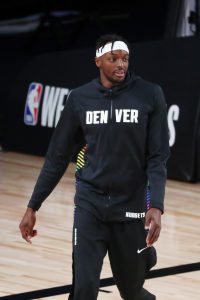 Jerami Grant, player option: $9,346,153
- Note: Grant will reportedly decline his option.
Non-Guaranteed Contracts:
- PJ Dozier ($1,762,796)
- Note: Partially guaranteed for $1.2MM.
- Monte Morris ($1,663,861)
- Keita Bates-Diop ($1,663,861)
Two-Way Contracts:
- Bol Bol (expires in 2021)
Free Agents:
- Paul Millsap (Bird)
- Mason Plumlee (Bird)
- Noah Vonleh (Non-Bird)
- Troy Daniels (Non-Bird)
- Torrey Craig (RFA; Bird)
- Tyler Cook (N/A)
- Note: Cook won’t have any form of Bird rights because he was signed as a substitute player.
2020 Draft Assets
First Round:
- No. 22 overall pick
Second Round:
- None
The Nuggets traded away both of their own picks in the 2020 draft. The first-rounder (No. 25) went to Oklahoma City in 2019’s Jerami Grant swap, while the second-rounder (No. 55) was part of a 2018 salary-dump deal that sent Kenneth Faried and Darrell Arthur to Brooklyn.
Denver did acquire an extra first-round pick to replace its own though, landing the Rockets’ pick (No. 22) in February’s four-team trade that sent Malik Beasley and Juan Hernangomez to Minnesota.
Three Key Offseason Questions
1. Will the Nuggets re-sign Jerami Grant?
Grant’s time in Denver got off to a shaky start in 2019/20. In their 42 games through January 19, the Nuggets had a -5.6 net rating when Grant was on the court and a +14.0 rating when he sat, one of the most significant discrepancies in the league.
That gap wasn’t all Grant’s fault, of course — he was still scoring in the double digits and knocking down his threes at a 36.4% clip during that time. But he was inconsistent on the defensive end, as it took some time for Denver to figure out how to make the most of his versatility and pair him with the right teammates.
After January 19, the Nuggets’ net rating for the rest of the regular season was five points better when Grant was on the court. And he was a key contributor in the postseason, starting 16 of Denver’s 19 playoff games and averaging 34.4 minutes per contest against the Jazz, Clippers, and Lakers. The Nuggets couldn’t do much in the Western Finals against the Lakers, but Grant was one of the few bright spots — he averaged 21.0 PPG on 47.6% in the team’s final three games of the season.
While Grant’s first year in Denver wasn’t perfect, he had become one of the team’s most important role players by season’s end and showed why the club surrendered a first-round pick for him last July. The Nuggets didn’t give up that first-rounder expecting Grant to be a one-year rental, so there’s no reason to think the organization won’t make every effort to re-sign him this fall.
Grant will be an unrestricted free agent, which means he’s free to sign elsewhere if he doesn’t want to return to Denver. But unless the Nuggets are willing to work out a sign-and-trade deal, the 26-year-old’s best opportunity to play for a contender in 2020/21 will probably be with his current club. Using his Bird rights, the Nuggets can offer Grant a starting salary well above the mid-level exception, outbidding most rival suitors.
That doesn’t mean Grant won’t have other options, especially if he’s willing to join a lottery team. The Pistons and Hawks are expected to have interest and have the cap room necessary to put pressure on Denver. The Suns and Heat have also been linked to Grant, though both of those clubs would need to jettison some of their own free agents to create enough cap space for a run at the Nuggets forward, which could complicate matters. The Mavericks are also said to have interest in Grant, but they project to be over the cap, which could compromise their ability to put a competitive offer on the table.
It may ultimately come down to price. Bobby Marks of ESPN projects a $12-14MM starting salary for Grant, while Mike Singer of The Denver Post has estimated the forward could command upwards of $14-16MM per year. An offer in the four-year, $60MM range seems about right for Grant and the Nuggets. If another team is willing to significantly outbid that offer, Denver will face a difficult decision.
2. Will any of the Nuggets’ other notable free agents be back?
Besides Grant, a handful of other Nuggets will be free agents, including Paul Millsap (unrestricted), Mason Plumlee (unrestricted), and Torrey Craig (restricted).
None of those players are indispensable, but president of basketball operations Tim Connelly and general manager Calvin Booth have spoken about wanting to retain as many of their own free agents as possible. It’ll be interesting to see how committed they are to following through on that vow, especially when it comes to Millsap.
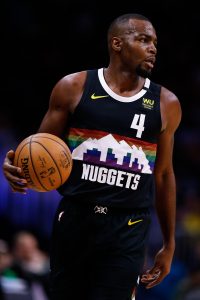 At age 35, Millsap is past his prime years and isn’t going to make any more All-Star teams, like he did in Atlanta for four consecutive years from 2014-17. But his value shouldn’t be understated. The big man has had a major impact on Denver’s defense since his arrival in 2017, fitting in perfectly on a team led by a pair of offense-first stars in Nikola Jokic and Jamal Murray. His toughness and defensive savvy have take some pressure off Jokic, and he’d be missed if the Nuggets let him walk.
Connelly has said he’d “love to see” Millsap spend the rest of his career in Denver and I expect the team to attempt to re-sign him. But it wouldn’t be a surprise to see a rival suitor try to lure Millsap away with an oversized one-year offer in the hopes of shoring up its own frontcourt defense.
If the Nuggets are willing to match an offer in the $9-10MM range for Millsap while also re-signing Grant, it would push team salary close to the tax and would likely prevent Denver from using its full mid-level exception. Connelly, Booth, and company may have to decide whether bringing back both its top free agent forwards is more important than retaining the flexibility to use that MLE on an outside target.
Plumlee and Craig are less likely to incite a bidding war, but they each have some value. Plumlee has been a solid backup and won’t be as expensive this time around as he was when Denver signed him to a three-year, $41MM deal in 2017. Assuming the Nuggets can get him at half of his previous $14MM salary (or less), he could be back.
As for Craig, he was one of the team’s top perimeter defenders, but his offensive contributions were limited. With the Nuggets likely to explore the free agent and trade markets for a wing who has more two-way value, Craig could become expendable unless he’s willing to take a minimum deal or something very close to it.
3. Do the Nuggets have the pieces to swing a trade for a third impact player?
Jokic has emerged as a perennial candidate for the All-NBA First Team, and Murray – despite some frustrating ups and down during the regular season – showed during the postseason at Walt Disney World that he deserves to be considered Denver’s second star. He averaged 26.5 PPG and 6.6 APG on .505/.453/.897 shooting during the Nuggets’ 19 playoff games.
With a frontcourt and backcourt star locked up the foreseeable future, the Nuggets could badly use a wing capable of making an impact on both ends of the court. Will Barton and Gary Harris are good players, but they aren’t stars. And while Michael Porter Jr. has star potential on offense, he’s a liability on the other end of the floor at this point in his career and is unlikely to ever develop into a lockdown defender, even if he makes some strides in that area.
The Nuggets don’t have the cap room to make a splash in free agency this fall and there aren’t any logical targets on the open market anyway. So the trade market may be the team’s best bet to try to find a wing of that caliber.
One potential trade candidate, who has been linked to Denver in the past, is Pelicans guard Jrue Holiday. A defensive dynamo, Holiday is entering a potential contract year and the Nuggets are expected to be among his most aggressive suitors if New Orleans makes him available.
What would an offer for Holiday realistically look like? Obviously Denver won’t include Jokic or Murray, and Porter is said to be virtually untouchable too. Harris is the most logical salary-matching piece — from there it would just be a matter of how many sweeteners the Nuggets are willing to offer. Monte Morris and/or Bol Bol could interest the Pelicans. Denver also has all its first-round picks available beyond this season and could put more than one – including this year’s No. 22 selection – in an offer.
It’s not clear if such a proposal would appeal to the Pelicans more than something the Nets or another suitor could put together. If New Orleans demands Porter, would the Nuggets be willing to change their stance on the 22-year-old? I’m skeptical. As good as Holiday is, he’s made one All-Star team in his career (in 2013), is on the wrong side of 30, and could reach free agency in a year. If Denver is convinced to give up Porter, I think it’d probably have to be for a player a tier above Holiday.
It’s not clear if that sort of player will be available this fall though. Victor Oladipo is another target who might make sense for the Nuggets, but his health makes him a risk — I’m not sure Denver would want to offer much more than Harris and a first-round pick for the Pacers guard.
The Nuggets made it to the Western Finals in 2020 after forcing a seventh game in the Western Semifinals in 2019. They’re close to breaking through and acquiring an impact wing could be the move that helps put them over the top. We’ll have to wait see how aggressively Connelly and the front office pursue that sort of player this offseason.
Information from Basketball Insiders and ESPN was used in the creation of this post. Photos courtesy of USA Today Sports Images.
Bulls Hiring Maurice Cheeks, Josh Longstaff As Assistants
Bulls head coach Billy Donovan has begun to fill out his new coaching staff, as Shams Charania of The Athletic reports (via Twitter) that Maurice Cheeks will be an assistant under Donovan in Chicago. The team is also hiring Josh Longstaff away from the Bucks to be an assistant coach on Donovan’s staff, per ESPN’s Adrian Wojnarowski (via Twitter).
Cheeks is a logical fit for the Bulls, having been an assistant under Donovan with the Thunder for the last five years. He’s also a Chicago native, so joining the Bulls will be a homecoming for him. In addition to his two stints in Oklahoma City as an assistant coach, Cheeks has been an assistant for the 76ers and served as a head coach in Portland, Philadelphia, and Detroit.
As for Longstaff, he’s another former Thunder assistant, though he worked for the team from 2010-14 and didn’t overlap with Donovan. Since then, he has been an assistant for the Knicks, the head coach of the G League’s Erie BayHawks, and – for the last two years – a member of Mike Budenholzer‘s staff in Milwaukee. He’ll get the opportunity to become a front-of-the-bench assistant in Chicago, Wojnarowski notes.
The Bulls announced last month that assistants Roy Rogers, Dean Cooper, Nate Loenser, and Karen Stack Umlauf wouldn’t be returning to the team. Although the club is revamping its coaching staff for Donovan, it sounds like there will be at least one holdover in Chris Fleming.
Draft Rumors: Combine, Hampton, Knicks, Nets, Mike
There are some eye-popping numbers coming out of the NBA’s virtual draft combine, such as Tyler Bey‘s record-breaking vertical for forwards, which we detailed over the weekend.
However, the format of this year’s combine has resulted in some leaguewide skepticism about the results being reported, according to reports from Sam Vecenie of The Athletic and Jeremy Woo of SI.com (Twitter links). Because the tests are being administered by different people at different facilities, there are some concerns about the consistency of the methods, per Vecenie and Woo.
According to Woo (Twitter link), there’s also a theory that because prospects have had several extra months to prepare for a handful of specific drills, the results have been skewed toward the high end. Determining how to assess and value the combine data will be another wrinkle in what his been an extremely unusual pre-draft process, says Woo (Twitter link).
Here’s more on the 2020 NBA draft:
- The Knicks believe RJ Hampton would be a reach at No. 8, a source tells Marc Berman of The New York Post. However, Berman says the Nets would be “extremely interested” in Hampton if he’s still on the board when they pick at No. 19. Sources tell The New York Post that Hampton has impressed teams in workouts with his work ethic and his form on his jumper.
- Former SMU forward Isiaha Mike has decided to keep his name in the 2020 draft, according to Bryan Kalbrosky of HoopsHype. Mike, who declared for the draft as an early entrant in the spring, later left SMU to sign with Chemnitz in Germany, forgoing his remaining NCAA eligibility. However, he still had the option of pulling out of the draft before the NBA’s withdrawal deadline this month — he apparently won’t do so.
- James L. Edwards III of The Athletic takes a shot at forecasting the Pistons‘ top 10 prospects, predicting that LaMelo Ball, Anthony Edwards, Deni Avdija, and Tyrese Haliburton will be atop the club’s big board, in that order.
Hoops Rumors Glossary: Gilbert Arenas Provision
Gilbert Arenas hasn’t played in the NBA since 2012, but his legacy lives on in the NBA’s Collective Bargaining Agreement. The NBA first introduced the Gilbert Arenas provision in the 2005 CBA as a way to help teams retain their restricted free agents who aren’t coming off standard rookie scale contracts.
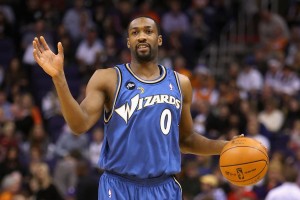 While Arenas isn’t specifically named in the CBA, the rule colloquially known as the Arenas provision stems from his own restricted free agency in 2003. At the time, the Warriors only had Early Bird rights on Arenas, who signed an offer sheet with the Wizards starting at about $8.5MM. Because Golden State didn’t have $8.5MM in cap room and could only offer Arenas a first-year salary of about $4.9MM using the Early Bird exception, the Warriors were unable to match the offer sheet and lost Arenas to Washington.
The Arenas provision, created to help avoid similar situations, limits the first-year salary that rival suitors can offer restricted free agents who have only been in the league for one or two years. The starting salary for an offer sheet can’t exceed the amount of the non-taxpayer’s mid-level exception, which allows the player’s original team to use either the mid-level exception or the Early Bird exception to match it. Otherwise, a team without the necessary cap space would be powerless to keep its player, like the Warriors were with Arenas.
An offer sheet from another team can still have an average annual salary that exceeds the non-taxpayer’s mid-level, however. The annual raises are limited to 5% between years one and two, and 4.5% between years three and four, but a team can include a significant raise between the second and third years of the offer.
As long as the first two years of a team’s offer sheet are for the highest salary possible, the offer is fully guaranteed, and there are no incentives included, the third-year salary of the offer sheet can be worth up to what the player’s third-year maximum salary would have been if not for the Arenas restrictions.
If we assume the salary cap for 2020/21 will remain unchanged ($109.141MM), the maximum offer sheet a first- or second-year RFA could receive this offseason would look like this:
| Year | Salary | Comment |
|---|---|---|
| 2020/21 | $9,258,000 | Value of non-taxpayer’s mid-level exception. |
| 2021/22 | $9,720,900 | 5% raise on first-year salary. |
| 2022/23 | $31,650,600 | Maximum third-year salary for a player with 1-2 years in NBA. |
| 2023/24 | $33,074,877 | 4.5% raise on third-year salary. |
| Total | $83,704,377 | Average annual salary of $20,926,094. |
In order to make the sort of offer outlined above, a team must have enough cap room to accommodate the average annual value of the contract. So a team with $21MM in cap space could extend this offer sheet to a first- or second-year RFA. But a team with only $17MM in cap space would have to reduce the third- and fourth-year salaries in its offer sheet to get the overall average salary of the offer down to $17MM per year.
The application of the Arenas provision is infrequent, since first- and second-year players who reach free agency rarely warrant such lucrative contract offers. First-round picks sign four-year rookie deals when they enter the NBA, so the Arenas provision generally applies to second-round picks or undrafted free agents whose first NBA contracts were only for one or two years.
One noteworthy example of the Arenas provision at work was Tyler Johnson‘s restricted free agency in 2016. The Heat had Early Bird rights on Johnson, who had only been in the NBA for two seasons. The Nets attempted to pry him away with an aggressive offer sheet that featured salaries of $5,628,000, $5,881,260, $19,245,370, and $19,245,370. It wasn’t the maximum that Brooklyn could have offered Johnson, but the massive third-year raise was a tough pill for Miami to swallow.
Overall, the deal was worth $50MM for four years. If the Heat had declined to match it, the Nets would have flattened out those annual cap hits to $12.5MM per year, the average annual value of the deal. However, due to the Arenas provision, Miami was able to match Brooklyn’s offer sheet with the Early Bird exception, even though the Heat wouldn’t have been able to offer Johnson a four-year, $50MM contract using the Early Bird exception outright.
When a team matches an Arenas-provision offer sheet, it also has the option of flattening those cap charges. However, that option is only available if the team has the cap room necessary to accommodate the average annual value of the deal. Otherwise, the club has to keep the unbalanced cap charges on its books. That’s why Johnson’s cap hit for the Heat jumped from $5,881,260 in 2017/18 to an eye-popping $19,245,370 in 2018/19, essentially turning the young guard from a good value to a salary-dump candidate overnight.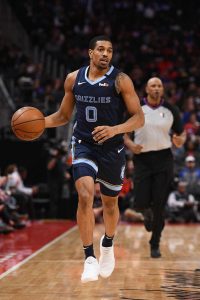
In 2020, there aren’t many restricted free agents who will be candidates for an Arenas-provision offer sheet. Top RFAs like Brandon Ingram and Bogdan Bogdanovic have four years of experience, so the rule won’t apply to them. The best candidate for an Arenas-provision offer sheet may be Grizzlies guard De’Anthony Melton, who emerged as an important rotation player in his second NBA season. But I’d be pretty surprised if Melton gets an offer worth more than the standard non-taxpayer’s MLE.
Finally, just because a club is given the opportunity to use the Arenas provision to keep its restricted free agent doesn’t mean it will necessarily have the means. Here are a few situations in which the Arenas provision wouldn’t help a team keep its restricted free agent:
- If the team only had the taxpayer mid-level exception or room exception available, it would be unable to match an offer sheet for a Non-Bird free agent if the starting salary exceeded the taxpayer mid-level or room exception amount.
- A team would be unable to match an offer sheet for a Non-Bird free agent if it used its mid-level exception on another player, including another one of its own Non-Bird free agents. A team could use Early Bird rights to match if those rights are available, however.
- If the player is a Non-Bird or Early Bird free agent with three years of NBA experience, the Arenas provision would not apply — only players with one or two years in the league are eligible.
Note: This is a Hoops Rumors Glossary entry. Our glossary posts will explain specific rules relating to trades, free agency, or other aspects of the NBA’s Collective Bargaining Agreement. Larry Coon’s Salary Cap FAQ was used in the creation of this post.
Earlier versions of this post were published in previous years by Luke Adams and Chuck Myron. Photos courtesy of USA Today Sports Images.
Sixers Officially Hire Daryl Morey As President Of Basketball Operations
The Sixers have made it official, announcing today in a press release that they’ve hired Daryl Morey as their new president of basketball operations. Within the release, the club also confirmed that general manager Elton Brand has signed a multiyear contract extension.
“Daryl Morey is one of the very best front-office executives in the NBA and I’m thrilled to welcome him to Philadelphia as the 76ers President of Basketball Operations,” Sixers owner Josh Harris said in a statement. “Talent like Daryl rarely becomes available so we moved quickly and aggressively to bring him here. He has an extraordinary track record of success in this league as an innovator, visionary and leader, and I believe he significantly improves our chances of delivering a championship caliber team to our fans.
“This offseason, we made it our mission to make this organization better and stronger. By hiring a tremendous front-office leader in Daryl and championship coach in Doc (Rivers), as well as extending Elton, we’re proud of what we’ve assembled. I’m excited for their leadership and look forward to continuing to build a team this city and our fans can be proud of.”
[RELATED: Sixers Hire Doc Rivers As Head Coach]
Reports first indicated last Wednesday that the Sixers and Morey were in advanced talks on a five-year deal that would make him the team’s president of basketball operations. David Aldridge of The Athletic said at the time that the team envisions Morey and Brand as a “1-2 punch” in the front office, though their titles suggest that Morey will be the one with the final say on basketball decisions.
Morey spent 14 years with the Rockets before parting ways with the franchise in October. In Houston, he developed a reputation as a outside-the-box thinker who was creative in navigating the salary cap and building his roster. The veteran executive, who was known for constantly pursuing star players, helped to revolutionize the Rockets as a small-ball team that relied heavily on shooting three-pointers.
At the time of his departure from Houston, reports indicated that Morey may take some time off before seeking a new NBA job, but the Sixers’ aggressive pursuit convinced him to accept a new position almost immediately. Rockets owner Tilman Fertitta had predicted that Morey would eventually join an East Coast franchise, but likely didn’t think it would happen so soon.
For the 76ers, it’s the culmination of their long-standing interest in Morey. Philadelphia received permission to talk to the Rockets’ GM two years ago and reportedly made an offer, but he elected to remain in Houston at that time. Now, Morey will be tasked with making the adjustments necessary to turn a roster headed by All-Stars Joel Embiid and Ben Simmons into a legit championship contender.
The Sixers have indicated both publicly and privately that it has no plans to trade Embiid or Simmons anytime soon, despite the fact that the fit between the two stars has been awkward at times. However, oversized long-term contracts for Tobias Harris and Al Horford will make it a challenge for the club to reshape its roster around its two franchise players.
Morey said in a statement within today’s Sixers press release that he’s looking forward to trying to win a title in Philadelphia.
“I am humbled by the challenge and will work tirelessly to win the hearts of Philadelphia’s legendary fans,” Morey said. “The opportunity to work again with Doc Rivers, Elton Brand, and a stacked roster that is ready to win made this a can’t miss opportunity.”
Photo courtesy of USA Today Sports Images.