
2020 NBA Offseason Preview: Boston Celtics
Hoops Rumors is previewing the 2020 offseason for all 30 NBA teams. We’re looking at the key questions facing each club, as well as the roster decisions they’ll have to make this fall. Today, we’re focusing on the Boston Celtics.
Salary Cap Outlook
At first glance, the Celtics’ cap situation looks fairly comfortable, with about $95MM in guarantees committed to eight players.
However, that figure doesn’t include Gordon Hayward‘s $34MM+ option or Daniel Theis‘ $5MM non-guaranteed salary. Enes Kanter is also a candidate to pick up his $5MM option, and Boston would add another $7-8MM to its books by using its three first-round picks. With all those costs taken into account, the Celtics’ projected team salary jumps to $146MM+.
Boston could make some cost-cutting moves, including trading one or more of its three first-round picks. But this will be an expensive roster, and it seems like the Celtics will be limited to the taxpayer mid-level exception (worth $5.72MM).
Our full salary cap preview for the Celtics can be found right here.
Roster Decisions To Watch
Options:
- Gordon Hayward, player option: $34,187,085
- Enes Kanter, player option: $5,005,350
- Semi Ojeleye, team option: $1,752,950
- Note: Salary doesn’t immediately become guaranteed if option is exercised.
Non-Guaranteed Contracts:
- Daniel Theis ($5,000,000)
- Javonte Green ($1,517,981)
Two-Way Contracts:
- Tacko Fall (expiring)
- Tremont Waters (expiring)
Free Agents:
- Brad Wanamaker (RFA; Early Bird)
2020 Draft Assets
First Round:
- No. 14 overall pick
- No. 26 overall pick
- No. 30 overall pick
Second Round:
- No. 47 overall pick
After having held extra first-round picks for most of the last few years, the Celtics don’t have any surplus first-rounders beyond 2020. But they do have a pair of first-rounders besides their own (No. 26) this year.
The Grizzlies’ pick at No. 14 finally conveyed after being protected in the past — it was originally part of the deal that sent Jeff Green to Memphis in 2015. The Bucks’ pick (No. 30), meanwhile, was initially sent to Phoenix in 2017’s Eric Bledsoe swap. The Suns flipped it to Boston during last year’s draft in order to land Aron Baynes and Ty Jerome.
In the second round, the Celtics traded away their own pick (No. 56) as part of last year’s Terry Rozier/Kemba Walker sign-and-trade deal, so the Hornets have it now. But in that same trade, Boston acquired Brooklyn’s second-rounder (No. 47) from Charlotte.
Three Key Offseason Questions
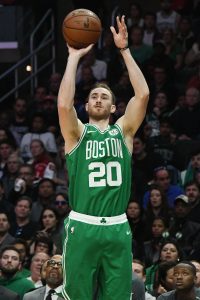
1. Will Gordon Hayward be back with the Celtics?
Hayward’s contract with Boston includes a player option worth $34MM for the 2020/21 season, which means there are a number ways the offseason could play out for him.
If he opts into the final year of his contract, Hayward could simply return to the Celtics for another year before reaching free agency, he could be traded, or he could sign a longer-term extension with the team. If he opts out, he could sign outright with a new team, join a new team via sign-and-trade, or negotiate a new, longer-term deal with the C’s.
For most of the year, it looked like a no-brainer that Hayward would exercise his player option. He has no chance of matching his $34MM salary for ’20/21 on a new deal, and the list of teams with cap room will be extremely short. Opting to test the open market wouldn’t seem to make much sense for the veteran forward.
However, there has been some recent chatter, instigated by ESPN’s Zach Lowe and Bobby Marks, that Hayward’s agent Mark Bartelstein is quietly surveying the landscape to see what might be out there for his client. During that ESPN podcast, Marks suggested there’s a chance that Hayward and Bartelstein could go the Al Horford route. A year ago, Horford unexpectedly turned down a $30MM option with Boston and signed a four-year contract with Philadelphia that guaranteed him $97MM.
The opportunity to secure one last lucrative long-term deal was the right move for Horford, who was 33 years old when he reached free agency in 2019. Hayward is still just 30 and will probably be well positioned for a nice payday a year from now if he has a healthy, productive 2020/21 season, so there’s less urgency for him to seek long-term security this year — especially with so few potential suitors with cap room out there.
It’s also worth noting that when the Celtics let Horford go, it helped them accommodate the acquisition of Kemba Walker. If they’d matched Philadelphia’s offer for Horford, landing Walker while staying under the tax apron would’ve been a challenge. This time around, there wouldn’t be much of an upside to letting Hayward walk. It would help the C’s avoid the tax, but wouldn’t open up any extra cap room to sign a comparable replacement.
Taking those factors into account, I think Hayward is most likely to either pick up his option or sign a longer-term deal with Boston that reduces his 2020/21 cap charge. In either scenario, the Celtics could simply run it back with Hayward or explore their trade options (though they’d have to wait a few months if they sign him to a new free agent contract).
There’s no shortage of teams looking for wings with size, but the Celtics already have a couple good young ones in Jayson Tatum and Jaylen Brown, making Hayward somewhat expendable. If they can figure out a trade that sends out Hayward for a player who addresses a more pressing need on the roster – perhaps in the frontcourt – it would make sense to explore that possibility.
If Boston’s hypothetical trade partner is a team Hayward wouldn’t mind committing to long-term, a sign-and-trade would be another option worth considering. However, that scenario would require plenty of pre-free-agency communication between the two teams and Hayward’s camp to figure out the logistics.
2. What will the Celtics do with their three first-round draft picks?
The Celtics own the 14th, 26th, and 30th picks in what is considered a deep draft. If they were a rebuilding club, that would put them in a great position to add a couple potential long-term building blocks to their roster. But since Boston has title aspirations and a nearly-full roster, adding another three rookies to next year’s squad isn’t in the organization’s best interests.
As a result, it’s pretty safe to assume the Celtics won’t keep all three of those picks, or at least won’t use all of them on players for next year’s roster. That gives them a few options.
Trading one or two of those picks for a future first-rounder is one path the Celtics could take. They did that a year ago, sending the Ty Jerome pick to Phoenix in a deal for the first-rounder that became this year’s No. 30 selection.
Continuously rolling a pick over to the following draft is a good way to retain value and flexibility — if the Celtics want to fortify their roster at next year’s trade deadline, having an extra first-rounder available for a veteran could come in handy. Plus, after holding extra first-round picks for most of the last several years, the Celtics only have their own first-rounders beyond 2020. Flipping one or two of this year’s picks for future selections would help avoid having those coffers run dry.
Trading a pick or two in a deal for a veteran would be another option, but salary matching would be an issue in that scenario. The Celtics have no trade exceptions to take on salary.
Using a pick on a draft-and-stash player is one way to try to maximize the value of the pick without requiring a spot on next year’s roster. That approach hasn’t worked out especially well for Danny Ainge in recent years, but perhaps Serbian forward Aleksej Pokusevski (18th on ESPN’s big board) would have more NBA success than Guerschon Yabusele and Ante Zizic did.
One of the most intriguing options for the Celtics – and one the team is reportedly exploring – would be to use all three picks in an attempt to move up in the draft to land an impact rookie who could contribute immediately and develop into a key future contributor.
Picks at or near the top of the draft are exponentially more valuable than those later on, so the Celtics shouldn’t expect to move into the top five by dangling Nos. 14, 26, and 30. Still, there could be a deal to be had in the middle of the lottery.
The Pistons, for instance, could badly use an influx of young talent and may be open to moving down to No. 14 if they don’t have a specific target in mind at No. 7 — and if they believe they can get good value with those two extra Boston picks at the end of the first round. It’s not clear which player the Celtics would be targeting if they move into the top 10, but Onyeka Okongwu and Tyrese Haliburton are among the mid-lottery options who might be of interest.
3. What will Jayson Tatum’s extension look like?
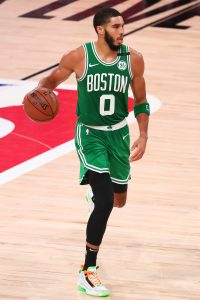 Tatum will become extension-eligible for the first time this offseason and there’s no question he’ll get a maximum-salary deal from the Celtics. But not all max deals are created equal. There are some details that the team will have to negotiate with Tatum’s camp that could be important down the road.
For one, the length of the contract will be critical. Of the three maximum-salary rookie scale extensions signed a year ago, two were for five years, while Pascal Siakam‘s was for just four. It’s safe to say the Celtics will push for five years without a fifth-year player option for Tatum, who would still just be 28 years old by the time a five-year extension expires in 2026.
The Rose Rule language in Tatum’s deal will also be critical. As we outline in our glossary entry on the subject, the Rose Rule allows a player with fewer than seven years of NBA experience to qualify for a higher maximum salary (up to 30% of the cap, rather than 25%) if he meets certain criteria. Making an All-NBA team allows a player to qualify for that higher max, and teams and players are permitted to negotiate various starting salaries between 25-30% depending on which specific All-NBA team a player makes.
Siakam, Ben Simmons, and Jamal Murray all negotiated this language into their extensions a year ago. Siakam, for instance, will earn 28% of the cap in 2020/21 because he made the All-NBA Second Team — if he had only made the Third Team, his max salary would’ve been worth 25% of the cap. Simmons, who had more player-friendly Rose Rule language in his deal, will also get a 28% max salary after making the Third Team. Murray wasn’t an All-NBA player, but could theoretically have earned up to a 30% max if he’d made the First Team.
Tatum is coming off an All-NBA Third Team nod of his own, and had a strong case for a Second Team spot. Will the Celtics be willing to give him a 30% max if he makes any All-NBA team again in 2021, or would they require a First Team spot to go that high?
While the difference may appear marginal on the surface, that extra money adds up over the course of a five-year deal. Based on a $115MM cap, a player who starts at 30% of the cap would earn about $33MM more over five years than a player starting at 25%.
With big-money long-term deals for Walker and Brown already on the books, the Celtics could also end up as a repeat taxpayer down the road, so if they’re able to save a little money on Tatum’s contract while still technically giving him a “max” deal, they might welcome that opportunity.
There’s little doubt that the Celtics and Tatum will hammer out an extension this fall, but if it doesn’t get done immediately when the new league year begins, it’s likely because the two sides are haggling over these under-the-radar details.
Information from Basketball Insiders and ESPN was used in the creation of this post. Photos courtesy of USA Today Sports Images.
NBA, NBPA Moving Toward Agreement On December 22 Start
The NBA’s Board of Governors and the National Basketball Players Association will hold separate calls on Thursday that are expected to culminate in an agreement on a December 22 start date for the 2020/21 regular season, according to Adrian Wojnarowski and Zach Lowe of ESPN.
As Shams Charania of The Athletic previously reported, the NBPA is expected to vote before the end of the week on the league’s December 22 proposal. Wojnarowski and Lowe say that vote will likely take place on Thursday night and that everything is progressing toward a deal between the NBA and the players’ union.
Per Woj and Lowe, the union is holding team conference calls prior to Thursday night – including several today – to provide details on the plan for 2020/21, including how the salary escrow will work going forward.
As Charania reported on Wednesday and as ESPN’s duo confirms, rather than holding a significant percentage (25-40%) of players’ salaries in escrow for ’20/21, the modified escrow figure is expected to be around 18% and will be applied to multiple seasons, smoothing out the losses for players.
Since the NBA and its players split revenue roughly 50/50 and the league is projecting a significant revenue decline for ’20/21, increasing the salary escrow is necessary to account for the losses from the players’ side.
According to ESPN’s Bobby Marks (Twitter link), an 18% escrow for next season would withhold about $720MM from the players, not counting the reduced pay based on a 72-game schedule instead of an 82-game slate. The league and the union are still negotiating that 18% figure though, Woj and Lowe note.
Once the NBA and NBPA reach an agreement on the salary cap, escrow, season start date, and all the other major aspects of the Collective Bargaining Agreement that need to be tweaked, the transaction moratorium can be lifted and dates for free agency can officially be set.
As Charania detailed on Wednesday, a 72-game season that starts on December 22 is expected to end around mid-May, with the Finals finishing around July 22, just in time for the Tokyo Olympics. The NBA is planning for a 25% reduction in travel, with a six-day All-Star break in early March. Training camps would open on or around December 1.
A number of players had been advocating for a later opening night, given how long the 2019/20 season ran, and January 18 was the other start date being considered. However, as Lakers forward Jared Dudley explained today during an appearance on SiriusXM NBA Radio with Frank Isola (audio link), the NBA’s proposal of a December 22 start date and 72-game season is the only option that makes financial sense for players.
“We’ll vote on it, but to be honest with you, there’s no real vote. No one’s playing 55 games. We’ve got to play 72,” Dudley said. “It’s the money thing.”
The NBA has estimated that starting the season before Christmas will save upwards of $500MM to $1 billion in future revenue, per ESPN and other outlets.
Draft Rumors: Mavs, P. Williams, Trades, Sixers
The Mavericks have made the No. 18 overall pick in this year’s draft available as they search for immediate help, according to Jeremy Woo of SI.com.
This isn’t the first time we’ve heard that the Mavericks will likely be active in trade talks this offseason. A previous report suggested that Dallas would like to upgrade its roster prior to the 2020/21 season rather than waiting until 2021 to make a splash, once the team can open up some cap space.
The Mavericks don’t have a ton of expendable assets that would interest potential trade partners, having surrendered a pair of future first-round picks when they acquired Kristaps Porzingis in 2019. But the team does have the 18th and 31st picks in the 2020 draft, which will be of interest to teams looking to add young talent.
Here’s more from Woo on the draft:
- Expect Florida State big man Patrick Williams to be drafted ahead of his former college teammate Devin Vassell, says Woo. Williams’ “raw skill set” and potential upside are viewed favorably by teams, Woo adds.
- While it’s widely known that Golden State and Minnesota have interest in moving down in the draft, there are plenty of other lottery teams viewed as trade-candidates too. Woo says the Bulls (No. 4), Cavaliers (No. 5), Hawks (No. 6), and Suns (No. 10) are all worth keeping an eye on.
- The Sixers have five picks in this year’s draft, starting with No. 21, but probably aren’t “married” to any of them and are a strong candidate to be active on draft night, per Woo.
- Woo also confirms a pair of items that were previously reported by Kevin O’Connor of The Ringer, writing that the Hornets have interest in Onyeka Okongwu and that teams expect Tyrell Terry to be drafted in the mid-to-late teens.
Stein’s Latest: Thunder, Morey, Rose
Spurs assistant coach Will Hardy, Bucks assistant Charles Lee, and Oklahoma City assistant Mark Daigneault are among the candidates who have received strong consideration for the Thunder‘s open head coaching position, according to Marc Stein of The New York Times.
The only one of nine teams making a head coaching change this year that has yet to finalize a new hire, the Thunder are conducting a lengthy, deliberate search for Billy Donovan‘s replacement. While one of the candidates mentioned above could ultimately land the job, Stein admits that he wouldn’t be shocked if Oklahoma City GM Sam Presti hires someone who has yet to be connected to the vacancy. That would be the “Prestian move,” Stein writes.
With the draft just two weeks away and training camps expected to open next month, it likely won’t be long before we get some clarity on OKC’s search.
Here are a few more items of interest from Stein’s latest newsletter for The New York Times:
- Industry sources estimate that Daryl Morey‘s salary on his new five-year contract with the Sixers is worth over $10MM per year, according to Stein, who adds that some people insist Morey’s new annual salary may even exceed $12MM. Morey had been planning to take a year off after leaving the Rockets this fall, but such an aggressive offer from Philadelphia would certainly have been a factor in his decision to change course.
- Another new head of basketball operations in the Atlantic, Knicks president Leon Rose, is said to have received an annual salary in the $8MM range, writes Stein.
- Stein’s newsletter also included a couple Rockets-related notes, which we passed along in an earlier roundup.
Rockets Notes: Lucas, Van Gundy, Harden, More
Although new Rockets general manager Rafael Stone opted for Stephen Silas over John Lucas as the team’s new head coach, Stone has been Lucas’ “biggest backer” within the organization in recent years, according to Marc Stein of The New York Times. Stone was a driving force in bringing Lucas back to coaching in 2016, when Houston hired him as its director of player development, says Jonathan Feigen of The Houston Chronicle.
The Rockets and Silas are working hard to keep Lucas on the team’s staff and to install him in a more prominent role, tweets Mark Berman of FOX 26 Houston. A source tells Feigen that, as of Tuesday, the two sides were in “extensive talks” on a deal that would keep Lucas in Houston as a member of Silas’ staff. While no deal is in place yet, there’s optimism one could get done on Wednesday, Feigen notes.
Here’s more on the Rockets:
- Sources tell Marc Berman of The New York Post that Jeff Van Gundy “sent mixed vibes” regarding his interest in the Rockets’ job after interviewing with the team. Berman speculates that Van Gundy may have had concerns about the James Harden/Russell Westbrook fit or that he was just comfortable with his role as an analyst for ABC and ESPN.
- According to Berman, some Rockets players were pulling for Lucas to get the team’s head coaching job. Marc Stein, meanwhile, says Harden’s top two endorsements for Lucas and Tyronn Lue. Rival teams are wondering if Harden is at all perturbed by the club’s eventual hire and whether the Rockets will become open to trading their superstar guard, Stein adds. Based on other recent reports, it sounds like that’s not an option Houston will consider this offseason.
- In a pair of stories for The Athletic, Kelly Iko and John Hollinger evaluated a series of hypothetical trades involving the Rockets.
Pelicans Discussing Jrue Holiday In Trade Talks
The Pelicans are “openly discussing” Jrue Holiday in trade talks, according to Shams Charania of The Athletic, who reports (via Twitter) that several contending teams are pursuing the veteran guard.
Holiday, 30, is coming off a 2019/20 season in which he averaged 19.1 PPG, 6.7 APG, 4.8 RPG, and 1.6 SPG with a shooting line of .455/.353/.709 in 61 games (34.7 MPG) for the Pelicans. Although he didn’t earn a spot on one of this season’s All-Defensive teams, he has done so twice in the past and is widely considered one of the NBA’s best perimeter defenders.
Holiday’s contract with New Orleans will pay him $26.2MM in 2020/21 and includes a $27.1MM player option for ’21/22. That means he can reach free agency a year from now, putting some pressure on the Pelicans to decide soon whether he’s part of the team’s long-term plans or if it makes sense to see what they can get for him on the trade market rather than risk losing him for nothing in 2021.
If the Pelicans are serious about moving Holiday, he should immediately become one of the league’s most intriguing offseason targets for contending teams. A recent report indicated that about 10 teams had already inquired on the former All-Star, with the Nuggets expected to be among his most aggressive suitors. I’d expect the Nets, Mavericks, Heat, Timberwolves, and several others to have interest as well, though some of those clubs are better equipped than others to put together an appealing package.
Presumably, if the Pelicans look to deal, they’ll be seeking players whose developmental timelines match up with those of franchise cornerstones Brandon Ingram (23 years old) and Zion Williamson (20).
Technically, no trades can be completed yet, as the NBA’s transaction moratorium remains in place. But there’s nothing stopping teams from engaging in discussions now and even reaching tentative agreements on deals that could be finalized once that moratorium is lifted.
And-Ones: Free Agents, Jersey Ads, Bubble, Europe
John Hollinger of The Athletic, who invented the PER stat during his time at ESPN, has developed a new metric called BORD$ that estimates a player’s salary value for the upcoming season. After providing an in-depth explanation of how exactly the BORD$ formula works, Hollinger has applied it to this year’s class of free agent point guards and shooting guards in an attempt to determine which players warrant the biggest investments.
Hollinger’s point guard list doesn’t include a ton of surprises — Fred VanVleet is easily the most valuable free agent at the position, with Mike Conley and Goran Dragic topping the next two tiers. Shabazz Napier, Trey Burke, and Jordan McLaughlin are among the point guards whose projections are higher than you might expect.
Applied to this year’s free agent shooting guards, the results from Hollinger’s metric are more eyebrow-raising. Grizzlies RFA-to-be De’Anthony Melton is considered the top free agent at the position by BORD$, ahead of Bogdan Bogdanovic and Evan Fournier. A pair of Bulls guards, Kris Dunn and Shaquille Harrison, also rank in Hollinger’s top seven FA shooting guards due to their defensive prowess.
Here are more odds and ends from around the basketball world:
- As the NBA considers potential new revenue streams to help offset the losses generated by the coronavirus pandemic, allowing a second advertisement patch on game jerseys is one idea being weighed, according to John Lombardo of SportsBusiness Journal.
- David Aldridge of The Athletic takes an in-depth look at the lessons learned from the NBA’s summer bubble experiment and the takeaways that could carry over to the 2020/21 season. As Aldridge observes, while players and coaches aren’t eager to re-enter a bubble next year, the fact that it worked so well this time around will go a long way toward convincing them it’s worth doing again, if need be — even if it’s just for a short period in the postseason, like Major League Baseball did.
- The coronavirus pandemic has continued to wreak havoc on European basketball leagues that have begun their 2020/21 seasons, as Ken Maguire of The Associated Press writes. Only half of the EuroLeague’s 18 clubs have played a full six-game schedule so far this season, as COVID-19 outbreaks have caused several last-minute postponements.
Northwest Notes: Jazz, Timberwolves, Nuggets
The sale agreement that will transfer controlling interest of the Jazz from the Miller family to Ryan Smith is a “seismic change” for the franchise, writes Tony Jones of The Athletic. However, it remains to be seen whether the average fan will notice the impact of the change in team ownership.
As Jones points out, the coming offseason will be a good early test to see how Smith intends to run the team. Donovan Mitchell and Rudy Gobert are both eligible for extensions, while Jordan Clarkson is a free agent and the Jazz would also like to fortify their roster with another solid rotation player, if possible.
Re-signing Clarkson and using the mid-level exception on an outside free agent may put Utah into tax territory, which is something the Miller family generally avoided — but if the Jazz are willing to go into the tax in Smith’s first year at the helm, it would bode well for his willingness to spend going forward.
Here’s more from around the Northwest:
- The sale price for the Jazz ($1.66 billion) should be encouraging to Timberwolves owner Glen Taylor, who is exploring the sale of his own franchise. However, as ESPN’s Brian Windhorst observes in an appearance on Darren Wolfson The Scoop podcast (audio clip), Taylor hasn’t wavered from his stance that any buyer must keep the team in Minnesota, which will limit his ability to maximize the value of the team in any sale.
- The Timberwolves finished the 2019/20 season just slightly over the tax line as a result of their deadline trade, a source confirms to Dane Moore of News Talk 830 WCCO (Twitter link). However, as Jon Krawczynski of The Athletic tweets, president of basketball operations Gersson Rosas is confident the team will stay out of the tax in 2020/21, reducing the likelihood of repeater penalties down the road.
- The Nuggets are fairly set at point guard with Jamal Murray and Monte Morris under contract, but they shouldn’t rule out the possibility of drafting another one at No. 22 if certain prospect – such as Cole Anthony – are still on the board, writes Mike Singer of The Denver Post.
Rockets Expected To Rebuff Sixers’ Interest In Harden
The Sixers are among the teams expected to show interest in and pursue a trade for former MVP James Harden this offseason, reports Shams Charania of Stadium (video link). However, according to Charania, any teams inquiring on Harden can expect to receive “an emphatic no” from the Rockets. The idea of a trading the superstar guard is a non-starter for Houston at this point, Charania adds.
While Charania’s report does confirm that the Sixers and other clubs will show interest in Harden, most of this information isn’t new. Last week, after word broke that longtime Rockets GM Daryl Morey would be hired as the 76ers’ president of basketball operations, there was speculation about a potential Philadelphia pursuit of Harden. ESPN’s Tim MacMahon said that Houston’s answer would be a “firm no.”
The Rockets are undergoing major changes this offseason, with Morey and head coach Mike D’Antoni both departing, having been replaced by new GM Rafael Stone and new coach Stephen Silas. It makes sense that teams across the league would poke around to see if Houston wants to make some major roster changes as well, but it doesn’t appear that’s in the cards for this fall.
Stone was a longtime Morey lieutenant in the Rockets’ front office, so this isn’t a case of an outside executive coming in and wanting to reshape a roster based on his philosophies — Stone’s vision likely isn’t too dissimilar to Morey’s.
Additionally, team owner Tilman Fertitta has stated that the Rockets have no plans to “blow up” their roster anytime soon. The plan instead is to try to make upgrades around the current core in the hopes of contending again in 2021.
If the Rockets take a step backward next season, the idea of trading Harden could become more palatable, and the Sixers – who have a pair of All-Stars in Joel Embiid and Ben Simmons – would be an intriguing potential trade partner. But it seems unlikely that there will be any action on that front within the next few weeks.
Heat Notes: Ramsey, Quickley, Draft, Crowder, More
Texas Tech guard Jahmi’us Ramsey and Kentucky guard Immanuel Quickley are among the prospects whom the Heat have reached out to about potential in-person workouts, according to Barry Jackson of The Miami Herald.
The club only holds the No. 20 pick in this month’s draft, but is doing plenty of homework on the players who could be options in that range — Ramsey is the 35th prospect on ESPN’s big board, while Quickley – who has interviewed with Miami twice, per Jackson – ranks 42nd.
As Jackson details, the Heat have also “taken a look” at Washington forwards Jaden McDaniels and Isaiah Stewart, who are 23rd and 27th on ESPN’s board. Additionally, Miami has called to speak to Kentucky guard Ashton Hagans, who is ranked just 68th by ESPN. Hagans would likely only be an option for the Heat if they acquire a second-round pick or if he goes undrafted, Jackson notes.
The Heat were also expected to view group workouts for Minnesota big man Daniel Oturu (No. 37 on ESPN) and Arizona guard Nico Mannion (No. 25), writes Jackson. And as our JD Shaw reported on Monday, College of Charleston guard Grant Riller has interviewed with Miami as well.
Here’s more on the Heat:
- Although Jae Crowder is a Georgia native, he has made Miami his adopted hometown, having prepared for the 2012 draft in South Florida and having bought a house in Miami in 2017. As Ira Winderman of The South Florida Sun Sentinel writes, Crowder’s fondness for both Miami and the Heat should put the team in a good position to re-sign him this fall, even if he doesn’t give the club an “adopted-hometown discount.”
- While the Heat are accustomed to getting the most out of players who might not have thrived in other environments, Derrick Jones may be a candidate to become a more complete player and have more success with a new team if he departs in free agency, Winderman says in a Sun Sentinel mailbag.
- Ultimate Software, the company that has an advertisement patch on Heat uniforms, has merged with The Kronos Group to form the Ultimate Kronos Group, resulting in a new jersey patch for the Heat. Darren Rovell of The Action Network (Twitter link) has the details.