
Grant Williams Discusses Not Reaching Extension With Celtics
Celtics forward Grant Williams was one of the 13 players eligible for a rookie scale extension who didn’t sign a new deal before Monday’s deadline. Speaking to Jay King of The Athletic, Williams said it would’ve been nice to lock in some long-term security, but that he and the C’s ultimately couldn’t find common ground.
“I wasn’t moving off of what I wanted,” Williams said. “And I don’t think they were either.”
Multiple reports leading up to the extension deadline indicated that a new deal for Williams was unlikely. He was believed to be seeking a long-term commitment in the range of $14-16MM per year, while the Celtics were unwilling to go that high.
Although the two sides couldn’t work anything out, Williams said he has no hard feelings about how the negotiations played out and hopes to remain in Boston going forward, adding that he’s “thankful for the opportunity” the club has given him.
Interestingly, Williams – who is a vice president of the National Basketball Players Association – said one important factor in his decision was that he felt a responsibility not to take a below-market contract that could hurt his fellow players in their own negotiations.
“When you look across the league, when you look at the role that I play in the Players’ Association, the idea is that you understand where the league is going in the future and you understand where the league is currently at,” Williams told King. “So for me it wasn’t a matter of life-changing money, it was a matter of value not only for this year but the years to come.
“I think that for both sides, we all negotiated to get to that point. And there was no ill will, there were no frustrations. It was one of those things that you just couldn’t come to terms. It doesn’t mean that a deal doesn’t get done next year, it doesn’t mean a deal won’t get done in the future.
“So for us, it’s just a matter of perspective. Like, I want to make sure that not only the deal that I take is something that I feel confident about, but it’s something that it doesn’t mess up the guys around me, it doesn’t mess up the market for the guys who do the things that I do.”
Williams will be eligible for restricted free agency next summer, at which time the Celtics will have the ability to match any offers he receives from other teams, assuming they issue him a qualifying offer.
Hoops Rumors Chat Transcript: 10/18/22
In advance of the opening night of the 2022/23 NBA season, Hoops Rumors held a live chat today at 12:00 pm Central time (1:00 pm ET).
Click here for today’s chat transcript, and join us on Thursday at 11:00 am CT for our next live chat with Dana Gauruder.
Robert Williams Receives PRP Injection In Knee
Celtics big man Robert Williams, who continues to recover from an arthroscopic procedure on his left knee, received a platelet-rich plasma (PRP) injection in that knee on Monday to promote healing and recovery, reports Shams Charania of The Athletic.
After Williams underwent the procedure, the Celtics announced on September 23 that he was expected to resume basketball activities in about eight-to-12 weeks. However, Charania suggests that Boston’s starting center is unlikely to return until the second half of the season. That would mean Williams would remain sidelined into the new year — the Celtics will reach the halfway point of their regular season schedule on January 9.
For their part, the Celtics say they don’t anticipate a change in Williams’ recovery timeline, tweets Steve Hewitt of The Boston Herald.
Williams, who celebrated his 25th birthday on Monday, initially underwent surgery on the knee in March after tearing his meniscus. He was able to return to the court less than a month later and played a part in the Celtics’ run to the NBA Finals, but he wasn’t at 100% in the postseason. He sat out five games in the second and third rounds of the playoffs and reportedly required extensive treatment as he dealt with fluid build-up.
As Charania notes, the hope was that Williams would be OK by the fall, but he experienced discomfort when he began ramping up for training camp, prompting him and the team to decide he required another procedure.
Williams is entering the first season of a four-year extension he signed with Boston a year ago. He’ll earn a base salary of approximately $10.7MM, but will almost certainly miss out on a series of bonuses that he can only trigger by appearing in at least 69 games this season.
As for the Celtics, they’ll get by during Williams’ absence in the first half by leaning more heavily on frontcourt players like Al Horford, Grant Williams, Blake Griffin, Luke Kornet, and Noah Vonleh.
Jazz Sign GM Justin Zanik To Multiyear Extension
The Jazz have signed general manager Justin Zanik to a multiyear contract extension, the team announced today in a press release.
A former player agent, Zanik originally joined the Jazz as an assistant general manager in 2013 and spent three years in that role before taking a job in the Bucks’ front office for the 2016/17 season. He returned to Utah as an assistant GM in 2017 and earned a promotion to general manager in 2019.
Although Zanik was initially below president of basketball operations Dennis Lindsey in the Jazz’s front office hierarchy and is now technically working under CEO and top decision-maker Danny Ainge, he has essentially been running the front office’s day-to-day operations since his promotion to GM in 2019.
“Justin’s basketball acumen, ability to create meaningful relationships throughout the league, and management of our front office are invaluable assets,” Ainge said in a statement. “We’re thrilled that he’ll continue to lead the team.”
Zanik’s new deal is a signal that Jazz ownership is happy with the job that he and the front office did this summer reshaping the roster and building for the future.
The Jazz acquired a total of seven unprotected first-round picks, a top-five protected first-rounder, and three future first-round pick swaps in trades involving Rudy Gobert, Donovan Mitchell, and Royce O’Neale during the offseason, setting the franchise up to be a player in the Victor Wembanyama sweepstakes this season.
2022 NBA Rookie Scale Extension Recap
The NBA’s annual deadline for rookie scale contract extensions passed on Monday, officially bringing the extension period for 2019 first-round picks to an end. In total, 11 players eligible for rookie scale extensions signed new contracts this year, which matched a record set last year.
We’ve seen a noticeable uptick in rookie scale extensions in recent years, with at least 10 such deals completed in each of the last three offseasons. Prior to 2020, the last time as many as 10 rookie scale extensions were signed in a single league year was back in 2006, when players like LeBron James, Carmelo Anthony, Dwyane Wade, and Chris Bosh were signing their second NBA contracts.
Here’s a breakdown of the 11 rookie scale extensions signed before this year’s deadline, sorted by total value. In cases where we haven’t yet seen the official contract terms for the extension, we’re basing our figures on the latest reports and will update these numbers as necessary. These deals will go into effect beginning in 2023/24:
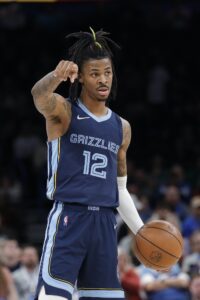 Ja Morant (Grizzlies): Five years, maximum salary (story). Projected value of $194,300,000. Projected value can increase to $233,160,000 if Morant meets Rose Rule criteria. Includes 15% trade kicker.
- Darius Garland (Cavaliers): Five year, maximum salary (story). Projected value of $194,300,000. Projected value can increase to $233,160,000 if Garland meets Rose Rule criteria. Includes 15% trade kicker.
- Zion Williamson (Pelicans): Five years, maximum salary (story). Projected value of $194,300,000. Projected value can increase to $233,160,000 if Williamson meets Rose Rule criteria.
- Note: Williamson’s salary guarantees in the final four years of the extension could be adjusted downward if he doesn’t meet certain games-played thresholds.
- Note: Williamson’s salary guarantees in the final four years of the extension could be adjusted downward if he doesn’t meet certain games-played thresholds.
- Jordan Poole (Warriors): Four years, $123,000,000 (base value) (story). Includes $17MM in incentives.
- Tyler Herro (Heat): Four years, $120,000,000 (base value) (story). Includes $10MM in incentives.
- RJ Barrett (Knicks): Four years, $107,000,000 (base value) (story). Includes $13MM in incentives.
- De’Andre Hunter (Hawks): Four years, $90,000,000 (base value) (story). Includes $5MM in incentives.
- Keldon Johnson (Spurs): Four years, $74,000,000 (base value) (story). Includes $6MM in incentives.
- Kevin Porter Jr. (Rockets): Four years, $63,440,000 (base value) (story). Only first year is fully guaranteed. Includes fourth-year team option and $19,032,000 in incentives.
- Brandon Clarke (Grizzlies): Four years, $50,000,000 (base value) (story). Includes $2MM in incentives.
- Nassir Little (Trail Blazers): Four years, $28,000,000 (story).
A couple of these extensions were no-brainers — there was never any doubt that Morant was going to get maximum-salary offer from the Grizzlies as early as possible, for instance.
Of the three maximum-salary deals, Williamson’s was the most interesting, given his injury history and the frequent speculation about his commitment to New Orleans. He and the Pelicans shut down that speculation by reaching a lucrative long-term agreement very early in July.
Interestingly, seven of this year’s eight non-max rookie scale extensions include incentives, giving the teams some level of protection if their newly extended youngsters don’t continue taking significant steps forward.
The Rockets‘ deal with Porter is the most extreme example of a high-variance, incentive-laden deal — as Mark Berman of Fox 26 Houston tweets, team-based incentives can push the value of that contract beyond $20MM per year, but the base value is just $15.86MM annually, and only the first season is fully guaranteed.
Little’s new contract with the Trail Blazers is another fascinating agreement. We’ve seen Grayson Allen (2021) and Taurean Prince (2019) accept two-year rookie scale extensions in recent years that were worth less overall than Little’s $28MM deal, but Little’s $7MM average annual salary is the lowest for a rookie scale extension since Jeremy Lamb signed a three-year, $21MM deal in 2015.
With 11 players signing rookie scale extensions, that left 13 players who were eligible for a new deal and didn’t get one (a 14th, Ty Jerome, was waived by the Rockets during the offseason).
Here’s that list of those players, who are now eligible to become restricted free agents during the 2023 offseason, assuming they finish their current contracts:
- Nickeil Alexander-Walker (Jazz)
- Darius Bazley (Thunder)
- Goga Bitadze (Pacers)
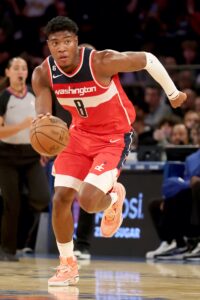
- Rui Hachimura (Wizards)
- Jaxson Hayes (Pelicans)
- Cameron Johnson (Suns)
- Romeo Langford (Spurs)
- Cam Reddish (Knicks)
- Matisse Thybulle (Sixers)
- P.J. Washington (Hornets)
- Coby White (Bulls)
- Grant Williams (Celtics)
- Dylan Windler (Cavaliers)
For a second consecutive year, the most noteworthy extension candidate not to sign a new deal is a Sun. After not extending Deandre Ayton in 2021, Phoenix opted not to lock up Johnson before he becomes eligible for restricted free agency next summer. Unlike Ayton, Johnson wasn’t seeking a maximum-salary contract, but his price tag could certainly increase substantially in the coming months as he enters the Suns‘ starting lineup in place of Jae Crowder.
Washington and Williams are among the other notable extension candidates who didn’t get new deals and could be targets for lucrative offer sheets in July of 2023. Hachimura, Hayes, Thybulle, and White are a few of the players who could set themselves up for nice paydays next offseason if they take a step forward in 2022/23.
The rest of these players in this group weren’t serious extension candidates. Some – including Langford and Windler – appear unlikely to receive qualifying offers next offseason to make them RFAs unless they show a lot more than they have in their first three NBA seasons.
Finally, it’s worth mentioning that there were five players selected in the first round of the 2019 draft who weren’t eligible at all for rookie scale extensions entering this offseason, for various reasons. Those players are as follows:
- Jarrett Culver: Fourth-year option declined by Grizzlies in 2021.
- Sekou Doumbouya: Waived by Rockets in 2021.
- Mfiondu Kabengele: Third-year option declined by Clippers in 2020.
- Chuma Okeke: Signed rookie scale contract in 2020; on track to be extension-eligible in 2023.
- Luka Samanic: Waived by Spurs in 2021.
NBA Announces Opening Night Rosters For 2022/23
After the deadline for teams to reduce their rosters to 17 players (15 on standard contracts and two on two-way deals) passed on Monday evening, the NBA issued a press release listing the opening night rosters for all 30 teams. That list can be found right here.
The NBA’s team-by-team breakdown doesn’t include any major surprises. The only discrepancies we noticed were as follows:
- Luke Kornet does not appear on the Celtics‘ roster, but our assumption for now is that’s a mistake. There has been no indication from the team that Kornet was waived, and no moves involving him show up in the NBA’s official transaction log. We’ll keep an eye out to see if that changes.
[UPDATE: Kornet has since been added to the Celtics’ roster on the NBA’s list.] - Mamadi Diakite, who signed a two-way contract with the Cavaliers, doesn’t show up on Cleveland’s roster because he completed his deal after the deadline to get down to 17 players had already passed. He now fills the Cavs’ second two-way slot.
- The Mavericks are reportedly signing Facundo Campazzo to a standard contract, while the Trail Blazers are reportedly signing John Butler to a two-way deal. However, neither move is official yet, so Campazzo and Butler don’t show up on the list of opening night rosters.
Once the Campazzo and Butler signings are finalized, there will only be nine roster spots available around the NBA, with 501 of 510 possible slots filled, including all 60 two-ways.
[RELATED: 2022/23 NBA Roster Counts]
The Hawks, Hornets, Cavaliers, Warriors, Clippers, Heat, Sixers, Suns, and Trail Blazers are the teams that will have an open spot on their respective standard rosters.
Mamadi Diakite Signs Two-Way Contract With Cavs
6:20pm: Diakite has officially signed a two-way deal with the Cavaliers, the team confirmed (via Twitter).
5:16pm: After being cut by the Cavaliers on Saturday, big man Mamadi Diakite has cleared waivers and the team intends to bring him back on a two-way deal, sources tell Chris Fedor of Cleveland.com (Twitter link). However, Fedor says “there are a few hurdles both sides need to clear” before the contract is signed.
Diakite had a strong preseason performance with the Cavaliers on a non-guaranteed Exhibit 9 contract, which cannot be converted to a two-way deal, so that’s why the team had to waive him before giving him a two-way deal. He averaged 9.3 PPG, 4.5 RPG, 1.3 SPG and 1.3 BPG on .824/.571/.833 shooting in four preseason games (16.8 MPG), per RealGM.
Diakite has appeared in a total of 27 regular season games for the Bucks and Thunder since going undrafted out of Virginia in 2020. He spent most of his rookie season on a two-way deal with Milwaukee before being promoted to the standard roster down the stretch. In 2021/22, he signed three separate 10-day contracts with Oklahoma City.
The 25-year-old has averaged 3.7 PPG and 3.4 RPG in his 27 NBA contests (12.2 MPG). He also put up 18.5 PPG and 10.4 RPG in 12 G League appearances (27.7 MPG) for the Lakeland Magic during the truncated 2020/21 season, earning a place on both the All-NBAGL First Team and the league’s All-Defensive Team.
Relatedly, Fedor and Michael Scotto of HoopsHype (Twitter links) both say the Cavaliers signed and waived Brazilian wing Didi Louzada in order to secure his G League affiliate rights for the Cleveland Charge, the Cavs’ NBAGL team.
Assuming the Cavs signed Louzada to an Exhibit 10 contract for that purpose, the team will be on the hook for two days’ worth of his prorated minimum salary, since he’ll spend the first two days of the regular season on waivers.
However, NBA.com’s transaction log indicates that Louzada was signed to a two-way deal. If Louzada briefly occupied the Cavs’ open two-way slot, it’s possible that’s one of the “hurdles” mentioned by Fedor to be cleared before Diakite signs. But it’s unclear if signing a player to a two-way contract and then waiving him secures his G League affiliate rights.
We’ll have to wait for a little more clarity on the Louzada situation, but in any case, it appears it will be Diakite who ultimately claims the two-way roster spot that opened up when Cleveland waived RJ Nembhard on Saturday.
Rory Maher contributed to this post.
Pistons Waive Kemba Walker
OCTOBER 17: As expected, the Pistons have waived Walker, the team confirmed today in a press release.
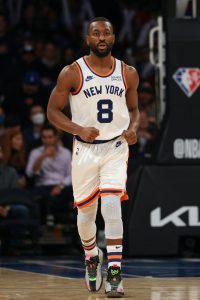 OCTOBER 14: The Pistons will likely waive veteran guard Kemba Walker in the coming days in order to get their roster down to the regular season limit of 15 players on standard contracts, according to Shams Charania and James L. Edwards III of The Athletic (Twitter link).
A four-time All-Star, Walker has seen his production dip in the last year or two as he has been slowed by knee issues. He averaged 11.6 PPG and 3.5 APG on .403/.367/.845 shooting in 37 games (25.6 MPG) last season for the Knicks, and was a liability on defense.
New York sent Walker to Detroit in a salary-dump trade in June, and reports immediately indicated that the 32-year-old and the Pistons would likely come to a buyout agreement. However, that buyout didn’t end up coming to fruition.
There are likely a couple reasons why Walker has yet to accept the Pistons’ buyout offer. For one, there has been no indication that he has a guaranteed contract offer on the table from another team, as he seemingly confirmed last week.
Additionally, since Detroit has more than 15 players on guaranteed contracts, the team was always going to have to trade or release one of those players by the regular season roster deadline of October 17 — since Walker is so obviously the odd man out, the Pistons had little leverage to encourage him to give back a portion of his $9.17MM salary unless they parted with another player on a guaranteed deal.
If and when Walker is waived, he’ll become an unrestricted free agent two days later and would be able to sign with any team except the Knicks. Potential suitors will certainly be wary of Kemba’s knee problems, but he insisted last week that he can still be a useful NBA player and still has “a few years left” in him.
“I’ve got something in the tank for sure,” he said. “I feel great. I’m going to be honest. I’m going to have my opportunity. I’m not in any rush right now. I’m just grinding and trying to feel as good as I can. And right now, I feel great. I feel as good as I’ve felt in a long time. I’m just waiting for the opportunity.”
Walker’s former team in Charlotte is one that has been mentioned as a possible landing spot — the Hornets were already short on point guard depth even before LaMelo Ball sprained his ankle during the preseason.
Thunder Waive David Nwaba, Trey Burke, Marquese Chriss
The Thunder have made three cuts ahead of Monday’s regular season roster deadline, announcing that they’ve waived swingman David Nwaba, guard Trey Burke, and forward/center Marquese Chriss.
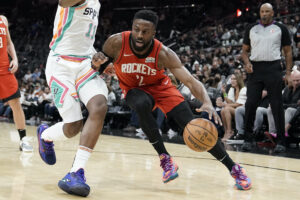 All three players were sent from Houston to Oklahoma City last month, but that trade was more about cutting costs for the Thunder than it was about the players involved. Oklahoma City also received Sterling Brown in that deal and waived him too, so none of the four players acquired from the Rockets are still under contract with the Thunder (Houston has also waived the four players it acquired in the trade).
Three cuts were required for the Thunder because they had been carrying 18 players on guaranteed contracts after signing Isaiah Joe earlier today.
The team will be on the hook for the 2022/23 salaries for Nwaba ($5,022,000), Burke ($3,423,750), and Chriss ($2,193,920), assuming they go unclaimed on waivers. However, none of the three are owed any guaranteed money beyond this season. Nwaba, Burke, and Chriss have been solid rotation players in the past, but none were particularly effective for Houston in 2021/22.
Nwaba averaged 5.1 PPG and 3.3 RPG in 46 games (13.2 MPG), while making just 30.6% of his three-point attempts; Burke put up 5.1 PPG and 1.4 APG in 42 games (10.5 MPG) and shot a career-low 31.7% on threes; Chriss averaged 4.5 PPG and 3.0 RPG in 34 appearances (10.2 MPG) and underwent knee surgery in June.
The Thunder now have 15 players on standard contracts and a pair on two-way deals, so their roster is set for the regular season.
As for Joe, his new deal with the Thunder is a three-year, minimum-salary contract that is fully guaranteed for the first season and non-guaranteed in year two, with a third-year team option, Hoops Rumors has learned. Oklahoma City used a portion of its mid-level exception to complete the signing, which head coach Mark Daigneault expressed enthusiasm about in a Monday media session.
“He’s a guy that our scouts and our people have liked for some time,” Daigneault said, per Joe Mussatto of The Oklahoman (Twitter video link).
Spurs Waive Joe Wieskamp
3:05pm: The move is official, the Spurs announced in a press release.
2:57pm: The Spurs will get down to the regular season roster limit by waiving swingman Joe Wieskamp, reports Shams Charania of The Athletic (Twitter link).
Wieskamp, 23, was drafted 41st overall in 2021 by the Spurs and spent most of his rookie season on a two-way contract with the team. He was converted to a rest-of-season standard contract in March, then re-signed with San Antonio in August on a two-year deal that includes a guaranteed $2.175MM salary for 2022/23.
A former Iowa standout, Wieskamp appeared in 29 games for the Spurs in his first pro season, playing a very limited role for the NBA club. He averaged 2.1 PPG and 0.5 RPG in 7.1 MPG.
In 15 G League regular season games for the Austin Spurs, Wieskamp played a more significant role, putting up 17.1 PPG and 3.3 RPG with a .371 3PT% in 33.5 MPG.
The Spurs entered the day with 16 players on guaranteed standard contracts and a pair on two-way deals, so they needed to make one cut to set their roster for opening night. Wieskamp and Romeo Langford were considered to be the players “on the bubble” — it appears Langford will remain on the roster to open the season.
Although San Antonio will have to eat Wieskamp’s $2.175MM salary, assuming he’s not claimed on waivers, taking on that dead money won’t really hurt the team financially. The Spurs remain far below the salary cap and the salary floor for 2022/23.